
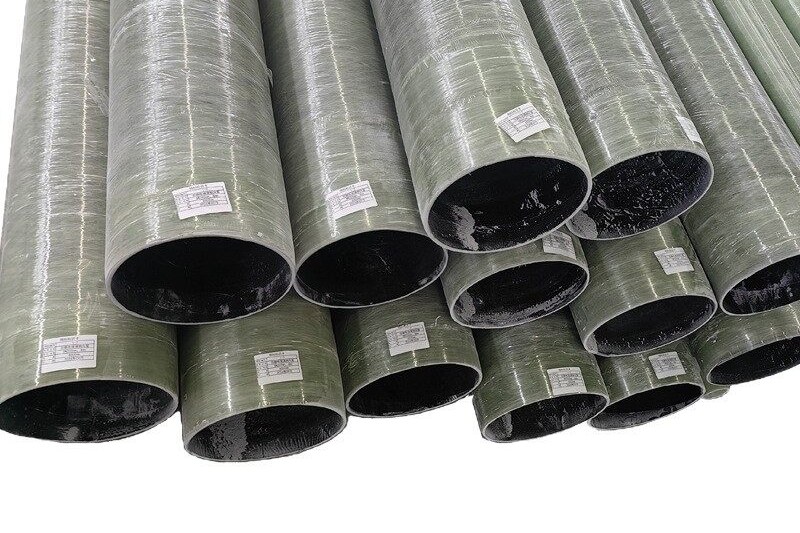
In explosive atmospheres — solvent storage yards, paint and chemical plants, mines, fuel transfer stations — a static spark on a pipe is not a nuisance, it is an ignition source. Ordinary plastics are electrical insulators: they generate and hold static charge as fluid flows through them, and that charge can discharge across a flange gap or to an earthed object with enough energy to ignite a vapour cloud.
Antistatic FRP pipe solves the problem by giving the pipe a controlled electrical path, so charge never accumulates to a dangerous level. This guide explains how conductive GRP pipe works, the resistivity classes that matter, where it is required, and the grounding rules that make it safe.
1. How Static Builds Up on a Pipe
When a liquid flows through a pipe, charge separates at the liquid–wall interface — the same triboelectric effect as rubbing a balloon. In a metal pipe the charge is drained continuously through the earthed steelwork. In an unmodified plastic pipe the charge has nowhere to go: it accumulates on the wall surface and in the liquid, and the pipe becomes a charged capacitor waiting to discharge.
- Charge generation increases with flow velocity and with low-conductivity liquids such as solvents, fuels and pure chemicals.
- Discharge typically happens at flanges, nozzles and any gap where the surface is close to an earthed object.
- The risk is a spark, not the pipe itself: the pipe is the source, the atmosphere is the victim.
2. Resistivity Classes: Dissipative vs Conductive vs Antistatic
Different industries use slightly different names, but the electrical ladder is the same:
| Class | Surface / volume resistivity | What it does |
|---|---|---|
| Insulating (standard FRP) | >10¹² Ω | Charge accumulates — not acceptable in classified areas |
| Static-dissipative | ~10⁶ – 10⁹ Ω | Slows charge build-up; used where very low currents must not flow |
| Antistatic / conductive | ≤10⁶ Ω (surface), often ≤10⁴–10⁵ Ω targeted | Charge drains continuously — the class used for hazardous service |
Test methods commonly cited are ASTM D257 (DC resistance) and IEC 60093; always confirm the exact target value and test method with the datasheet, because "conductive" alone is not a specification.
3. How Antistatic GRP Pipe Is Made
Conductivity is engineered into the laminate, not painted on:
- Conductive fillers (carbon black, graphite) in the resin, giving the whole wall a volume-conducting path.
- Conductive veils or carbon layers near the bore and outer surface to keep surface resistance low and stable over the service life.
- The structural glass layers remain the load bearer — conductivity is an added function of the liner and resin matrix, and it must be verified after manufacturing, not assumed from the recipe.
4. Where Antistatic FRP Pipe Is Required
- Solvent and hydrocarbon transfer lines, paint and ink plants
- Chemical plants handling low-conductivity liquids (esters, ketones, aromatics)
- Vent and vapour lines from storage tanks in classified areas
- Dust and powder handling where static on the pipe wall attracts or ignites fines
- Mines, fuel depots and anywhere ATEX, IECEx or NEC Article 500 zoning applies
5. Grounding Rules That Make It Safe
A conductive pipe that is not earthed is a conductive pipe that stores charge across the whole line — worse than an insulated one. The installation rules are as important as the material:
- Earth the pipe at both ends and at intervals along long runs, using the manufacturer's grounding lugs or earthing points.
- Maintain continuity across joints — use conductive gaskets or bonding straps at flanged connections so the electrical path is not broken by an insulating gasket.
- Verify with a meter: measure surface resistance and continuity to earth after installation, not just at the factory.
- Keep flow velocities within the recommended range for the liquid — conductivity in the pipe does not remove charge generation, it removes accumulation.
6. Testing and Verification Checklist
| Check | Why |
|---|---|
| Resistivity target + test method stated (ASTM D257 / IEC 60093) | Confirms the pipe actually meets a defined conductive class |
| Conductive path includes liner and joints | The bore surface is where charge forms — a conductive outer wall only is not enough |
| Grounding lugs supplied and fitted | Gives the earthing system a defined attachment point |
| Field resistance test after installation | Proves the assembled line, not just the pipe, is continuous to earth |
7. Specification Mistakes to Avoid
- Ordering "antistatic pipe" without a resistivity target and test method.
- Fitting insulating rubber gaskets or non-conductive couplings that break the earth path at every joint.
- Assuming one earth point at the pump end is enough for a long line.
- Treating conductivity as a coating — coatings wear; a conductive laminate with conductive veil does not.
Our antistatic FRP pipes are supplied with resistivity test data and grounding points for classified service; see also the FRP pressure pipe range if the line also carries pressure, and the full pipes & fittings range for matching conductive joints.
Need help selecting FRP products?
Our engineers answer technical questions free of charge.
Ask an Engineer on WhatsApp