
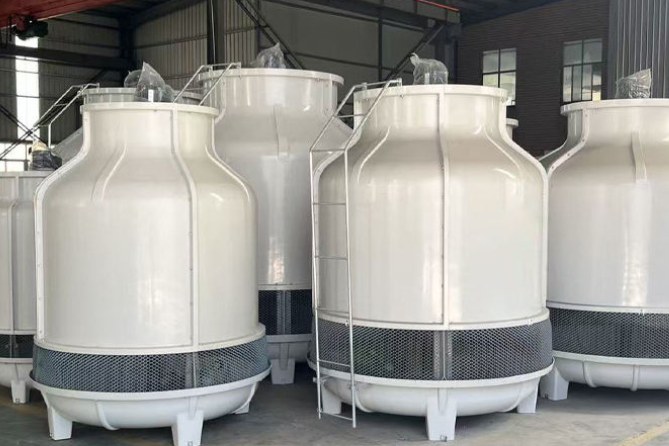
A cooling tower loses efficiency quietly. The fan keeps spinning, water keeps flowing, and yet the approach temperature creeps up by a degree a month while the fill quietly clogs, scales and collapses. Because the fill pack is where almost all the heat transfer happens, its condition is the condition of the tower — and it is the component most maintenance programs ignore until performance is already gone.
This guide covers the fill and component maintenance that keeps an FRP cooling tower at nameplate efficiency: fill types and their failure modes, the component tour, a working maintenance schedule and the water chemistry that decides fill life.
1. Why the Fill Pack Is the Efficiency Core
Cooling happens where water surface meets air. A fill pack multiplies that surface: film fill spreads water into thin sheets (high efficiency, sensitive to clogging); splash fill breaks water into droplets (tolerant of dirty water, less efficient per volume). When fill is clean, water spreads evenly and air passes freely; when it fouls, water channels to open paths, air short-circuits, and approach temperature drifts up while pump and fan power stay constant — efficiency loss with no visible event.
2. Fill Types and Their Failure Modes
| Fill type | Best water | Main failure mode | Typical life |
|---|---|---|---|
| PVC film fill (cross/corru-flute) | Clean, filtered, treated | Scale bridging, biological slime, channeling | 8–15 yrs |
| Splash fill (grid/lath) | Dirty, high suspended solids | Breakage, algae loading | 10–20 yrs |
| High-temp fill (CPVC/PP) | Hot return water > 50°C | Thermal distortion if standard PVC misapplied | 8–12 yrs |
The classic specification error is film fill on unfiltered water with high suspended solids — the sheets bridge within a season. Anti-clogging tower designs pair larger-inlet nozzles and open-ish fill zones for exactly this water.
3. The Component Tour: What Else Wears
- Nozzles: clog or erode; uneven spray = dry patches on fill = scale where water still lands. Check distribution pattern monthly from the basin.
- Drift eliminators: clog with slime, raising drift and water loss; warped eliminators also short-circuit air.
- Fan & gearbox: blade pitch, belt tension or gearbox oil decide power draw; vibration tells the story before performance does.
- Distribution basin (gravity towers): trough level and orifice fouling cause the same maldistribution as bad nozzles.
- Cold water basin: silt accumulation feeds biological growth; strainers protect the pump.
4. Maintenance Schedule That Actually Works
| Interval | Task |
|---|---|
| Weekly | Visual spray pattern; strainer check; basin blowdown confirmation |
| Monthly | Nozzle inspection; fan gearbox oil level; vibration walk-by; drift eliminator glance |
| Quarterly | Fan pitch/belt tension; fill top-surface inspection through louvres; biocide dosing review |
| Annual | Full fill inspection (sample bundle out); basin clean-out; gearbox oil change; structure/ladder checks |
| Seasonal start | Distribution flush; freeze protection checks where relevant |
5. The Three Efficiency Killers: Scale, Slime, Solids
Scale (calcium carbonate) grows where water evaporates and cycles concentrate — first on the hottest, driest fill faces. Biological slime mats over film surfaces and under-deposit corrodes; it grows fastest in warm, sunlit basins. Suspended solids settle in low-velocity corners and bridge fill channels. All three are managed upstream in water chemistry, not by fill replacement: control cycles of concentration, run filtration (side-stream or full-flow), and keep the biological program validated with dip tests rather than assumed.
6. When to Replace Fill
Replace rather than clean when: sheets are brittle (UV/chemical ageing — bend a sample; if it cracks, the pack is done), scale loading exceeds roughly a third of fill weight (mechanical load on supports and permanent channeling), or bundles have collapsed zones from upset temperatures. Spot-replacing affected bundles is fine; a tower with unevenly old fill runs maldistributed permanently.
7. Efficiency Verification: Measure, Don't Guess
Two numbers tell the story: approach (cold water temperature minus wet-bulb — rising approach at design flow means fouling or maldistribution) and kW/TR (fan + pump power per ton of cooling — rising power at the same load means fouled fill, wrong pitch or gearbox trouble). Log both monthly; a tower with a data trend justifies its own maintenance budget.
8. Specification Checklist for Replacement Parts
- Fill: flute geometry, sheet thickness, and material matched to return-water temperature (PVC vs CPVC)
- Nozzles: original spray pattern and anti-clog design
- Drift eliminators: drift rate specification (e.g. ≤0.001% of circulating flow)
- Fan: pitch and balance certificate after any motor/gearbox work
- Structural fasteners: FRP/316 SS, not mixed metals in the basin
9. Common Mistakes
- Pressure-washing film fill hard enough to unlink sheets — flush gently, replace what cannot be cleaned.
- Running standard PVC fill on 55°C return water.
- Treating symptoms (more biocide) while the real issue is unfiltered solids.
- Ignoring gearbox oil until the fan seizes mid-summer.
- Replacing fill bundles of different ages and wondering about channeling.
See our 100-ton round counter-flow FRP cooling towers, anti-clogging round towers, square industrial towers and the full machinery & production lines range; related: cooling tower selection guide.
Need help selecting FRP products?
Our engineers answer technical questions free of charge.
Ask an Engineer on WhatsApp