
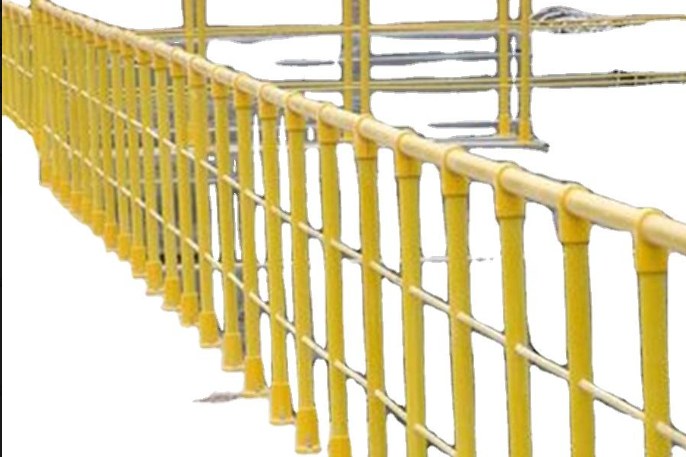
A handrail system is one of those products where the code sheet and the catalogue rarely meet: heights and loads are set by building and occupational codes, while suppliers quote profiles and colours. This guide connects the two — what the main codes require, what loads a system must carry, and when pultruded FRP handrail is the better material choice over galvanised steel or aluminum.
1. Guardrail vs Handrail: Two Different Jobs
Codes distinguish a guardrail (prevents people falling from an edge) from a handrail (something to grasp while using stairs or a ramp). On industrial platforms the same FRP system usually performs both roles — a 42-inch top rail guarding the edge with a mid-rail and toe board — but the requirements differ, and mixing them up is the most common specification error.
2. Heights: What the Main Codes Require
| Code / reference | Requirement | Notes |
|---|---|---|
| IBC 1015 (guards) | 42 in (1070 mm) min above walking surface where drop > 30 in | Commercial buildings; industrial floors often adopt it |
| OSHA 1910.29 (guards) | 42 in ± 3 in top rail, mid-rail halfway | US workplaces; toe board ≥ 3.5 in where dropping objects matter |
| OSHA 1910.29 (stair rails) | 30–38 in rail height on stairs | Handrail, not guard, height on stair slopes |
| EN ISO 14122-3/-4 (machinery access) | 1100 mm guard height; handrail 900–1000 mm on stair slopes | European machinery platforms and fixed ladders |
Confirm which code your project's authority having jurisdiction (AHJ) applies — export projects routinely mix IBC, OSHA and ISO references in one specification.
3. Loads: What the Rail Must Survive
| Load case (IBC 1607.8.1 / OSHA) | Value | Meaning for FRP design |
|---|---|---|
| Top rail point load | 200 lb (0.89 kN) any direction | Governs post spacing and post section |
| Top rail uniform load | 50 lb/ft (0.73 kN/m) | Governs rail section |
| Mid-rail / infill | 50 lb on 1 sq ft patch | Check panel-type infills |
FRP's lower stiffness means post spacing — not material strength — is the design driver. Pultruded handrail systems are typically spaced at 1.5–2.0 m post centres with engineered posts; always ask the supplier for load test or calculation sheets at your actual spacing, because deflection (not failure) is what inspectors measure first.
4. Material Choice: FRP vs Steel vs Aluminum
| Criterion | Pultruded FRP | Galvanised steel | Aluminum |
|---|---|---|---|
| Corrosion | Immune — no coating to renew | Coating-dependent; cut edges rust | Good, pitted by chlorides |
| Weight | ~1/4 of steel | Heavy — crane or 2-person lifts | Light |
| Electrical | Non-conductive | Conductive | Conductive |
| Stiffness | Lower — spacing matters | Highest | Moderate |
| Heat / flame | Thermoset, will char | Best | Softens, non-combustible |
| Fabrication on site | Cut with standard tools, bonded or bolted | Welding + touch-up paint | Weld/bolt |
The pattern: FRP wins wherever corrosion, electrical insulation or weight dominate — chemical plants, coastal and marine platforms, substations, water/wastewater treatment, and anywhere maintenance access is expensive. Steel still wins on extreme stiffness, impact zones and fire-exposed structures.
5. System Components
A complete pultruded handrail system is more than tube: posts (round or square, with engineered wall thickness), top rail, mid-rail, knee braces on longer spans to control rail deflection, base plates (cast aluminum or FRP) with through-bolts, adjustable/inclined fittings for stairs and ramps, and corner, tee and cross fittings. Specify the fittings as a system — mixing profiles from different suppliers is where compatibility problems start.
6. Fixing and Installation Notes
- Base fixing: through-bolted base plates with chemical or mechanical anchors; adhesive anchoring suits vibrating platforms.
- Post spacing: per the supplier's load data, commonly 1500–2000 mm; add knee braces before you add posts.
- Stair runs: use inclined fittings so rails follow slope; heights measured vertically from nosing line.
- Cutting: carbide blades, no welding; cap open tube ends.
- Installation sequence: our fiberglass guardrail installation guide walks the full site sequence.
7. Electrical Insulation and Special Environments
Near live equipment — substations, switchgear rooms, tram and rail depots — non-conductive handrail removes an entire class of risk, which is why FRP power guardrails are standard around electrical infrastructure. In chemical plants, FRP also removes the paint-maintenance cycle; in marine air, aluminum's pitting and steel's rust are both avoided. For areas with hot-work above the rail (welding slag, torch cutting), shield the rail or choose steel locally.
8. Maintenance and Inspection
FRP handrail needs no repainting; inspect annually for impact damage (whitened or cracked pultrusions), loose base anchors, and UV surface chalking on older installations — chalking is cosmetic, cracking is not. Retorque base bolts after the first month of service, as with any bolted structure.
9. Specification Checklist
- Governing code named (IBC / OSHA / EN ISO 14122) and heights stated
- Load cases with post spacing justified by supplier data
- Resin system for the environment (isophthalic vs vinyl ester)
- Complete fitting set — corners, tees, crosses, knee braces, base plates
- Toe boards / kick plates where dropping objects matter
- Colour and UV-stabilised surfacing for outdoor use
10. Common Mistakes
- Specifying "42-inch handrail" when the code situation requires a 1100 mm ISO guard — measure first, quote later.
- Copying steel post spacing (2.5 m+) onto an FRP system without load checks.
- Buying rails and fittings from different suppliers.
- Ignoring toe boards on platforms above work areas.
- Using FRP handrail where welding slag will rain on it daily.
Explore our FRP insulating power guardrails, pultruded stair handrail profiles, engineering guardrail fencing and the full profiles & structural components range.
Need help selecting FRP products?
Our engineers answer technical questions free of charge.
Ask an Engineer on WhatsApp