
"FRP" tells you what a product is made of — fiberglass reinforcement in a polymer matrix — but not how it was made. And the manufacturing process is exactly what determines a part's strength, dimensional accuracy, cost and best-fit application. If you buy FRP tanks, pipes, gratings or profiles, understanding the four main processes helps you read a quotation like an insider and spot under-specified offers.
1. Filament Winding — Pipes, Tanks and Vessels
Glass rovings are pulled through a resin bath and wound under tension onto a rotating mandrel at controlled angles (typically ±55° for pressure pipe). The winding angle is engineered: low angles maximize axial strength, high angles maximize hoop strength for internal pressure.
- Best for: pressure pipe, storage tanks, SCR/chemical vessels, sewer pipe
- Strengths: excellent hoop strength, highly repeatable, computer-controlled fiber alignment
- Watch for: glass content and cure quality vary widely between factories — ask for burn-off test results and Barcol hardness readings
Filament-wound pipe is qualified under standards like ASTM D2992 and AWWA C950. For buyers, the practical checkpoint is a hydrostatic pressure test report per batch, not just a catalog number.
2. Pultrusion — Constant Cross-Section Profiles
Continuous glass fibers are pulled through a resin bath and then through a heated die, where the profile is shaped and cured in seconds. The line runs non-stop, producing I-beams, tubes, angles, channels, handrails, cable trays and grating rods with outstanding axial strength.
- Best for: structural profiles, walkway systems, ladder/cable support, cooling tower fill frames
- Strengths: highest glass content (up to ~80% by weight along the axis), tight tolerances, unlimited length, lowest cost per kg at volume
- Limitation: the part must be straight and constant-section — curves need other processes
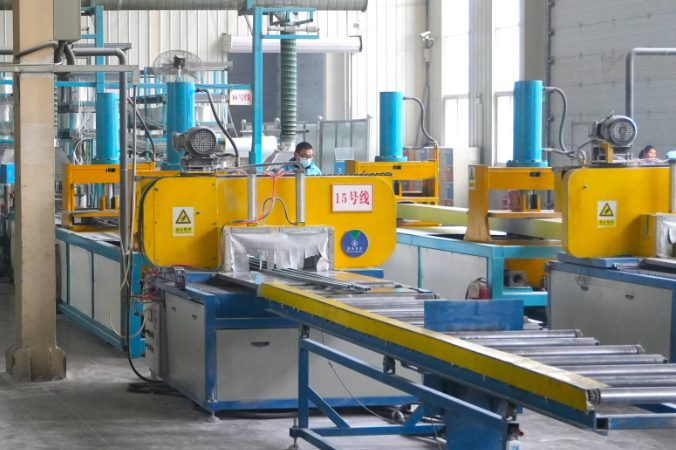
This is also the process behind our own heavy-duty FRP pultrusion production lines: the same machines we run in-house are the ones we build and export for profile and anchor-rod manufacturers.
3. Compression Molding / Hand Lay-up — Complex Shapes
SMC/BMC compression molding presses pre-formed glass-resin sheets in matched metal dies — ideal for high-volume panels, housings and covers with consistent surface finish. Hand lay-up and spray-up remain the flexible workhorses for large or low-volume parts: septic tanks, small vessels, repairs and tooling, where a molder wets out fabric or chopped spray directly in an open mold.
- Best for: irregular shapes, flanges, covers, tanks with heavy fittings, prototypes
- Watch for: hand lay-up quality depends on operator discipline — wall thickness tolerance and void content should be verified by ultrasonic or spark testing on critical parts
4. Centrifugal Casting — Large-Diameter Buried Pipe
Chopped glass and resin are cast against the inside of a rotating steel mold, producing dense, smooth-bore pipe in large diameters (the process referenced by ASTM D2997). It excels for jacking pipe and gravity sewers where stiffness and a hydraulically smooth liner matter.
Process vs Product: Quick Reference
| Process | Typical Products | Key Strength | Key Spec to Ask For |
|---|---|---|---|
| Filament winding | Pipe, tanks, pressure vessels | Engineered hoop strength | Glass content %, hydrostatic test report |
| Pultrusion | Profiles, grating rods, cable trays, anchor rods | Highest axial strength, tight tolerance | Tensile strength (ASTM D638), glass content |
| Molding / lay-up | Tanks with fittings, panels, complex parts | Shape freedom | Wall thickness map, spark/void test |
| Centrifugal casting | Large-diameter pipe, jacking pipe | Dense wall, smooth bore | Stiffness class (SN), liner hardness |
5. What Buyers Should Verify Before Ordering
- Resin system matched to your medium — isophthalic for water, vinyl ester for acids/solvents.
- Design standard cited in writing — BS 4994, ASME RTP-1, AWWA C950, ASTM families.
- Batch test certificates — burn-off, Barcol hardness, hydrostatic or spark test.
- UV protection — gelcoat or UV-stabilized topcoat for outdoor exposure.
- Factory audit or video inspection — a real factory welcomes it; traders resist it.
Browse our FRP production machinery and pultruded profiles.
Need help selecting FRP products?
Our engineers answer technical questions free of charge.
Ask an Engineer on WhatsApp