
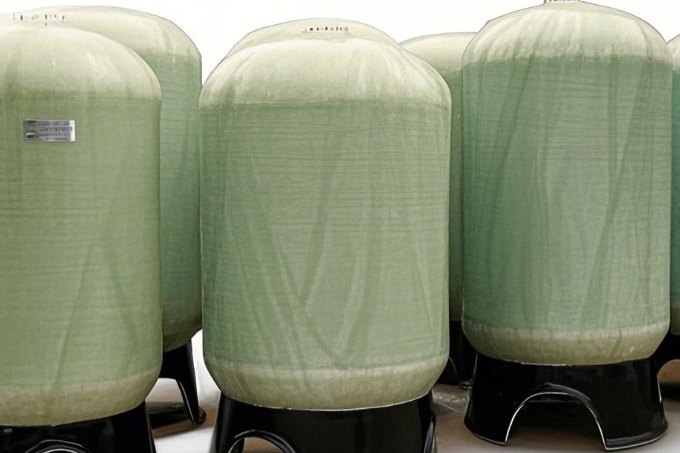
A biodiesel producer orders two 50 m³ storage tanks: one for finished B100 meeting EN 14214, one for the crude glycerine phase coming off the transesterification skid. The buyer, who has just been through an acid storage project, asks for the same vinyl ester laminate everywhere and considers the matter closed. It is not. Biodiesel is an ester, not a mineral acid; crude glycerine is a water-miscible alcohol carrying methanol residue, soaps and salts; and the failure modes of an organic storage system - swelling, permeation, catalytic oxidation, water pick-up and microbial growth - have almost nothing in common with the acid attack the buyer is used to designing against.
This guide works through the streams as they actually arrive, the specification properties that matter to the tank, the fire-code classification that surprises people on both sides, the way FAME attacks elastomers and thermoplastics that a chemical plant would normally trust, resin and liner selection per stream, heating and viscosity management for glycerine, and the containment, venting and inspection details that keep a biodiesel farm compliant for its design life.
1. Why FAME and Glycerine Are Not Just Mild Liquids
The intuitive error is to rank fluids by pH. Biodiesel is neutral, so it is assumed benign; sulphuric acid is aggressive, so FRP is specified carefully. But FAME is a solvent and a reactive ester. It swells and extracts from plastics and elastomers that shrug off acids, it permeates some of them outright, it oxidises on contact with certain metals to form insoluble gels and salts, and it supports microbial growth at every free-water interface in the tank. None of these mechanisms exists in the acid storage world; all of them are active in a B100 tank at ambient temperature.
In acid service you protect the laminate from the liquid. In FAME service you protect the liquid from the materials around it - and protect the laminate from swelling, permeation and the water layer.
Crude glycerine inverts the problem. Glycerol itself is chemically mild, non-corrosive to steel and hardly volatile (flash point around 160 °C). The storage difficulty is physical: at 25 °C refined glycerol is around 1,000 cP - roughly a thousand times the viscosity of water - so the tank, pipework and pumps must manage a liquid that will not pump until it is warm, and crude glycerine brings methanol residue and alkaline soap salts that change the materials conversation entirely.
2. What You Are Storing: EN 14214 and ASTM D6751
B100 is bought and sold against a specification, and the specification is the tank designer's source of truth, because several limits that look like engine concerns are in fact storage concerns. The European specification EN 14214 sets these generally applicable requirements (2012 edition and later, with referee test methods):
| Property | Limit | Test method | Why the tank designer cares |
|---|---|---|---|
| Ester (FAME) content | min 96.5 % (m/m) | EN 14103 | Defines what "biodiesel" is; off-spec feedstock fractions behave differently |
| Density at 15 °C | 860-900 kg/m³ | EN ISO 3675 / 12185 | Hydrostatic design basis; lower than water |
| Viscosity at 40 °C | 3.50-5.00 mm²/s | EN ISO 3104 | Pumpability at operating temperature |
| Flash point | min 101 °C | EN ISO 2719 / 3679 | Drives the fire classification (Section 3) |
| Water content | max 500 mg/kg | EN ISO 12937 | Free water is the root of microbial growth and corrosion of internals |
| Acid value | max 0.50 mg KOH/g | EN 14104 | Trending this in storage detects degradation early |
| Oxidation stability at 110 °C | min 8.0 h | EN 14112 / EN 15751 | Raised from 6 h in the 2012 revision - a widely misquoted figure |
| Methanol content | max 0.20 % (m/m) | EN 14110 | Methanol is the Class IB hazard hiding inside a Class IIIB fuel |
| Total glycerol | max 0.25 % (m/m) | EN 14105 | Free glycerol settles into the water phase and feeds microbes |
| Free glycerol | max 0.02 % (m/m) | EN 14105 / 14106 | As above, at 10x lower limit |
| Total contamination | max 24 mg/kg | EN 12662 | Sediment management and floor drain design |
| Iodine value | max 120 g I₂/100 g | EN 14111 | Proxy for unsaturation - more double bonds, more oxidation sensitivity |
The American specification ASTM D6751 covers the equivalent B100 grades for the US market; the details differ, but the tank-relevant pattern - low water, bounded methanol, bounded acidity - is the same. Two specification points deserve emphasis. First, the oxidation stability limit is 8 hours in the current EN 14214; a meaningful share of supplier and even laboratory web pages still quote the pre-2012 value of 6 hours. Second, the methanol limit of 0.20 percent by mass is what keeps the fire classification of conforming B100 benign: 50 m³ of B100 at 885 kg/m³ carries at most 88.5 kg of methanol, whereas the same tank of off-spec fuel at 1 percent methanol would hold roughly 442 kg of a flammable liquid with a flash point near 12 °C.
3. Fire Classification: A Class IIIB Fuel with a Class IB Ghost
Under the NFPA 30 classification for ignitible liquids, closed-cup flash points sort fluids into Class II (60 to 93 °C), Class IIIA (93 to 200 °C) and Class IIIB (at or above 200 °F / 93 °C). Conforming B100, with its 101 °C minimum flash point, is a Class IIIB combustible liquid - the same class as lubricating oils, and a step milder than petroleum diesel in a storage fire sense. Glycerine, flash point around 160 °C, is also Class IIIB. Methanol, flash point near 12 °C, is Class IB flammable.
The design consequences flow in both directions. For the B100 tank itself, Class IIIB storage enjoys the relaxed provisions NFPA 30 reserves for its least hazardous combustible class - but the designer must not lean on that relaxation for a tank whose contents can drift off-spec. The methanol washing and recovery area of the same plant, the crude glycerine stream before methanol stripping, and any upset-condition vent stream are all methanol territory, and there the full Class I provisions apply: bonding and grounding, restricted fill velocities, vapour-tight venting and electrical classification. A tank farm that treats "biodiesel plant" as a single hazard class will be over-built in one corner and genuinely under-protected in another.
- Classify each stream separately: B100 and stripped glycerine (Class IIIB), crude glycerine before methanol removal (check by test), methanol systems (Class IB).
- Verify flash point on receiving batches; the classification is only as good as the specification conformance.
- Keep methanol-containing vapour paths out of the B100 vent system design assumptions - oversize vents for the upset case, not just the normal case.
4. Attack Mechanisms on Plastics: Swelling, Permeation and What FAME Does to Polymers
The authoritative material-compatibility picture for FAME handling is set out in the Concawe guidelines for handling and blending FAME, and its central finding deserves to be quoted as a principle: because FAME is chemically different from hydrocarbon fuels, materials that are perfectly adequate for diesel can swell, lose integrity, or even promote fuel degradation after prolonged contact with B100. The specific findings that matter to tank and system design:
- FAME may permeate polyethylene and polypropylene over time - neither is recommended for storing B100; fluorinated polyethylene and fluorinated polypropylene are acceptable.
- Elastomers at particular risk: nitrile rubber, neoprene, chloroprene, natural rubber, Hypalon, styrene-butadiene and butadiene rubbers.
- Elastomers that hold up: fluorocarbon (FKM/Viton), nylon, PTFE/Teflon.
- Polyurethane and PVC are also listed as unsuitable for B100 contact.
- Most fibreglass products are listed among acceptable tank materials for B100 - FRP's advantage is exactly that its polymer phase is cross-linked and glass-rich, so it neither dissolves nor swells the way thermoplastics do.
For the FRP tank itself, the mechanisms to respect are slower ones. The polymer matrix can absorb small amounts of FAME over years - a softening of the inner surface, and in marginal laminates a gradual reduction of the corrosion barrier's effectiveness. Permeation through a well-built FRP wall of the kind used for chemical service is negligible at the low vapour pressures of B100, which is precisely the contrast with the light-alcohol problem in ethanol service. The design response is the standard corrosion-barrier architecture - a resin-rich liner with veil layers, properly cured - plus a cure verification before first fill, because an under-cured polyester matrix absorbs far more of everything than a fully cross-linked one.
5. Resin and Liner Selection by Stream
With the mechanisms on the table, resin selection becomes stream-specific rather than tank-specific:
| Stream | Recommended resin / liner | Rationale and cautions |
|---|---|---|
| Finished B100 to EN 14214 / ASTM D6751 | Isophthalic polyester FRP with full corrosion barrier; vinyl ester preferred for longer design life | Concawe lists most fibreglass products as acceptable; the barrier liner and cure quality do the work |
| Washed, unwashed or partially stripped biodiesel with methanol residue | Vinyl ester; consider thermoplastic-lined (dual laminate) for repeated methanol excursions | Methanol is the aggressor; keep concentration and temperature bounded and verify by test |
| Stripped crude glycerine (80 %+, warm) | Isophthalic polyester or vinyl ester; FRP's insulation value helps hold tank temperature | Glycerol itself is mild; design for viscosity and heating, see Section 7 |
| Crude glycerine with methanol + soaps + NaOH/KOH salts | Vinyl ester; dual laminate PP for the most contaminated phases | Alkaline soap brines and methanol together; verify by immersion coupon before committing |
| Free fatty acids / acid-oil side streams | Vinyl ester | Organic acidity plus water; acid value trending applies to the tank, not just the fuel |
| Wash water and soap stock | Isophthalic polyester upward | Mild chemically, warm and biologically active - a hygiene and odour problem, not a laminate problem |
Two disciplines make this table safe in practice. First, qualification by coupon: immerse candidate laminate coupons in the actual stream at maximum expected temperature for a stated duration and measure weight change, hardness and visual condition - a week of coupon testing is cheaper than one relining. Second, keep the streams separated in the tank farm design so an upset in the methanol recovery loop cannot put Class IB vapour into a tank vented for Class IIIB service. Our general resin selection guide for chemical equipment and the dual-laminate liner guide cover the underlying choices in more depth.
6. Metals, Elastomers and Internals: What FAME Attacks Besides the Tank
The tank is rarely where biodiesel systems fail first; the hardware is. The Concawe compatibility tables are unambiguous about metals: brass, bronze, copper, lead, tin and zinc may catalyse the oxidation of FAME, accelerating the formation of insoluble gels and salts - so copper pipes, brass fittings, lead solders and zinc linings are excluded from B100 service, and carbon steel, stainless steel and aluminium are the accepted alternatives. For a tank, this rules out more than it seems: copper-alloy level gauge internals, bronze-cored valves on the outlet, galvanized brackets inside the vapour space, and brass instrument fittingry all generate degradation products exactly where they are hardest to clean out.
| Component family | Use with B100 | Avoid |
|---|---|---|
| Wetted metals | Carbon steel, stainless steel, aluminium | Copper, brass, bronze, lead, tin, zinc (incl. galvanizing in contact) |
| Elastomers / seals | FKM (Viton), PTFE, nylon | Nitrile, neoprene, natural rubber, SBR, Hypalon, polyurethane |
| Thermoplastics | Fluorinated PE/PP, PTFE | PE, PP, PVC, polyurethane for B100 contact |
| Tank internals | FRP, 316 SS | Cast bronze stilling wells, zinc-coated ladders in the vapour space |
The same oxidation-catalysis logic has a tank-side echo: the acid value trending that matters to the fuel also matters to the tank's contents management, because a tank that sits with copper-alloy hardware and rising acid value is manufacturing its own sediment.
7. Temperature, Heating and Viscosity Management
B100's cold-flow properties (cloud point, CFPP, set nationally per climate grade) determine whether the tank needs heating; in cold climates even storage at 10-15 °C can put high-CFPP FAME near its wax-appearance range, and transfer pumps do not move wax. Glycerine is the harder problem. Refined glycerol runs about 1,000 cP at 25 °C and drops to roughly 100 cP at 60 °C - a ten-to-one viscosity ratio available simply by warming the liquid 35 degrees, which is why guidance for glycerol handling centres on storage at 40 to 60 °C and optimum pumping in the high-30s to high-40s Celsius.
The arithmetic of a heated FRP tank is friendly. Take a 20-tonne glycerine tank (about 2.6 m diameter, 3 m high, roughly 35 m² of surface) holding 45 °C against 0 °C ambient, with 50 mm of rock wool insulation on the shell: the overall transmittance is about 0.70 W/m²K, so the steady holding load is only around 1.1 kW. Reheating the full contents from 15 to 45 °C in 48 hours takes about 8.4 kW on top of the holding load - a 12 kW heater with margin does the whole job. FRP's low thermal conductivity is an asset here: an uninsulated steel tank of the same size loses several times more heat through its shell, and the condensation that forms on that cold steel is the corrosion mechanism FRP does not have.
Heat the glycerine, not the building: 50 mm of insulation turns a continuous multi-kW loss into a 1 kW trickle, and the same insulation keeps the laminate away from any heater skin temperature that could challenge the resin.
The pump-side numbers justify the heating system to the finance department. Pushing 25 °C glycerine through a DN80 line at 1 m/s costs about 5,000 Pa per metre of pipe in laminar friction; the same line at 60 °C costs 500 Pa per metre - ten times less, in the same pipe, with the same pump. Pipework that is trace-heated and insulated pays for itself in the first winter; a line that is allowed to cool and solidify between batches becomes a maintenance project. Our tank insulation and heat tracing guide covers the heating design method in detail.
8. Water, Microbes and Vapour Management
Water is the quiet driver of most B100 tank problems, because biodiesel is hygroscopic relative to hydrocarbon diesel and biodegradable by design. Free water that accumulates at the tank bottom becomes the growth medium for bacteria and fungi at the fuel-water interface; the colonies produce biosurfactants and acidic metabolites, the acid value in the interface layer climbs, and sludge forms that filters and engines receive as "bad fuel". The defences are operational and simple, and they belong in the tank design: a low-point water draw-off that is actually used, sloped floors so water collects where the draw-off is, sample points at the interface, and housekeeping that treats a wet-bottom test as an alarm rather than a note.
Quantify the habit: 0.2 percent free water by volume in a 50 m³ tank is 100 litres - in a 2.4 m diameter tank that is a 22 mm layer across the whole floor, thin enough to be invisible on a dip tape's fuel reading and thick enough to run a microbial culture. That single number is the argument for sloped floors and scheduled draw-offs.
Vapour management for Class IIIB storage is far lighter than for the solvents elsewhere on a chemical site, but it is not zero: vents must handle filling and emptying displacement plus thermal in-breathing and out-breathing, and methanol-containing upset conditions must not be allowed to pressurise a vent system sized for B100 vapour. Glycerine tanks add a hygroscopic subtlety - glycerol absorbs moisture from the air, so tanks are sealed with an air-breather trap (a desiccant breather) rather than an open vent, both to keep the product dry and to keep dust out of a food-adjacent product. Vent sizing methods are covered in our chemical tank safety guide.
9. Secondary Containment, Bunding and Siting
Secondary containment for the tank farm follows the governing framework of the site - in US practice, the SPCC rule (40 CFR 112) requires containment capacity at least equal to the capacity of the largest container, with allowance for precipitation; many operators and European sites specify 110 percent of the largest tank. The numbers from a 50 m³ tank show how the criteria differ in practice: a 7 × 5 m bund must be 1.43 m deep to hold the bare 100 percent floor, 1.57 m for the 110 percent criterion, and about 1.8 m once a 200 mm freeboard for rain and wave action is added. FRP bunds and lined bunds are a natural fit here - the containment sees warm glycerine or FAME plus rainwater, both of which are far milder duties than the acid service where FRP bunds were first standardised, and a fibreglass bund does not corrode at the waterline the way a steel one will.
- Size the bund for the largest single failure plus rain allowance; verify the local rule, because 100, 110 and 125 percent criteria all exist in practice.
- Route tank drain points and draw-offs inside the bund; a water draw-off that discharges outside the containment defeats the design in the one scenario it exists for.
- Keep methanol storage out of the shared bund unless the containment and fire provisions are designed for the combined case.
- Provide the bund with its own inspection routine - standing rainwater in an FRP bund is a maintenance item, not a feature.
10. Inspection and Service-Life Management
An FRP tank in B100 service does not corrode, but it does age, and the inspection programme should target the ageing modes in order of likelihood: liner softening and barrier condition at the liquid interface, water-layer chemistry at the floor, connection and nozzle laminate condition, and foundation settlement. Acoustic emission testing per ASTM E1067 provides a whole-tank structural screening while the tank stays in service, and it pairs naturally with a visual and hardness survey of the bottom liner where the water layer lives. Trending is the real tool: record acid value, water content (Karl Fischer) and free-water draw volumes per batch, and plot them - a rising acid value in stored fuel is a materials-management alarm that costs a filter change if caught in month one and a tank cleaning if caught in month twelve.
A practical commissioning-to-service checklist:
- Verify resin cure (hardness per the resin system's test, e.g. Barcol) before first fill; an under-cured liner absorbs FAME measurably more.
- Coupon-test any laminate in contact with crude streams at maximum temperature before committing the tank.
- Confirm no copper, brass, bronze, lead, tin or zinc in wetted service anywhere in the tank or its nozzles.
- Commission the water draw-off and log volumes from the first month; slope and draw-off beat biocide economics.
- Schedule the first acoustic emission survey within the first years of service and repeat on the interval the data supports.
- Keep methanol recovery operations out of the B100 vent paths and bund volumes.
Handled this way, an FRP tank on B100 or stripped glycerine is close to the low-maintenance ideal the material promises: no corrosion protection system to renew, no under-film rust to chase, and inspection effort concentrated on the two honest risks - the water layer and the connection details.
Request a Stream-Specific Tank Proposal
Henan HuanGang manufactures filament-wound FRP storage tanks for biodiesel, glycerine and allied biofuel streams, with resin selection and corrosion-barrier design matched to your actual process chemistry. Send us the stream specification, temperatures and site conditions, and we will return a materials-justified proposal with heating and containment options.
Related reading: FRP resin selection for chemical service, chemical storage tank safety and venting, sodium hypochlorite tank venting practice, tank insulation and heat tracing, acoustic emission testing per ASTM E1067, liquid fertiliser and UAN storage, dual-laminate FRP equipment, and gel coat corrosion barrier design.
Need help selecting FRP products?
Our engineers answer technical questions free of charge.
Ask an Engineer on WhatsApp