
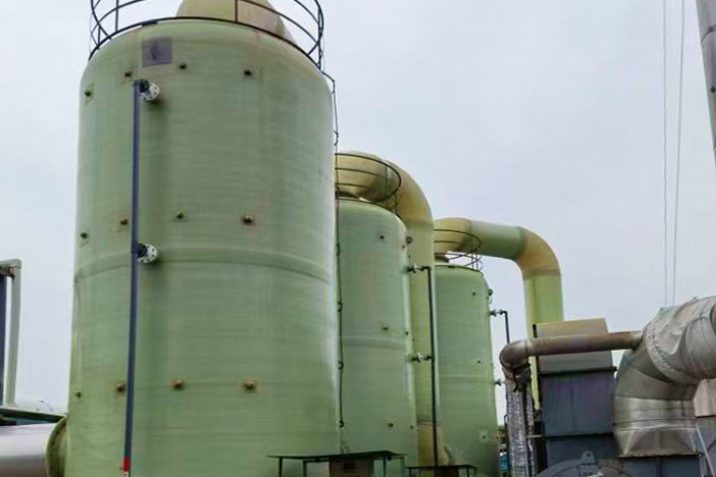
When engineers specify a storage tank, pipeline or process vessel, the shortlist almost always comes down to two materials: FRP (fiberglass reinforced plastic) and stainless steel. Both are corrosion-resistant, both are proven, and both can serve for decades. But the right choice depends on your medium, temperature, budget and lifecycle expectations — and picking wrong either way costs real money.
This guide compares FRP and stainless steel across the seven factors that matter most in real procurement decisions, based on what we see in chemical, water treatment, power and municipal projects across 50+ export markets.
1. Quick Comparison Table
| Factor | FRP / GRP | Stainless Steel (304/316) |
|---|---|---|
| Corrosion resistance | Immune to electrochemical corrosion; resin selected per medium (acids, alkalis, seawater) | Excellent, but vulnerable to chlorides (pitting), acids and crevice corrosion |
| Density / weight | ~1.8–2.0 g/cm³ — about 1/4 the weight of steel | ~7.9 g/cm³ — heavy; higher transport and installation cost |
| Typical service temperature | Depends on resin: roughly up to 80–110 °C for vinyl ester systems | Handles far higher temperatures (400 °C+) |
| Initial cost | Generally lower for large corrosion-resistant tanks and pipes | Higher material cost, fluctuates with nickel prices |
| Life-cycle cost | Very low — no coating, no rust maintenance | Low, but chloride environments may need inspection and passivation |
| Customization | Molded to any diameter/volume; fittings laminated in place | Requires welding; complex shapes raise cost quickly |
| Impact / abrasion | Good but can crack under sharp impact; repairable by laminate patch | Dents rather than cracks; weld repair |
2. Where FRP Wins
Chloride and salt environments
Seawater, brine and wastewater are where stainless steel most often disappoints: 316L can pit above roughly 200–1000 ppm chlorides depending on temperature and pH. FRP — with the correct resin, typically vinyl ester — is essentially unaffected. This is why desalination plants, coastal facilities and fish-farm systems specify FRP pipe and tanks so consistently.
Acids and mixed chemical service
Dilute sulfuric acid, hydrochloric acid and many plating chemicals attack even 316 stainless. A properly specified FRP tank handles them for decades. The key is matching the resin and liner (veil) to the exact chemical concentration and temperature — something a factory engineer should confirm before order.
Large diameters and buried service
For big-volume tanks (1–5000 m³) and large-diameter pipe, FRP's light weight cuts crane, foundation and freight costs dramatically. Buried FRP tanks also resist external soil-side corrosion that destroys carbon steel without protection.
Budget predictability
Stainless pricing tracks the nickel market and can swing 20–30% within a year. FRP pricing is driven by resins and glass, which are far more stable — easier for EPC budgeting.
3. Where Stainless Steel Wins
- High temperature: anything routinely above ~100–120 °C, or thermal cycling beyond FRP resin limits.
- Hygienic / food and pharma: polished stainless remains the standard for CIP-cleanable process equipment (though FRP is common for the associated storage and cooling water).
- Heavy mechanical abuse: loading points, high-velocity slurry, and areas exposed to sharp impact favor steel's ductility.
- Small, simple vessels where a standard welded tank is cheaper than a one-off mold.
4. A Practical Decision Checklist
- What is the worst-case chemical (not average) — concentration, temperature, chlorides?
- Is the service temperature above 100 °C at any point?
- Is the installation buried, coastal, or in a corrosion-heavy zone?
- What is the 20-year cost — freight, foundation, coatings, inspection, replacement risk?
- Do you need future modifications (nozzles, manways)? FRP modifications are laminated in place, often cheaper than re-welding.
If your answers point to corrosive media at moderate temperature, FRP almost always delivers the lower life-cycle cost. If temperature or hygiene dominates, stainless — or a hybrid: FRP body with steel nozzles and supports — is the safer pick.
5. Common Buyer Questions
Is FRP strong enough for industrial service?
Yes when engineered properly. Filament-wound FRP pipe routinely operates at 6–16 bar and is standardized under ASTM D2992 / AWWA C950; tank design follows BS 4994 or similar. The failure mode we see in cheap imports is skipped quality steps — wrong glass content, no cure testing — not the material itself. Buy from a factory that provides design calculations and test certificates.
How long does FRP last vs stainless?
In corrosive service, properly made FRP commonly exceeds 25–30 years, often outlasting 304 stainless in the same environment. UV-exposed surfaces should include a resin-rich gelcoat or topcoat.
Can the two be combined?
Frequently. FRP tanks with stainless/flanged connections, FRP ducting on steel structures, and dual-laminate (thermoplastic liner + FRP shell) systems give you the best of both.
Related: FRP pipes, FRP storage tanks and ask our engineers for a material recommendation.
Need help selecting FRP products?
Our engineers answer technical questions free of charge.
Ask an Engineer on WhatsApp