
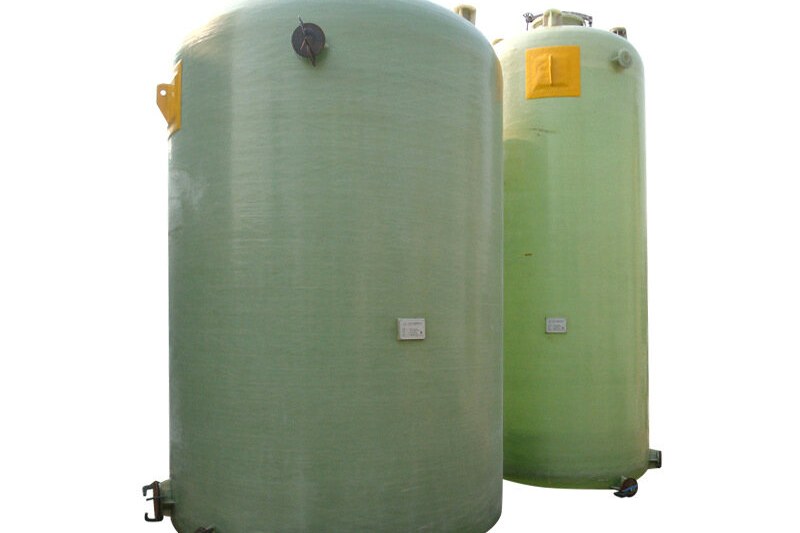
Every FRP tank starts with the same decision: put it in the open where you can see, touch and repair it — or bury it where it frees the surface but hides every problem. The choice is not about the tank, which can be built for either duty; it is about what you are willing to pay in land, access and leak detection, against what you gain in thermal stability, fire protection and usable space.
This guide compares above-ground and buried FRP tank installations across the factors that decide the right answer for a site, including the buried-tank risks that are most often underestimated: groundwater floatation, soil loads and hidden leaks.
1. Above-Ground Tanks: Visible and Serviceable
- Inspection and repair are cheap — a leak, blister or impact mark is seen early, and patching an accessible tank costs a fraction of excavating a buried one.
- Leak detection is immediate — drips and stains are visible; regulators also accept visual inspection as the monitoring method in many cases.
- Costs and limits: footprint, wind and seismic anchorage, UV exposure, ambient freeze protection for contents, vandalism/security, and the visual impact of chemical storage on site.
2. Buried Tanks: Hidden but Efficient
- Surface space stays usable — car parks, yards and roads can sit above a correctly designed buried tank.
- Thermal stability: soil insulates, reducing heating loads and condensation; contents stay closer to ground temperature.
- Fire protection: a buried tank is shielded from radiant heat and from nearby ignition — often a decisive factor for fuel and flammable service.
- Security and aesthetics: no visible chemical store, less vandalism and theft of fittings.
- Costs and risks: excavation and backfill, higher stiffness class, floatation control, hidden leaks, limited access, and the cost of digging up a failed tank.
3. Side-by-Side Comparison
| Factor | Above ground | Buried |
|---|---|---|
| Installation cost | Pad + anchorage | Excavation + bedding + backfill |
| Inspection | Visual, anytime | Manway + leak detection only |
| Repair cost | Low | High (dig-out if serious) |
| Leak visibility | Immediate | Needs detection system |
| Groundwater uplift | N/A | Critical — must be checked |
| Freeze protection | Needed for water in cold climates | Soil provides insulation |
| Wind / seismic anchorage | Required (empty case) | Soil restrains the tank |
4. The Buried-Tank Check That Decides Everything: Floatation
An empty buried tank in high groundwater is a buoy: the displaced water weight tries to lift it out of the ground, cracking the base or pushing the tank up through the backfill. The floatation check compares the empty tank weight plus any anchor/ballast against the upward force of the surrounding groundwater. If it fails, options are:
- Ballast — water ballast inside during and after backfill until permanent load is present.
- Concrete anchor slab or straps — cast below the tank and strapped over it.
- Dewatering — keep the groundwater level below the tank invert while empty.
Never backfill an empty buried tank without checking the groundwater table first — it is the single most common cause of buried FRP tank failure.
5. Bedding, Backfill and Stiffness Class
A buried tank carries soil and traffic loads through its ring stiffness and the quality of the surrounding bedding:
- Specify the SN class (commonly SN 5000–10000) for the actual cover depth and loading.
- Bed the tank on a prepared, level foundation and surround it with the specified granular backfill, placed in layers and compacted — never with the excavator bucket or sharp rocks.
- Confirm maximum cover depth and any road-crossing case with the manufacturer before ordering the wall schedule.
6. Detecting Leaks on a Buried Tank
- Double-wall tanks with an interstitial space and a monitoring port give early warning of either wall leaking.
- Monitoring wells around single-wall tanks allow sampling of groundwater for product.
- Inventory reconciliation (tank gauge vs deliveries) catches chronic losses that a wet well may miss.
7. Decision Guide
- Choose above ground when: maintenance access matters, contents must be visibly checked, the site has space, and there is no driver for burial.
- Choose buried when: surface space is valuable, contents are flammable or temperature-sensitive, aesthetics/security matter, or regulations require underground storage.
8. Common Specification Mistakes
- Burying a tank without a floatation check — the empty-tank uplift case is missed in most first designs.
- Backfilling with site soil containing sharp stones or boulders against the tank wall.
- Choosing an above-ground SN class for a buried duty and letting the tank ovalize under fill.
- Assuming buried equals "no maintenance" — hidden tanks need more systematic monitoring, not less.
Our buried FRP tanks and the rest of the FRP storage tank range are supplied with stiffness, bedding and floatation guidance; see also the tank installation guide for site procedures.
Need help selecting FRP products?
Our engineers answer technical questions free of charge.
Ask an Engineer on WhatsApp