
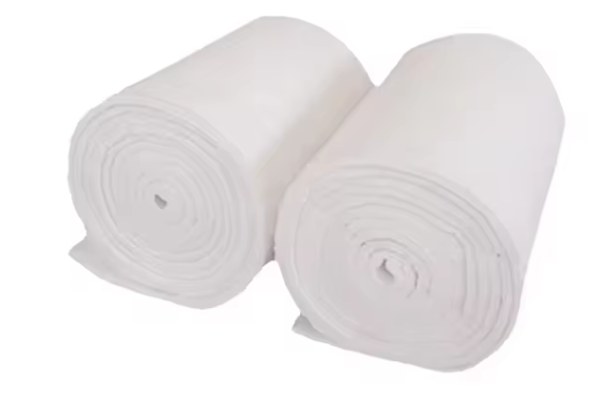
Ceramic fiber (alumino-silicate) insulation comes in three engineering forms — blanket, board and folded module — made from the same family of fibres but behaving very differently in a furnace. Choosing the form wrong is expensive in both directions: modules specified where blanket belongs triple the lining cost, and blanket specified where a hot face needs board fails within the first heat-up.
This guide explains what each form is, where it wins, how temperature ratings actually work, and the installation details that decide lining life.
1. Same Fibres, Three Forms
All three forms start from the same alumino-silicate fibre family — melted and fibreised, then needled (blanket), vacuum-formed with binders (board), or folded and compressed with anchors (module). The chemistry sets the temperature class; the form sets the mechanical behaviour, density and installation method. That is why form choice is an engineering decision, not a catalogue pick.
2. Blanket: Flexible, Compressible, Everywhere
Blanket is needled from the melt — a fluffy, compressible roll in densities around 64–160 kg/m³. Its strengths: it conforms (pipe wraps, curved shells, expansion joints), it is the cheap bulk material for multi-layer lining construction, and it compresses to absorb movement between harder components. Its weakness: no self-support — it cannot be a hot face where gas velocity or mechanical contact would erode it. Typical uses: backup insulation behind hot-face layers, kiln car seals, door and penetration packing, pipe and duct wrap, welding blankets and stress-relief enclosures.
3. Board: Rigid, Machinable, Hot-Face Capable
Board is blanket with binders and vacuum forming — rigid sheet in 200–400 kg/m³ densities that saws, drills and routes like dense timber. It is self-supporting, so it faces the fire: hot-face linings in kilns and furnaces, burner blocks, sight-port surrounds, cast-in inserts and precision-machined shapes. Boards resist gas erosion far better than blanket and hold machined tolerances, which is why furnace furniture and burner quarls are board, never blanket.
4. Modules: Factory-Folded Wall and Roof Systems
A module is blanket, folded and compressed (typically to ~200 kg/m³ equivalent) into blocks pre-assembled with anchor hardware. Installed row by row to a shell, modules give a fully anchored, joint-free (with sequenced installation) lining that goes up fast — a wall system measured in square metres per shift rather than the layer-and-stud choreography of board construction. Modules dominate furnace walls, roofs and kiln linings where speed of installation and anchor-supported durability pay for the higher unit cost.
5. Temperature Ratings: The Honest Reading
| Classification | Continuous service (realistic) | Typical products |
|---|---|---|
| 1260°C class | ~1050–1100°C hot face | Standard RCF blanket/board/module |
| 1400°C class | ~1200–1250°C | High-alumina / zirconia-boosted fibre |
| 1500–1600°C class | ~1350–1450°C | Polycrystalline / alumina fibre boards |
The classification temperature is measured on fibre with a specific shrinkage limit — it is not a continuous-use rating. The practical rule: run a class 100–150°C below its classification at the hot face, and step down grades layer by layer through the lining (hot face 1400-class, backup 1260-class, backup-backup blanket) to buy performance where it matters and bulk where it is cheap.
6. Selection Table: Form by Job
| Job | Form | Why |
|---|---|---|
| Furnace roof & walls | Modules | Anchored, fast, joint-controlled |
| Backup insulation layers | Blanket | Compressible bulk, lowest cost per m³ |
| Burner blocks, ports | Board (machined) | Erosion resistance + tolerances |
| Expansion joints / door seals | Blanket (compressed) | Conforms and recovers |
| Pipe / duct wrap | Blanket | Curves, fast, cheap |
| Kiln furniture, saggers | Board | Self-supporting, machinable |
7. Installation Notes That Decide Lining Life
- Blanket layering: run layers with joints staggered and butted under light compression (2–3%); through-thickness joints are heat leaks.
- Boards: fix with ceramic anchors or castable-embedded studs; seal board joints with ceramic fiber mortar in erosive zones.
- Modules: weld anchors to pattern, install modules in rows so compression between adjacent modules closes gaps; remove the retaining strips last and fluff-cut corners; the first row direction sets the shrinkage plane — follow the supplier's pattern sheet.
- Heat-up: follow the cure schedule (binder burnout releases water); a rushed first heat-up spalls any binder-containing board.
8. Inspection and Repair
Inspect annually for shrinkage gaps (caulk with ceramic fiber wool + mortar), anchor-facing module fallout, and board edge erosion. Small gaps re-pack with blanket offcuts; eroded hot-face boards patch with matching grade; a module wall repairs module-by-module — that modularity is one of its quiet advantages over monolithic linings.
9. Specification Checklist
- Classification temperature and realistic continuous hot-face temperature stated separately
- Density per layer and total lining cold-face heat loss target
- Module system: anchor type/spacing, module size, installation pattern supplied
- Boards: machining tolerances and binder type for the first heat-up
- Chemistry: RCF vs alkaline-earth silicate (low-bio-persistent) where regulations require
10. Common Mistakes
- Reading classification temperature as continuous service rating.
- Blanket as hot face in gas streams — erosion for lunch.
- Modules installed with joints in line — shrinkage opens a heat path.
- First heat-up raced past binder burnout.
- Single-grade lining instead of graded layers — expensive where cheap works.
See our 1260°C ceramic fiber blankets, the glass-kiln grade, ceramic fiber boards, 1500°C alumina boards and the full refractory & fireproof materials range; for the alternative where lower temperatures rule, see our basalt rock wool boards, and read the refractory materials selection guide for the brick/ceramic-fiber/castable decision.
Need help selecting FRP products?
Our engineers answer technical questions free of charge.
Ask an Engineer on WhatsApp