
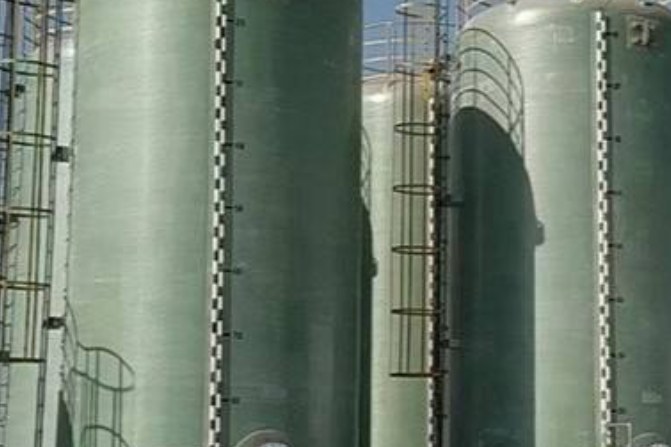
A chemical storage tank is a small, quiet accident waiting for a mistake: a cross-connected fill line, an undersized vent, a bund that cannot hold the contents, or a fitting cracked by an overtightened flange. In bulk chemical storage, the tank itself is rarely the cause — the system around the tank (containment, venting, bunding, labelling and procedures) decides whether an incident stays small or becomes a release.
This guide covers the safety engineering that should surround every FRP chemical storage tank: secondary containment, venting and emergency relief, layout and segregation, grounding for flammable service, and the operating rules that prevent the most common incidents.
1. Containment: Assume the Tank Will Eventually Leak
Regulations in most jurisdictions (such as EPA SPCC in the US, and equivalent national rules) require that a bulk chemical tank's contents be contained if the tank or its pipework fails:
- Bund (secondary containment) capacity — commonly 110 % of the largest tank's volume, or 10 % of total volume plus the largest tank, whichever is greater; confirm the local rule.
- Bund material must resist the chemical — concrete bunds are attacked by acids and some solvents; line them with a chemical-resistant FRP liner or use an FRP bund pan, matched to the stored product.
- Drainage — bund floors slope to a sump with a normally closed valve, and rainwater must be removed without letting chemical escape.
- Leak detection between an inner tank and any secondary liner gives early warning of a wicking failure.
2. Venting: The Most Common Cause of Tank Damage
More FRP tanks are damaged by their own vents than by their contents:
| Scenario | Risk | Protection |
|---|---|---|
| Pumping out fast with a blocked vent | Vacuum collapse of the shell | Vacuum-breaker or adequately sized vent |
| Fill without a sized vent | Pressure rise, lid or joint failure | Free-breathing vent sized to fill rate |
| Fire near the tank | Internal pressure from heated vapour | Emergency vent / pressure-vacuum valve per the design code (e.g. API 2000 methodology) |
| Volatile contents breathing | Vapour loss and odour | Pressure-vacuum (PV) vent or scrubber connection |
Size the vent from the maximum fill/withdrawal rate, and never rely on a loose manway lid as a vent.
3. Layout and Segregation
- Keep incompatible chemicals apart — acids away from hypochlorite and cyanides, oxidisers away from flammables — and give each family its own bund so a spill cannot mix two chemicals into a worse one (chlorine gas, fire, toxic fumes).
- Set tanks back from site boundaries, ignition sources and drainage paths; position vents and flanges away from walkways where practical.
- Provide spill kits and an isolation valve at the tank outlet that stops flow even if the pump fails.
4. Flammables: Grounding and Bonding
Where the stored liquid is flammable or the atmosphere is classified:
- Specify an antistatic/conductive FRP tank (or internal conductive path) so charge cannot accumulate on the wall.
- Earth the tank at dedicated lugs and bond the fill pipework, hoses and the tank together before filling.
- Verify continuity with a meter after installation and periodically — a conductive tank with a broken earth bond is a hazard, not a solution.
5. Operating Rules That Prevent the Classic Incidents
- Cross-connection is the number one cause of chemical tank incidents — label every nozzle, use different coupling sizes for different products, and verify the line before opening the fill valve.
- No hot work near an FRP tank — grinding, welding and cutting sparks ignite FRP; issue permits and cover the tank if work is unavoidable nearby.
- Torque flanged connections to the FRP value and re-check after thermal cycles; a cracked flange is a hidden leak source.
- Inspect liner condition internally with lighting on a schedule; catch scratches before the chemical reaches the glass.
- Keep a written inspection and test record per tank: vent check, bund integrity, earth continuity, flange torque.
6. Specification Checklist
| Safety item | Requirement |
|---|---|
| Secondary containment | Chemical-compatible bund, 110 % capacity, sealed drainage |
| Venting | Fill/withdrawal sized vent + emergency vent for fire case |
| Material compatibility | Resin and liner match the actual chemical and temperature |
| Flammable service | Antistatic laminate, earthing lugs, bonding of pipework |
| Identification | Label, contents sign, line marking, isolation valve |
7. Common Safety Mistakes
- Bunds built of materials the stored chemical attacks — a "containment" that dissolves on day one.
- Vents sized for normal breathing but not for fast pumping or fire exposure.
- Storing incompatible chemicals in one bunded area, so a single spill creates a secondary reaction.
- Treating the tank as the whole system: piping, flanges, vents and procedures are where incidents actually happen.
Our filament-wound FRP chemical tanks are supplied with liner, vent and grounding provisions matched to your chemical; browse the complete FRP storage tank range and the vertical tank installation guide for foundation and anchorage details.
Need help selecting FRP products?
Our engineers answer technical questions free of charge.
Ask an Engineer on WhatsApp