
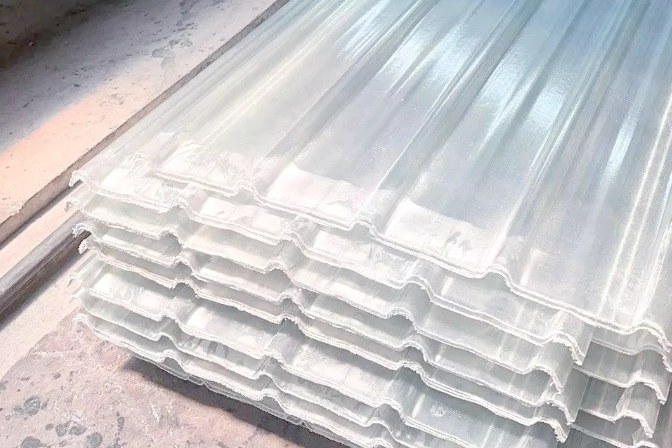
Factory roofs waste a free resource: daylight. FRP daylighting panels — translucent corrugated sheets and twin-wall panels that sit between metal roof sheets — are the cheapest way to light a production hall, and they replace like-for-like with the steel sheeting around them. But panel quality varies enormously: cheap sheets yellow within two summers and chalk in five. This guide covers panel types, light transmission, UV protection, strength and the specification details that decide whether your skylights last five years or twenty.
1. Panel Types and Where Each Fits
| Panel type | Form | Best suited to |
|---|---|---|
| Corrugated / profiled sheet | Wave or trapezoidal profile matching steel roof sheets | Direct replacement of roof sheet bays on purlin roofs |
| Twin-wall (hollow) panel | Flat multi-cell sheet | Wall cladding windows, canopy covers, diffused light zones |
| Flat / opaque coloured panels | Flat or profiled, tinted | Facades, partitions, anti-glare areas |
The critical fit dimension is the profile match: corrugated daylight sheets must mirror the adjacent steel sheet's pitch and depth exactly, or the sidelaps leak and the sheets rock under foot traffic. Always supply your steel roof profile drawing to the panel supplier.
2. Light Transmission: Clear vs Diffused
Transmission typically runs 50–90%: fully clear sheets maximise light but produce hard shadows and glare on moving machinery; diffused (translucent) sheets spread light evenly and are the safer choice above workstations. A practical spec: 60–70% diffused transmission over the work area, with clear panels reserved for aisles and storage zones. More panels is not better — each is a thermal and leak-risk bay, so design for even spread, not maximum area (10–20% of roof area covers most halls).
3. UV Protection: The Yellowing Battle
UV turns unprotected polyester yellow and brittle; the surface chalks, fibres bloom, and transmission drops. What actually protects the panel: a gel-coat or UV-stabilised surfacing veil on the weather side (not just UV powder in the resin), and quality resin systems. Ask the supplier for weathering data — years of outdoor exposure behind them, warranty terms in writing — and expect quality panels to hold ≥90% of initial transmission after years of service. Panels without a dedicated weather surface are the ones that fail in two summers.
4. Fire Performance
FRP panels are combustible thermosets; grades differ. Standard panels achieve moderate fire classes (e.g. B-s1,d0 on European scales for quality formulations), while fire-retardant resin systems push performance higher for buildings with strict roof requirements. For warehouses with sprinklered, high-bay risks, panel fire class should be specified alongside the steel deck's — and never let a cheap unclassified panel become the weak bay of a rated roof.
5. Strength, Span and Walking Loads
Corrugation is the stiffness: deeper profiles span more between purlins. Real installations must state purlin spacing and the panel thickness/profile that carries it — including the temporary load of a maintenance worker, because somebody will walk near that panel. Quality systems mark walkable zones or provide grating-walkway protection over panel bays; for high-traffic roofs, pair daylight bays with designated grating walkway routes.
6. Corrosive and Hot Environments
A quiet advantage over polycarbonate: FRP panels shrug off the corrosive atmospheres around chemical plants, plating shops, livestock buildings and coastal works — the same resin logic as every FRP product in this guide. Temperature ceiling matters though: sustained surface temperatures near 80–90°C and above soften standard panels, so keep them away from hot exhaust stacks and specify high-heat formulations where roofs run hot.
7. Installation Notes
- Sidelaps: match the steel sheet lap with sealing tape or sealant beads; end laps overlap 150–200 mm minimum with sealant.
- Fasteners: use the roof system's self-drilling screws with weather-sealing washers; over-tightening cracks panels — drive to washer seal, not torque.
- Cutting: carbide abrasive blades, cold cutting; support the sheet to avoid cracking at the cut.
- Order: install panels in the same sequence as adjacent sheets, never walking directly on unsupported panel centres.
8. Specification Checklist
- Roof profile drawing supplied; panel profile matched exactly
- Light transmission % (clear vs diffused) per zone
- UV surface system + weathering/warranty data in writing
- Fire class per the building's roof requirements
- Purlin spacing and panel thickness verified for walk-through loads
- Thickness (typically 0.8–2.0 mm) matched to span and wind zone
9. Common Mistakes
- Ordering panels by length only — profile mismatch leaks for the life of the roof.
- Choosing the cheapest no-veil sheet and repainting the yellow in year three.
- Letting installers walk on unsupported panel centres.
- Clear panels above inspection benches — glare complaints within a week.
- Ignoring the temperature map of the roof (exhaust stacks, kiln walls).
See our transparent corrugated daylight sheets, twin-wall daylight panels, anti-corrosion coloured corrugated panels and the wider plates & panels range; background: how FRP products are made.
Need help selecting FRP products?
Our engineers answer technical questions free of charge.
Ask an Engineer on WhatsApp