
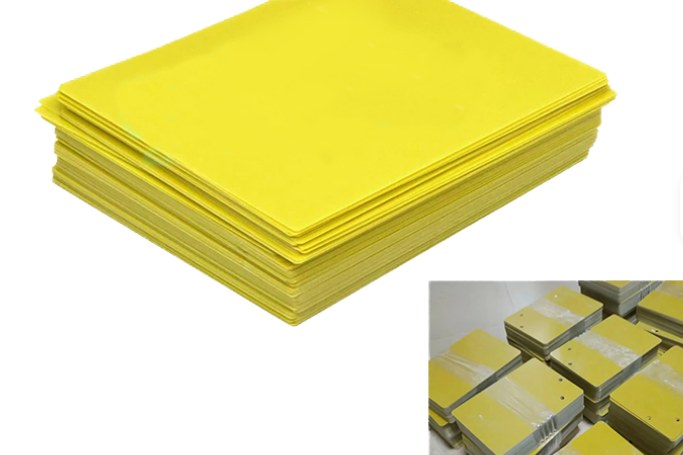
Electrical equipment needs materials that are structural and insulating at once — barriers that carry load, spacers that hold busbars, panels that survive machining into complex shapes. Glass-fiber reinforced epoxy laminates fill exactly that niche, and the workhorse grade in Chinese industry is 3240 epoxy fiberglass laminate — the equivalent family to NEMA G-11 / FR-4 glass-epoxy laminates used worldwide.
This guide explains what 3240 laminate is, its key properties, how it is machined into finished components, and where tubes, pultruded sections and molded FRP complete the electrical insulation toolkit.
1. What 3240 Epoxy Glass Laminate Actually Is
3240 is a laminate of woven E-glass cloth impregnated with epoxy resin, pressed under heat and pressure into sheets. The glass carries mechanical load; the epoxy binds and insulates. It sits in the mid-to-high performance band of rigid insulating laminates: better moisture and electrical performance than phenolic-paper grades, more economical than high-end polyimide or mica systems, and machinable with standard tooling. Sheets come typically 0.5–100 mm thick, in the characteristic yellow-green colour.
2. Key Properties (Typical Values)
| Property | Typical value | Why it matters |
|---|---|---|
| Dielectric strength | ~14–20 kV/mm (1–3 mm) | Barrier and spacer duty between live parts |
| Flexural strength | ~340+ MPa | Structural panels, brackets, supports |
| Water absorption | Low (fractions of a %) | Stable insulation in humid switchrooms |
| Temperature class | Class B–F (~130–155°C) | Continuous duty near transformers, busbars |
| Flammability | Self-extinguishing grades available (UL94 V-0 analogues) | Panel and barrier compliance |
Values are indicative — confirm against the manufacturer's datasheet and the applicable IEC/GB standard for your application, and ask for test certificates with the shipment.
3. CNC Machining into Components
The practical value of laminate sheet is that it machines like a dense, stable plastic: routed, drilled, milled and waterjet-cut into busbar supports, insulating barriers, terminal panels, gear insulation plates, jigs and fixture components. Quality machining practice: sharp carbide tooling, support under the cut to avoid delamination at exits, deburred edges (a rough machined edge is a tracking path in dusty switchrooms), and tolerance discipline — glass-epoxy holds ±0.1 mm-class dimensions comfortably. For volume parts, CNC nesting from your DXF drawings is standard supplier service.
4. Tubes and Pultruded Sections
Beyond flat sheet, the insulation toolkit extends to filament-wound insulating round tubes (spacers, bushing supports, fuse tubes) and pultruded square/rectangular sections for structural frames that must not conduct — equipment racks, cable support systems, ladder structures. The pultruded family's non-conductivity is the same principle behind our FRP handrail systems in substations: eliminate an entire class of electrical risk by removing the conductor.
5. Where These Materials Go
| Application | Material |
|---|---|
| Switchgear barriers & phase separators | 3240 sheet, machined |
| Busbar supports & insulating brackets | 3240 sheet / machined blocks |
| Spacer tubes, fuse & bushing tubes | Filament-wound insulating tubes |
| Equipment racks, non-conductive framing | Pultruded square/rect tube |
| Substation platforms & guardrails | Pultruded FRP systems |
| Transformer & motor slot insulation | Thin laminate / specialised grades |
6. Choosing Between Insulation Material Families
| Family | Relative to 3240 glass-epoxy |
|---|---|
| Phenolic paper (XPC-class) | Cheaper; weaker in moisture and punch quality; low-voltage duty |
| Polyester glass (GPO-3 style) | Better tracking resistance & arc; common in US switchgear |
| FR-4 / G-10 glass-epoxy | Higher performance family; FR-4 adds flame retardancy |
| Mica / high-temp systems | For extreme temperature classes; costly |
7. Incoming Quality Checks
- Thickness and flatness across the sheet (tolerance drift breaks assembly fits)
- Dielectric breakdown test certificate per batch
- Flexural strength and water absorption certificates
- Machined edge quality — smooth, sealed, no fibre fuzz
- Colour/resin consistency for visual inspection panels
8. Specification Checklist
- Grade named (3240 / FR-4 / GPO-3 equivalent) with standard reference
- Thickness, tolerance and machined-part drawings
- Electrical requirements: working voltage, clearance/creepage context
- Temperature class and flame-retardancy requirement
- Certificate package: dielectric, mechanical, per batch
9. Common Mistakes
- Specifying "insulating board" with no grade — phenolic paper shows up instead of epoxy glass.
- Machined edges left fuzzy, then dust tracks across them.
- Ignoring moisture: cheap laminates drift electrically in humid switchrooms.
- Over-torqued fixings cracking thin laminate around bolt holes.
- Buying by price per kilogram instead of per certified property.
See our 3240 epoxy fiberglass laminate sheets, insulating fiberglass tubes, insulating power guardrails and the wider profiles & structural components range.
Need help selecting FRP products?
Our engineers answer technical questions free of charge.
Ask an Engineer on WhatsApp