
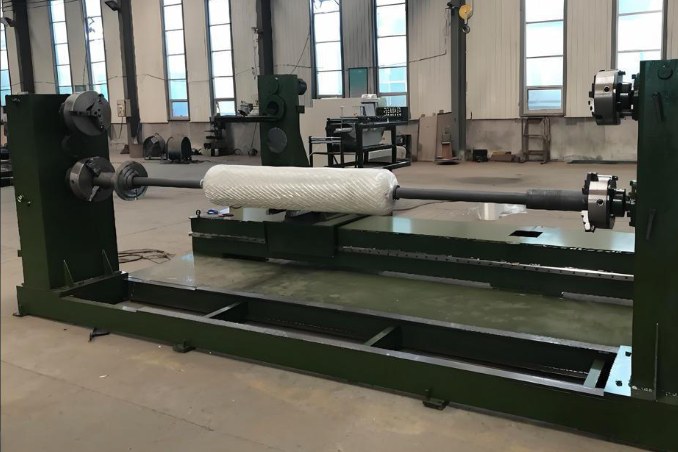
A filament winding machine is the single largest investment in a wound-FRP product line — and the most commonly mis-bought. Buyers overpay for axes they will never program, or underbuy and spend years fighting a mechanical machine that cannot wind the geometry their market demands. This guide sets out the machine classes, what each can and cannot wind, and the checks that separate a good purchase from an expensive lesson.
1. What the Machine Actually Does
Filament winding pulls resin-wetted glass rovings under controlled tension onto a rotating mandrel, laying them at precise helix angles. The machine coordinates two basic motions — mandrel rotation and carriage traverse — plus optional cross-feed and eye control. Wound parts get their strength from fibre continuity; the machine's job is to place that fibre exactly, repeatably, at line speeds that make the economics work.
2. The Three Machine Classes
| Class | Motions | Typical products | Watch out for |
|---|---|---|---|
| Mechanical 2-axis | Mandrel spin + carriage via chain/cam | Fixed-ratio helix: simple pipes, mandrel-wound tubes | One geometry ≈ one gear set; changeover is slow |
| 4-axis servo | Spin, traverse, cross-feed, eye yaw | Water softener tanks, filter housings, small pressure vessels, septic tanks | The volume workhorse — programmable patterns, fast changeover |
| CNC multi-axis | 6+ axes incl. eye pitch/yaw, dual carriages | Complex fittings, elbows, tapered and non-cylindrical bodies | Price and programming skill; overkill for round products |
3. Matching Machine to Product
Buy for the geometry you will actually sell. Straight cylindrical pipes and tanks with uniform wind angles are comfortably handled by 4-axis machines. Tapered poles and conical pipes need a moving eye path relative to a varying mandrel diameter — that is conical-capable 4-axis or CNC territory. Elbows, tees and fittings need multi-axis CNC with pattern software. If your business plan includes water softener tanks plus street-light poles, a programmable 4-axis with a conical option covers both; if it includes branches and fittings, budget CNC from day one rather than retrofitting.
4. Mandrels and Extraction
The mandrel defines the inside of the product, and extraction defines your cycle. Steel mandrels with a slight taper and release agent extraction suit rigid pipes; collapsible or segmented mandrels suit fittings; for tank liners, the liner itself often becomes part of the laminate. Check three things when comparing suppliers: mandrel material and surface finish (affects release and interior quality), extraction method (hydraulic puller, winch, or press), and whether spare mandrels are part of the quoted line — downtime waiting for a mandrel is the most common hidden bottleneck.
5. Control Systems: PLC vs CNC
A PLC-controlled machine stores recipe-based patterns (angle, bands, length) and is operated by technicians — ideal for standard product families. A CNC machine accepts off-line programmed paths for arbitrary geometry — needed for fittings and complex shapes, and it rewards you only if you employ or train a programmer. Ask to see the pattern library and the operator interface during factory acceptance; an interface your floor staff cannot use is a feature you do not have.
6. Throughput: What Sets Cycle Time
| Parameter | Typical range | Effect on output |
|---|---|---|
| Carriage speed | ~0.1–1 m/s | Directly scales metres wound per shift |
| Wind angle | Hoop (≈90°) to helix (10–30°) | Low angles wind faster; hoop bands slower |
| Band count per layer | Product-specific | More bands = more traverse cycles |
| Cure/handling time | Product-specific | Often the true bottleneck, not the machine |
Run the throughput math on your actual product mix, not the brochure's demo part. A machine quoted at a headline speed for thin-wall tube may deliver a third of that on your 6 mm tank wall with hoop-dominated layup.
7. Tension and Wet-Out: Where Quality Is Made
Fibre tension control (per-creel or zone-based) decides consolidation and ring strength; inconsistent tension shows up as soft spots and ovality. Wet-out options range from dip baths to injection boxes — injection boxes meter resin, cut VOC exposure and waste, and pay back quickly on volume lines. When auditing a machine, inspect the creel brakes and the resin bath design as seriously as the frame: quality is made at the fibre-resin interface, not in the cabinet.
8. Pre-Purchase Checklist
- Product list with diameters, lengths, wall build-ups and wind angles
- Mandrel set, extraction method and spare tooling included in quote
- Servo axes count and repeatability specification, with a live demo on your geometry
- Control type matched to your staffing (recipe PLC vs programmable CNC)
- Resin system compatibility (polyester / vinyl ester / epoxy) and wet-out method
- Tension control per creel, with brake quality demonstrated
- Safety guarding, resin containment and cleanup design
9. After-Sales, Spares and Training
Winding machines are electromechanical systems with long lives — the supplier's support matters more than the spec sheet. Confirm: commissioning on site, operator and programmer training included, remote diagnostics, a spares list with lead times (servo drives, brake pads, eye components), and software update policy. A slightly cheaper machine without local support is usually the more expensive one within two years.
10. Common Buying Mistakes
- Buying CNC for a straight-pipe product family — axes you never program.
- Buying mechanical for a business plan that will change geometry yearly.
- Ignoring mandrel logistics, then discovering extraction is the bottleneck.
- Comparing headline speeds across different demo parts.
- No acceptance test clause — insist on winding your part before payment milestone.
See our 4-axis filament winding machines, CNC winding lines for tank & pipe, pole production lines, conical pipe winding machines and the full machinery & production lines range; background reading: FRP manufacturing processes explained.
Need help selecting FRP products?
Our engineers answer technical questions free of charge.
Ask an Engineer on WhatsApp