
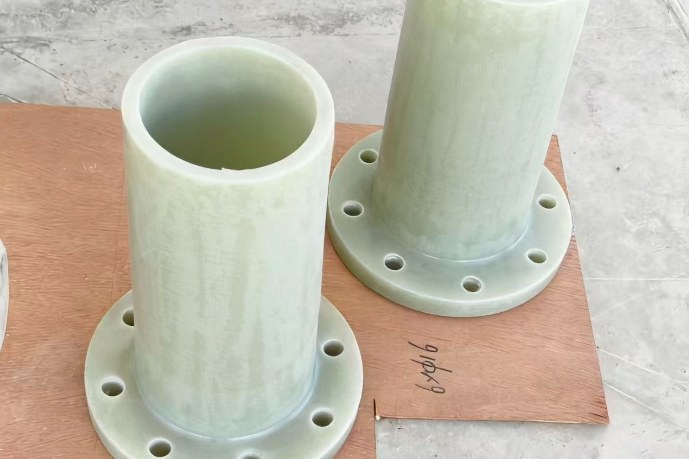
A pipeline is only as strong as its weakest flange. Pipe manufacturers rate the straight pipe carefully — pressure class, stiffness, liner — but the elbows, tees, reducers and flanges bolted to its ends often decide whether the line leaks, cracks or survives its first hydrotest. Mismatched fittings are the most common cause of premature failure in FRP piping systems.
This guide explains how to match FRP flanges and fittings to the pipe's pressure class, which joint and gasket to choose, how to bolt an FRP flange without cracking it, and the details that keep an assembled system leak-free for decades.
1. The Rule: Fittings Must Match the Pipe Class
An FRP fitting is rated like the pipe — by pressure class, temperature and chemical service — and every fitting in the line should carry at least the pipe's class. A PN 10 line fitted with one unrated elbow is a PN 10 line with a PN 3 weak point. When ordering, state the pipe class and ask for fittings rated to it, from the same laminate system, so liner, resin and glass content match.
2. Flange Types and Bolt Patterns
| Flange style | Typical use | Note |
|---|---|---|
| Full-face flanged end | Standard bolted connections, most pipe sizes | Bolt pattern per ANSI 125/150 or DIN PN10/PN16/EN 1092 |
| Loose / vanstone flange | Large diameters, frequent dismantling | Backing flange rotates to align bolts; stub end carries the load |
| Integral moulded flange | Small bores, moulded fittings | Reinforced hub; still needs careful torque |
Confirm the standard and drill pattern with your piping designer before manufacturing — re-drilling an FRP flange in the field is a common source of cracked bolt holes and voids.
3. Gaskets and Bolting: Why FRP Is Different
- Gasket: use a full-face elastomeric gasket (EPDM for water and mild chemicals, neoprene or PTFE-faced for aggressive media). A full-face gasket spreads the bolt load across the flange face and prevents point-contact crushing.
- Torque: FRP flanges crack when overtightened. Tighten in a star pattern in at least three passes to the manufacturer's torque value — typically far lower than steel flanges of the same size.
- Bolt material: stainless steel (A4/316) with wide washers; never galvanized bolts against the FRP face in chemical service, and keep bolt threads clean so the torque reading is real.
4. Fittings Families
- Elbows (45°/90°) — wound or moulded. Filament-wound bends keep continuous glass around the turn and carry higher pressure than mitered (section-built) elbows; specify wound for pressure lines.
- Tees and reducers — moulded or hand-laminated with reinforcing layers at the junction; the branch junction is the natural weak point, so ask how the crotch is reinforced.
- Stub ends and couplings — double-seal couplings join plain-end pipe quickly without flanges; stub ends convert them to flanged connections for valves and equipment.
- Adapters — flange-to-coupling and pipe-to-metal transitions; transitions to metal need careful design to avoid galvanic-adjacent corrosion and thermal stress at the interface.
5. Pressure and Temperature Matching
| Pipe class | Fitting requirement | Temperature derating |
|---|---|---|
| PN 6 / PN 10 | Same class, wound or moulded | Check resin HDT — ratings fall above ~50–60 °C for standard polyesters |
| PN 16 / PN 25 | Same class, filament-wound bends and reinforced tees | Vinyl ester or epoxy systems for higher temperatures |
| Vacuum / pulsating | Fittings with extra wall and crotch reinforcement | Fatigue duty — discuss with the manufacturer |
6. Assembly Rules That Prevent Leaks
- Align flanges square before bolting — never pull a misaligned flange into place by force; the bending load cracks the hub later.
- Torque in three passes (50 % → 75 % → 100 %) in a star sequence, then re-torque after the first thermal cycle.
- Support the pipe and valve independently so no equipment weight hangs on the fitting.
- On conductive (antistatic) lines, fit conductive gaskets or bonding straps across flanged joints to keep the earth path continuous.
- Hydrotest the assembled system, not just the pipe lengths, and inspect each joint while pressurized.
7. Specification Checklist
| Item | Example |
|---|---|
| Fitting class | PN 16, matching pipe class |
| Flange standard | ANSI B16.5 150# or EN 1092 PN16 bolt pattern |
| Gasket | Full-face EPDM (or PTFE-faced for solvent) |
| Bend type | Filament-wound 90° for pressure service |
| Bolts | 316 stainless, torque table supplied |
8. Common Specification Mistakes
- Buying unrated fittings because "they look the same" — the weak link becomes the whole line's rating.
- Torquing FRP flanges to steel values and cracking the hub.
- Using ring gaskets on full-face FRP flanges, concentrating load on a narrow band.
- Mixing supplier systems — a pipe from one factory and fittings from another rarely share liner chemistry, tolerances and pressure data.
Our FRP flange pipe fittings are rated and manufactured to match our pipe classes; see the full GRP/FRP pipes & fittings range and the companion guide on specifying GRP pipes for the pressure and stiffness background.
Need help selecting FRP products?
Our engineers answer technical questions free of charge.
Ask an Engineer on WhatsApp