
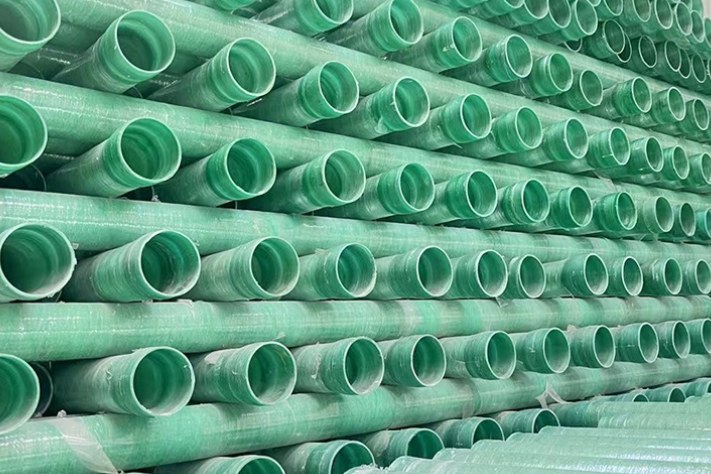
GRP (glass reinforced plastic, also called FRP or fiberglass) pipe is chosen for one reason: it outlasts steel and concrete in corrosive water, sewage, chemical and process service. But unlike a steel pipe ordered by schedule number, a GRP pipe is engineered for your duty — pressure class, ring stiffness, resin system and joint type are all selected, not assumed. Get those four right and the line runs for decades; get them wrong and no amount of corrosion resistance will save you.
This guide walks through exactly what a buyer must specify — and what to check on the datasheet — when sourcing GRP/FRP pipes, whether for a water main, a chemical transfer line or a power plant cooling system.
1. First, Know How the Pipe Is Built
The manufacturing route decides the pipe's performance ceiling and its price. Four processes cover nearly every GRP pipe on the market:
| Process | Typical products | Key properties | Common use |
|---|---|---|---|
| Filament winding | Pressure pipes, large-diameter process pipes, flues | Continuous helical roving = highest strength-to-weight; good pressure rating; diameters up to several meters | Water mains, seawater, chemical, power plant |
| Centrifugal casting | Sewer and drainage pipes, lower-pressure lines | Sand-filled walls give high ring stiffness at low cost; limited pressure capability | Gravity sewers, culverts, buried drainage |
| Pultrusion | Round / square / rectangular tubes, profiles | Constant cross-section, very high axial strength; not a pressure-pipe process | Structural columns, cable protection, handrails, supports |
| Hand lay-up | Custom ducts, large bespoke shapes | Flexible geometry, labor-intensive, lower and less consistent strength | Ducting and one-off fabrications |
For a pressure or buried water line, filament winding is almost always the correct family — the same process we use for our custom filament-wound GRP pipes. Pultruded tubes and profiles are structural products, not pressure carriers, so do not specify them where internal pressure exists.
2. Start With What Is Inside the Pipe
The fluid chemistry drives the resin system and the need for a corrosion liner. The liner — a resin-rich inner layer reinforced with C-glass or synthetic veil — protects the load-bearing structural wall from the medium. It is the difference between a pipe that lasts 30 years and one that wicks and fails at the wall.
- Water and sewage → isophthalic polyester or vinyl ester resin; standard liner with C-glass veil
- Mild acids / alkalis, industrial effluent → vinyl ester resin; chemical-grade liner matched to the medium
- Aggressive oxidizers, solvents, high temperatures → epoxy or specialty vinyl ester; confirm chemical compatibility tables before specifying
- Potable water → verify NSF 61 / WRAS / local food-grade approvals for the liner
State the full medium list, not just "wastewater": pH, temperature, solids content and intermittent chemicals all change the resin recommendation. When in doubt, water-service GRP pipe and pressure pipe product pages list the resin grades we standardize on.
3. Pressure Rating: Understand Class, Working and Burst Pressure
GRP pressure is expressed as a pressure class (e.g. PN 6, PN 10, PN 16 — meaning 6, 10 or 16 bar rated working pressure) or as an AWWA pressure class. Three numbers matter and buyers routinely confuse them:
| Term | Meaning | Why it matters |
|---|---|---|
| Rated / working pressure | Sustained internal pressure the pipe is designed to carry | Your operating pressure + surge allowance must stay below this |
| Burst pressure | Pressure at which the pipe fails | Typically 4–6× rated pressure; confirms design safety margin |
| Test / hydrostatic pressure | Site or factory proof pressure | Usually 1.5× rated; the number on the hydrotest certificate |
Buyer tip: specify the maximum surge pressure, not just steady operating pressure. Pump starts and valve closures can spike a 6 bar line past 12 bar in seconds — and the joint, not the pipe wall, is usually what fails first.
When you request a quotation, give the design pressure in bar or MPa and the surge condition. Do not simply ask for "the strongest pipe" — over-rating raises wall thickness and cost and can reduce the pipe's flexibility.
4. Stiffness (SN): The Number That Decides Installation Cost
Ring stiffness — written as SN (nominal stiffness, in Pa) — tells you how the pipe resists external load. Common classes are SN 1250, SN 2500, SN 5000 and SN 10000. This is the single most underestimated specification on buried GRP pipe, because it dictates bedding and backfill requirements:
- SN 2500 and below → designed for proper trench bedding per the installation standard; cheapest pipe but strict installation discipline
- SN 5000 → the common workhorse for buried water and sewer with controlled backfill
- SN 10000 → for shallow cover, traffic loads, poor soil or above-ground exposure; higher material cost, far more forgiving installation
Above-ground lines, racked pipes and low-cover crossings generally need the higher stiffness classes. A cheap low-SN pipe installed with poor bedding will ovalize and crack long before its corrosion life is reached — so stiffness is really an installation-cost decision, not just a pipe decision.
5. Diameter, Wall, Length and Joints
GRP pipe is manufactured to your diameter and stiffness class; wall thickness follows from pressure + stiffness calculations. Agree these details:
- Diameter — nominal bore or outside diameter? Confirm which convention the drawings use, and the tolerance.
- Length — 6 m and 12 m are standard; fewer joints = faster lay and fewer leak points.
- Joints — the most common field-failure point. Options: coupling (envelope) joints with double seals, bell-and-spigot with gasket, butt-and-wrap (laminated field joint), or flanged for above-ground and equipment connections. Ask which joint the price includes and how it is pressure-tested after assembly.
- Fittings — elbows, tees, reducers and flanged adapters should be supplied by the same manufacturer from the same laminate system; mixing brands voids the integrity of the line. Our flanged FRP pipe fittings are wound to match the pipe rating.
6. Standards, Datasheets and What to Verify
Insist that the quotation names the standard the pipe is built and tested to. Common references: AWWA C950 (USA, pressure pipe), BS EN 1796 / ISO 10639 (Europe, pressure water), ASTM D2996 (filament-wound pipe), ASTM D2997 (centrifugal cast), ISO 14692 (oil & gas GRP piping). What to request on the datasheet:
- Rated pressure and test pressure, with the safety factor used
- SN class and modulus of elasticity in the hoop direction
- Resin type, glass content (%), liner construction and thickness
- Hydrostatic test certificate and stiffness test report per batch
- Long-term (50-year) strain or pressure regression data — short-term burst numbers alone are not enough
7. The RFQ Checklist: What to Send the Supplier
A one-line enquiry ("need FRP pipe 300 mm") guarantees a guess, not an engineering answer. Copy this table into your enquiry:
| Parameter | Example entry |
|---|---|
| Service / medium | Cooling water, pH 7–8, <40 °C, no solids |
| Diameter & length | DN 400, 12 m lengths, 240 m total |
| Pressure (working + surge) | 6 bar working, 9 bar surge |
| Installation | Buried, 1.2 m cover, road crossing sections |
| Joint preference | Double-seal coupling, hydrotested |
| Standard required | AWWA C950 or BS EN 1796 |
| Certificates needed | Batch hydrotest, stiffness test, resin content |
8. Common Specification Mistakes
- Ordering by steel-pipe habit (schedule/diameter only) and ignoring pressure class, SN and liner — GRP is specified by performance, not by a single number.
- Confusing burst pressure with working pressure, then running the line near its limit.
- Buying low-SN pipe to save money but skipping the engineered bedding it demands.
- Mixing pipe and fittings from different suppliers — the joint becomes the weak point.
- Accepting a generic "fiberglass" datasheet without resin system, liner detail or long-term regression data.
For a wider material comparison before you commit, read FRP vs stainless steel for corrosive service, and to understand how the pipe is actually manufactured, see how FRP products are made.
Related: browse our GRP/FRP pipes & fittings, FRP ventilation ducts and FRP storage tanks for the complete line-up.
Need help selecting FRP products?
Our engineers answer technical questions free of charge.
Ask an Engineer on WhatsApp