
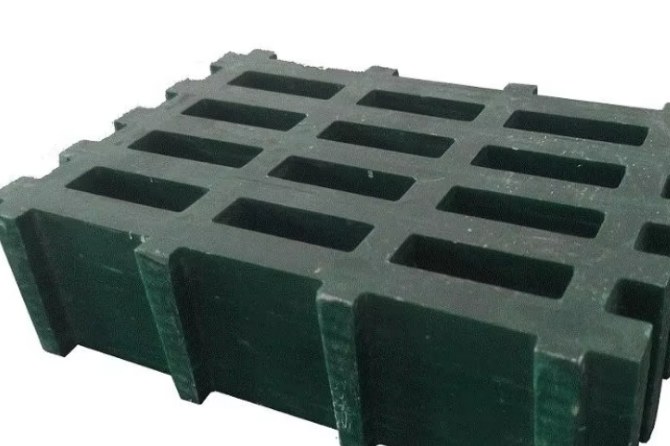
An FRP grating load table looks simple — a grid of numbers that says a panel spans X metres and carries Y kilonewtons. Read it naively and you will either overspend on a grating you did not need or undersize a walkway that flexes alarmingly under a loaded trolley. The table is a contract between the manufacturer's test method and your site's real loads, and the skill is reading the conditions behind the numbers.
This guide explains how FRP grating load tables work, the difference between uniform and concentrated loads, why deflection is usually the real limit, and what to check before you trust the number.
1. The Two Numbers in Every Table
| Rating | What it means | Typical presentation |
|---|---|---|
| Uniform load | Load spread evenly over the panel (kg/m² or kPa) | Safe uniform load for each span |
| Concentrated load | A point load at the worst position — usually mid-span (kg or kN) | Safe concentrated load per span, often with a wheel/person assumption |
Both are quoted at a deflection limit — commonly L/100 (span divided by 100) for walkways. That limit, not the strength of the glass, is what usually caps the safe load.
2. Molded vs Pultruded Grating Behave Differently
- Molded grating has roughly balanced strength in both directions, so its table is simpler and it carries well on four-edge support or with cut-outs near panels.
- Pultruded grating is much stronger along the bearing bars than across them — the table assumes the load spans across the bearing bars, with support at each end. Turn it 90° and the safe load drops sharply.
Confirm with the manufacturer which direction your installation spans, and never treat a pultruded panel as square in both directions.
3. Reading an Example Row
A typical molded-grating row might read: "38 × 38 × 38 mm panel, simply supported, span 600 mm — safe concentrated load 6.3 kN at L/100 deflection." Breaking it down:
- 38 × 38 × 38 mm — mesh size, bar height and bar thickness (a deeper bar stiffens the panel).
- Simply supported — the test assumes a clean support at each end; a support that only catches half the bearing bar reduces the real capacity.
- Span 600 mm — the unsupported distance; the safe load falls as the span grows, roughly with the inverse of the span for deflection-limited cases.
- 6.3 kN at L/100 — the load that produces 6 mm deflection on a 600 mm span. If your application tolerates less movement, the allowable load drops.
4. Deflection Is the Real Limit
FRP's stiffness is about one-tenth of steel, so grating rarely fails by breaking — it fails by flexing beyond what is safe or comfortable. Consequences for the specifier:
- Choose the span from the deflection-limited column, not the strength column.
- For equipment access with trolleys or pallet trucks, use a tighter deflection limit (L/150 or less) and a heavier bar.
- Long unsupported spans need deeper bar sections (e.g. 40 or 50 mm high bars), not just thicker mesh.
5. Support Conditions and Cut-Outs
- Support the panel on both ends of the bearing direction with a minimum bearing length (typically 25–50 mm) on the frame.
- Four-edge support (framing under all edges) increases capacity; support clips at every bearing bar prevent lifting and vibration.
- Cut-outs for pipes and columns remove load path — frame the opening with a border or use a wider panel and cut only what is necessary, then clip around the edge.
6. Test Method and Safety Factor
Ask three questions about any load table:
- How was the panel tested? — as a simply supported beam, on a standard frame, or on four edges? The table only applies to that condition.
- Is a safety factor included? — some tables quote ultimate load, others a working load with a safety factor; never mix the two.
- Is the load at a deflection limit? — if no deflection is stated, the table is not complete enough to design against.
7. Specification Checklist
| Item | Example |
|---|---|
| Grating type | Molded, 38 × 38 × 38 mm, gritted surface |
| Span and support | 600 mm, simply supported on both ends |
| Design load | 5 kN concentrated + 5 kN/m² uniform |
| Deflection limit | L/100 walkway (L/150 for equipment access) |
| Fire class | Class 1 / self-extinguishing resin where required |
8. Common Specification Mistakes
- Using the strength column and ignoring the deflection column.
- Turning a pultruded panel 90° on site so it spans across the weak direction.
- Supporting panels only at two opposite corners of the frame and letting the rest hang.
- Comparing "ultimate" tables from one supplier with "working load" tables from another.
Browse our FRP grating and stair treads and the wider plates & gratings range; for the corrosion-versus-metal decision see FRP vs steel grating TCO.
Need help selecting FRP products?
Our engineers answer technical questions free of charge.
Ask an Engineer on WhatsApp