
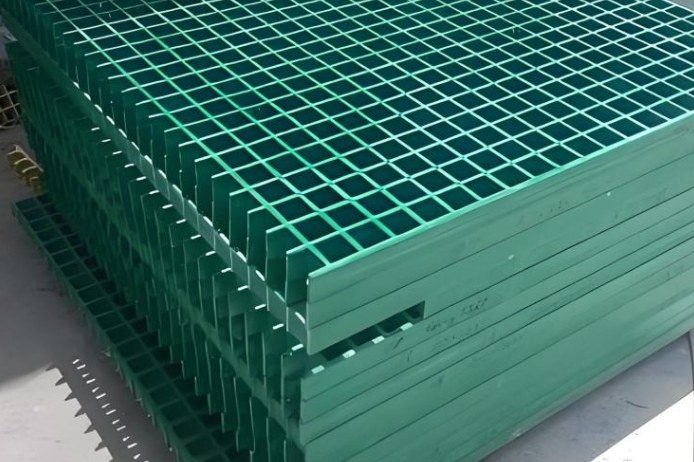
In a chemical plant, grating is bought once and paid for continuously. Galvanized steel grating is cheap on the invoice and expensive on the balance sheet: in an atmosphere of acid fumes, chlorides and wash-down chemicals, the zinc is consumed, the coating schedule begins, and the "cheap" grating starts costing money every year until it is replaced under a live process. FRP grating inverts the curve — a higher first cost and a near-zero maintenance cost for the life of the plant.
This guide compares FRP and steel grating on total cost of ownership (TCO) in chemical service, with the cost lines and lifetimes that procurement should model — not the price per square metre alone.
1. What TCO Actually Includes
| Cost line | Steel grating | FRP grating |
|---|---|---|
| Purchase price | Lower | Higher (2–3× typical) |
| Installation | Heavy — more cranage and labour | ~1/4 the weight — faster, cheaper install |
| Coating / protection | Galvanizing then repainting cycle | None — corrosion barrier is the material |
| Inspection & repair | Coating surveys, touch-up, section replacement | Visual checks; localized repair rare |
| Replacement | Typical 5–15 years in aggressive chemical air | 25+ years in the same service |
2. How Chemical Atmospheres Kill Steel Grating
- Acid fumes strip the zinc — hydrochloric and sulphuric acid vapours convert the galvanizing to soluble salts, exposing bare steel within a few years in severe areas.
- Coating touch-up is a recurring event: surface preparation in a live plant (containment, permits, shutdown windows) makes each repaint several times more expensive than the paint.
- Corroded bearing bars lose load capacity silently — the grating that fails is not the one that looks rusted; it is the one thinned from underneath where nobody walks and nobody looks.
3. FRP Grating: No Coating, Because There Is No Steel
- Corrosion resistance is in the laminate — vinyl ester or polyester resin with the glass protected by a resin-rich surface; there is no coating with a finite life to fail.
- Integrated anti-slip — grit is bonded into the surface, so slip resistance does not wear away with the paint.
- Non-conductive and spark-resistant — valuable around electrical equipment and in classified zones where steel needs bonding and sparks are a hazard.
- Fire-retardant grades — self-extinguishing resin systems are available where the specification requires Class 1 flame spread.
4. A 15-Year TCO Sketch (1,000 m² Walkway, Aggressive Chemical Air)
| Line | Galvanized steel | FRP |
|---|---|---|
| Supply (indicative) | 1.0× (baseline) | ~2.2× |
| Install labour | 1.0× | ~0.6× (lighter panels) |
| Repainting cycles (15 yrs) | 2–3 full cycles + touch-ups | 0 |
| Section replacement (15 yrs) | Partial, in worst zones | 0 |
| Cumulative 15-year cost | Roughly equal or higher | Roughly equal or lower |
The crossover sits between year 5 and year 10 for most chemical service — beyond that, FRP is simply the cheaper grating. Model your own numbers: the two variables that change everything are the real repaint interval on your site and the cost of working in a live plant.
5. Where Steel Grating Still Wins
- Extreme point loads and impact — forklift aisles and heavy dropped loads; specify heavy-duty pultruded FRP or accept steel if impact is the dominant case.
- High-temperature service — steel retains strength well beyond the practical range of standard FRP resins.
- Fire-resistance requirements where structural integrity through a fire is the criterion, not just flame spread.
- Budget-constrained first builds where the client will not pay for 20-year economics — but document the recurring cost for them.
6. Specification Checklist for Chemical Service
| Parameter | Example |
|---|---|
| Resin system | Vinyl ester for acid/chloride service |
| Surface | Gritted anti-slip, quartz or alumina |
| Fire rating | Class 1 / self-extinguishing |
| Loads & span | Per load table at L/100 or tighter |
| Fixings | 316 stainless clips, full bearing support |
7. Cost-Comparison Mistakes
- Comparing purchase prices and calling it an analysis.
- Ignoring the site's real repaint interval — "maintenance-free for 20 years" is a steel-salesman phrase.
- Forgetting that light weight saves money on every lift, scaffold and man-hour.
- Specifying FRP for a pure impact case and blaming the material when it is the wrong tool.
For the correct way to read load and span data, see the FRP grating load table guide; browse our FRP grating and stair treads and the full plates & gratings range for chemical-service panels.
Need help selecting FRP products?
Our engineers answer technical questions free of charge.
Ask an Engineer on WhatsApp