
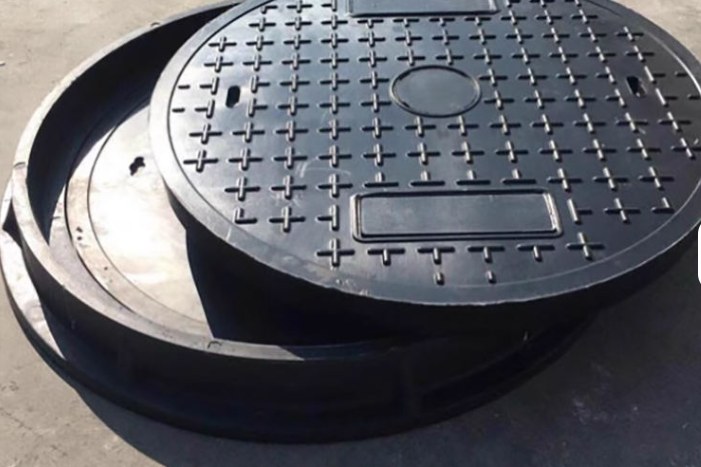
Every year cities lose thousands of covers to scrap thieves, crews strain their backs lifting 50 kg iron frames, and sewer gases eat castings thin from below. Those three problems — theft, weight and corrosion — are exactly where composite (SMC/BMC) manhole covers were engineered to win. Cast iron, meanwhile, still holds real advantages that a fair comparison should state plainly.
This guide compares FRP and iron covers on weight, load class, corrosion, theft resistance and seating behaviour, and ends with a checklist for municipal and industrial buyers.
1. Where the Two Materials Diverge
Cast iron is a metal with high stiffness and high scrap value. An SMC cover is a compression-molded composite: glass fibres in a thermoset resin, reinforced locally as needed. The composite is not "stronger" than iron in any single property — it wins by combining adequate strength with low weight, corrosion immunity and zero scrap value. Deciding between them is therefore a project question, not a materials rivalry.
2. Weight and Site Handling
Weight is the most immediate, measurable difference. A typical 600×600 mm D400-class cover illustrates it well:
| Cover (600×600, D400) | Typical weight | Handling |
|---|---|---|
| Cast / ductile iron | ~50–70 kg | Two-person lift or lifter bar mandatory |
| SMC composite | ~20–30 kg | One-person lift for most sizes |
Lighter covers mean faster inspections, fewer back injuries and no crane or lifter for routine utility work — a real cost saving repeated thousands of times across a network. (Figures are indicative; always confirm per size and class with the supplier.)
3. Load Classes and Testing
Load capacity is about the tested class, not the material name. Both iron and composite covers are made across the full range:
| Class (EN 124) | Typical application | Composite availability |
|---|---|---|
| A15 / B125 | Footways, gardens, car parks | Standard |
| C250 | Kerbside channels | Standard |
| D400 | Roadway carriageways | Standard (reinforced designs) |
| E600 / F900 | Docks, aircraft pavements | Limited — iron dominates |
For North American projects the equivalent benchmark is AASHTO HS-20/HS-25 loading. Ask for the actual test report (proof load at ultimate and service limit states), not a class stamp: quality varies widely between molding plants.
4. Corrosion: H2S and Biogenic Sulfide Attack
In sewers, sulfate-reducing bacteria convert sulfate in wastewater to H2S; aerobic bacteria above the waterline then oxidise it to sulfuric acid, which attacks cementitious and ferrous materials alike. Iron covers and frames thin, pit and seize in their seats after years of this attack, while FRP is unaffected by the pH range found in municipal sewers. For aggressive industrial effluent, composite also avoids galvanic interactions with nearby metalwork. If your network has documented sulfide problems, the frame deserves as much attention as the cover — composite frames solve the same problem.
5. Theft, Scrap Value and Locking
Cast iron has scrap value; SMC has none. That single fact removes the economic motive for cover theft — no resale channel exists for a used composite cover. Composites are also non-sparking and electrically non-conductive, which matters where covers sit near live cables or in explosive atmospheres. For high-risk locations, specify integrated stainless lock bolts or captive locking inserts either way: deterrence beats replacement.
6. Seating, Rattle and Acoustics
A cover's day-to-day quality is decided at the seat. Molded composite seats are machined to a close fit, so they resist rattle under traffic and do not ring when struck — the metallic "clang" of a loose iron cover is a common noise complaint on residential streets. Iron covers, by contrast, can develop rock and noise as seating surfaces corrode. On either material, insist on a machined (not as-cast) seat for trafficked roads.
7. Where Cast Iron Still Wins
- Extreme impact and point loads: ports, aircraft aprons and heavy industrial tracks still favour ductile iron's stiffness and ductility.
- Mandated specifications: some highway and utility standards still name ferrous covers only.
- Fire and hot-work exposure: where covers may contact welding slag or open flame, steel survives what a thermoset cannot.
- Very large or deep frames: structural iron remains the straightforward choice for oversized special chambers.
8. Specification Checklist
- Load class with test report (EN 124 class or AASHTO HS-20/25)
- Weight per size and one-person-lift limit confirmed
- Machined seat, and frame material matching cover
- Locking hardware specified for theft or tamper risk
- Chemical/pH exposure of the chamber reviewed
- Anti-slip surface texture and wear depth stated
9. Common Mistakes
- Buying composite covers for E600/F900 locations because a catalogue lists "heavy duty".
- Pairing a composite cover with a corroded iron frame and blaming the material.
- Comparing purchase price only — weight, theft losses and frame replacement dominate lifetime cost.
- Omitting lock bolts in theft hotspots, then losing covers within months.
See our SMC composite manhole covers, matching FRP drain grates and the full plates & gratings range; for whole-life cost thinking on adjacent products, read FRP vs steel grating total cost of ownership.
Need help selecting FRP products?
Our engineers answer technical questions free of charge.
Ask an Engineer on WhatsApp