
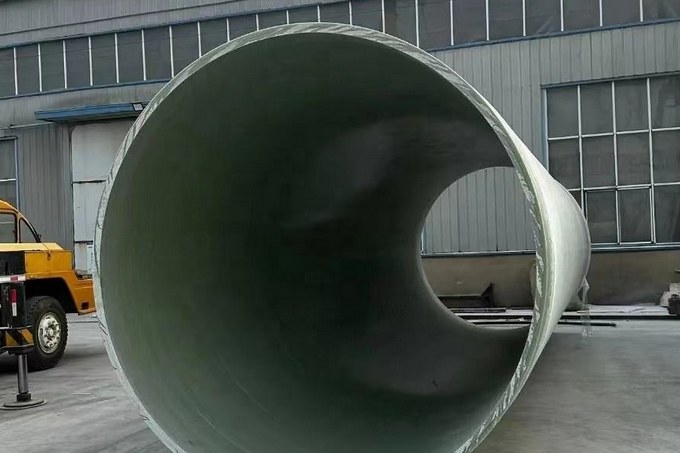
Two numbers define every GRP/FRP pipe on an order: the diameter, which is set by how much fluid must move and how fast, and the wall thickness, which must carry the internal pressure, resist external load and survive handling and installation. Get the first wrong and the line is permanently over- or under-sized; get the second wrong and the pipe either costs too much or fails in service.
Unlike steel pipe, where you pick a nominal bore and a schedule, FRP pipe is built to your numbers: the wall is a laminate that can be thickened or reinforced to suit the pressure class and stiffness you actually need. This guide explains how to arrive at both numbers correctly — and how to read the call-out on a quotation so you know exactly what you are buying.
1. Diameter: Start With Flow, Not Fittings
Diameter selection is a hydraulics exercise. For a given flow rate, a smaller pipe raises velocity, which raises friction losses and pumping energy; a larger pipe costs more and may run so slowly that solids settle or disinfectant residual decays. Practical velocity bands for FRP lines are:
| Service | Recommended velocity | Notes |
|---|---|---|
| Water mains and transfer lines | 0.9 – 2.4 m/s | Higher velocities raise surge pressure on pump start |
| Raw sewage and sludge | 0.9 – 1.8 m/s | Below ~0.9 m/s solids can settle; keep self-cleansing |
| Chemical / process lines | 1.0 – 3.0 m/s | Confirm with the resin supplier's erosion and chemical data |
| Gravity sewers (part-full) | Design for minimum scour velocity | Pipe is sized on slope and capacity, not pressure |
Calculate the minimum diameter from the design flow and an agreed velocity (Q = A × v), then check the head loss over the route length — a DN one size up can cut friction losses by half or more, so compare the pipe cost against the pumping energy over the line's life.
2. Reading a GRP Pipe Call-Out
A correctly specified FRP pressure pipe is described by at least four parameters, for example DN 300 · PN 10 · SN 5000 · AWWA C950:
- DN — nominal size. Confirm whether it refers to the nominal inside diameter (common for pressure pipe) or the outside diameter (common for sewer pipe). They are different pipes.
- PN — rated pressure class in bar (PN 10 = 10 bar working pressure).
- SN — ring stiffness in Pa (SN 5000 = 5,000 N/m²), set by the installation, not by the pressure.
- Standard — the design and test basis (AWWA C950, BS EN 1796, ISO 14692...).
3. Wall Thickness: What the Laminate Must Carry
An FRP pipe wall is a sandwich, and each layer earns its place:
| Layer | Typical role | Typical thickness (small/medium bore) |
|---|---|---|
| Inner resin-rich liner | Chemical barrier + smooth hydraulic surface | ~0.5 – 2.5 mm incl. C-glass or synthetic veil |
| Structural wall | Resists hoop stress from pressure; helical/hoop glass | Set by pressure + stiffness calculations |
| Outer layer / topcoat | UV protection and impact resistance (above ground) | ~0.5 – 1.0 mm gelcoat or veil layer |
The structural wall is sized so the hoop stress stays below the material's long-term design stress — the regression-tested strength divided by a design factor (commonly 6 or higher for pressure pipe, which is why burst pressure is typically 4–6× the rated pressure). The liner is not structural: it is there so the medium never touches the load-bearing glass.
4. Worked Example: Pressure to Wall Thickness
A simplified hoop-stress check gives the logic. For a thin-walled cylinder, hoop stress σ ≈ P × D / (2 t), where P is pressure, D the diameter and t the structural wall. Rearranging for the wall required by pressure alone:
t = P × D / (2 × σ_design)
Example: DN 400 (D = 0.4 m) at PN 16 (1.6 MPa), with a long-term design stress of, say, 25 MPa after applying the manufacturer's safety factor:
- t = 1.6 × 400 / (2 × 25) = 12.8 mm structural wall before adding liner and tolerances.
In practice the manufacturer's table will add the liner, the stiffness contribution and wall-thickness tolerance, so the ordered total wall will be thicker than the pure pressure number — that is normal, not padding. Always ask for the split between liner and structural wall on the datasheet.
5. Stiffness and Handling Often Set a Thicker Wall Than Pressure
For buried low-pressure and gravity lines, the ring stiffness (SN) requirement usually governs the wall, not the internal pressure. A deep cover, traffic loading or poor bedding demands SN 5000–10000 and a correspondingly thicker laminate. And even a pressure pipe needs enough wall to survive handling: lifting, lowering into the trench and backfilling without ovalizing. Do not shave wall thickness to save cost and then install a pipe that cannot survive its own erection.
6. The Liner Is Your Real Corrosion Protection
FRP does not corrode away like steel, but the medium will attack the glass fibres if it reaches them. The liner — resin-rich, reinforced with a chemical-grade veil — is what keeps the medium away from the structural wall. Two practical consequences:
- Specify the liner chemistry for the actual medium (isophthalic for water, vinyl ester for acids and solvents), not "standard liner".
- Protect cut ends and drilled holes on site with resin, or the exposed fibre ends become the entry point for wicking.
7. Tolerances and the Joint That Follows
Wall thickness and diameter tolerances matter most at the joint: couplings and bell-and-spigot joints depend on tight dimensional control. A pipe that meets its pressure class but has an out-of-tolerance outside diameter will leak at every coupling no matter how good the laminate is. Check the supplier's tolerance statement against the standard, and confirm that fittings come from the same laminate and dimension system as the pipe.
8. Diameter and Wall Specification Checklist
- Design flow (average and peak) and agreed velocity → minimum diameter.
- Route length and allowable head loss → check whether to step up a size.
- Working + surge pressure → pressure class (PN).
- Cover depth, traffic and soil → ring stiffness (SN).
- Medium chemistry and temperature → liner and resin system.
- Diameter convention (ID vs OD) and tolerances confirmed with the supplier.
- Datasheet must split liner / structural wall and state the design factor.
Related: our FRP pressure pipes and FRP water pipes are wound to your diameter, pressure and stiffness numbers; the full GRP/FRP pipes & fittings range covers couplings and fittings from the same laminate system. For the wider pressure, stiffness and joint background, read the GRP pipe specification guide.
Need help selecting FRP products?
Our engineers answer technical questions free of charge.
Ask an Engineer on WhatsApp