
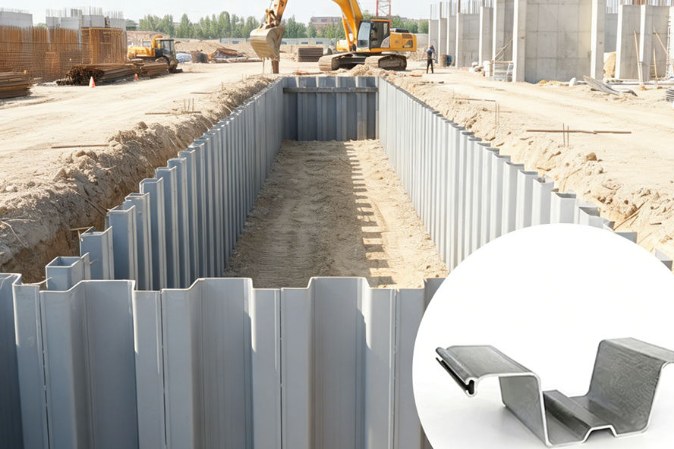
Sheet piling is usually a steel story: heavy sections, pile hammers, and a 20-year fight against corrosion — or a shorter one in marine and contaminated ground. Pultruded FRP sheet piles rewrite that story for the large class of walls that are modest in height but brutal on materials: flood defences, drainage margins, pump-station pits, waterfront edges and cut-offs through contaminated soil.
This guide covers where FRP sheet pile makes sense, how walls are sized and installed, and the details (interlocks, walers, caps) that decide whether the wall performs for decades.
1. Where FRP Sheet Pile Fits
FRP sheet piling competes best against steel, vinyl/PVC and concrete in specific niches. Against vinyl it offers far higher strength and stiffness, so it holds taller walls and survives handling. Against steel it offers immunity to rust, roughly one-quarter the weight (no crane on many sites), and no coatings to maintain. Typical services: canal and riverbank protection, flood walls, retaining margins along roads and parking areas, tank and pump-station pits, cut-off walls in contaminated ground, and marine works where splash-zone corrosion eats steel sections.
2. Profiles and the Numbers That Matter
| Profile family | Form | Typical service |
|---|---|---|
| U / hat section | Deep corrugated tray with interlocks on both edges | Cut-off walls, moderate retaining, general purpose |
| Z section | Z-shaped webs, efficient bending section | Taller cantilever and anchored walls |
| Wave / curved profile | Continuous wave form | Bank protection, facades, lighter walls |
| Connector / corner piles | Special corner and T pieces | Closing the wall geometry |
Wall capacity is quoted as section modulus per metre of wall (cm³/m) and allowable moment — compare suppliers at equal modulus, and check whether the value is the interlock-connected or the single-pile figure. Pile width is typically 400–600 mm, depth as required by design; lengths can be ordered cut-to-size or cut on site with standard carbide blades.
3. Design Basics: Height, Embedment, Groundwater
A sheet pile wall is a soil-structure interaction problem, and the governing numbers are embedment depth, retained height, water level difference and soil parameters. Broad brushstrokes for orientation: cantilever FRP walls commonly serve retained heights of roughly 1–3 m in competent soils; beyond that, or with a large water-level difference, the design moves to tied or propped systems. Drainage matters as much as strength — weep holes or granular backfill prevent water pressure building up behind the wall, and groundwater cut-off walls must be detailed for the uplift case. The embedment length and wall section must come from a geotechnical engineer's calculation for your actual soils; treat catalogue tables as pre-sizing, not design.
4. Interlocks: Slip vs Structurally Connected
Two interlock philosophies exist. A slip interlock (friction fit) lets adjacent piles move independently and relies on soil pressure for transfer — adequate for cut-offs and light walls. A structurally connected interlock transfers bending moment between piles, effectively making paired piles act as one deeper section — used for engineered retaining walls. Confirm which type your supplier quotes, because capacities differ several-fold and the difference is invisible in photos.
5. Installation Methods
- Excavator-mounted vibratory hammer: the standard method for FRP in soft to medium soils — fast, and the machine is already on site.
- Press-in / silent piling: for tight urban or vibration-sensitive sites.
- Pre-auguring or jetting: assists driving in dense sands or stiff clays; never force-drive FRP — a damaged tip means a rejected pile.
- Pitching in panels: set 3–5 piles in a guide frame, check line and plumb, then drive to final depth; panel driving keeps the wall straight.
- Water work: start from the deepest section and work outward; check interlock cleanliness before each placement.
6. Sealing the Interlock
For water cut-off or contamination containment, interlocks are sealed with factory-applied gaskets or site-applied sealant beads placed before driving. The seal rides with the pile as it interlocks, giving a continuous barrier. For flood walls, detail the capping beam junction carefully — the wall-to-cap joint is where most leaks appear, not the interlocks themselves.
7. Walers, Caps and Corners
Taller or tied walls use walers (horizontal beams) to spread anchor or prop loads — FRP, steel or concrete walers all work, with compatible bearing pads. A cap (concrete capping beam or pultruded cap profile) protects pile tops, ties heads together and gives the wall a finished line. Corners close with special corner piles or fabricated combinations; order them with the main piles so the geometry is proven before mobilisation.
8. UV, Temperature and Creep
Pultruded piles use UV-stabilised surfacing veils; decades of outdoor service are normal, and fading is cosmetic. Two engineering notes: sustained high lateral loads are resisted within creep limits verified in the section data — keep working stresses within the supplier's allowable values; and in fire-exposed locations FRP behaves as a thermoset (it will char), so combustible-construction rules apply where relevant.
9. Specification Checklist
- Profile type, section modulus (cm³/m, connected) and allowable moment
- Interlock type: slip or structural — with tested capacity
- Embedment and retained height from geotechnical design
- Resin system and UV surfacing for the exposure
- Interlock sealant/gasket for cut-off service
- Corners, walers, cap and anchorage hardware included
- Installation method agreed (vibratory / press-in) with tip protection
10. Common Mistakes
- Sizing FRP walls from steel-sheet-pile charts or vendor pictures.
- Force-driving through obstructions — FRP does not forgive what steel survives.
- Assuming all interlocks transfer moment.
- Skipping drainage behind a low wall and wondering about bulge.
- Ordering corners after the piles are cut.
See our corrosion-resistant FRP/GRP sheet piles, wave retaining sheet piles, marine sheet piling, U-type sheet pile and the wider profiles & structural components range; for the pultrusion process behind them, read our pultruded profiles application guide.
Need help selecting FRP products?
Our engineers answer technical questions free of charge.
Ask an Engineer on WhatsApp