
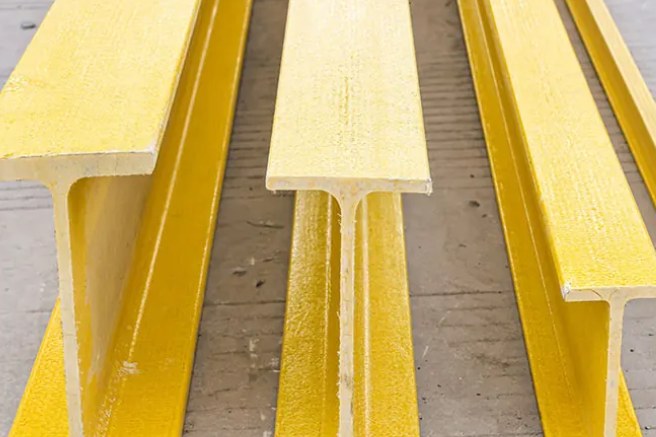
Pultruded FRP (fiberglass reinforced plastic) profiles are the structural workhorses of the composite world: continuous glass fibers pulled through a resin bath and a heated die, producing constant cross-sections — I-beams, channels, angles, tubes, bars and custom shapes — with excellent longitudinal strength and none of the corrosion that ends a steel structure's life early.
But a pultruded profile is not a black steel section. Its stiffness, connections and failure modes are different, and structures designed by copying steel span tables are the ones that disappoint. This guide covers what pultrusion makes, where these fiberglass structural shapes genuinely outperform metal, and the design and fixing rules that keep FRP structures safe for decades.
1. What Pultrusion Produces
| Shape family | Typical sections | Where it is used |
|---|---|---|
| Beams | I-beam, H-beam, wide-flange | Walkway joists, equipment supports, tank platforms, clarifier bridges |
| Channels | C-channel, U-channel | Cable tray runs, framed panels, edge protection, stringers |
| Angles | Equal / unequal leg | Bracing, trim, stiffeners, grating seating frames |
| Tubes | Square, rectangular, round | Columns, handrail posts, guardrails, lightweight frames, ladder rails |
| Flat / bar | Flat bar, rod | Brackets, wear strips, insulating separators, stays |
| Sheet piling | Z-type, U-type interlocking | Retaining walls, cofferdams, riverbank and marine protection |
| Custom | Any constant cross-section | Customer-specific stiffeners, glazing beads, electrical housings |
See how pultrusion compares with filament winding and molding for the process background — the key point here is that properties are directional: most glass runs along the profile, so strength is highest along its length and modest across it.
2. Where Pultruded Profiles Beat Steel and Aluminum
| Environment / requirement | Why FRP wins | Typical projects |
|---|---|---|
| Corrosive atmospheres | No rust, no painting cycle; resists salts, acids, alkalis and H₂S | WWTP walkways, chemical plant platforms, coastal structures |
| Electrical insulation | Non-conductive; no grounding needed; no eddy losses | Substation fencing, cable trench covers, switchgear supports |
| Weight limits | Roughly 1/4 the weight of steel — hand-carriable sections, no crane | Rooftop plant platforms, bridge decks, remote sites |
| Low maintenance | UV-stabilized surface, no repainting; lifetime cost wins | Handrails, ladders, gratings in public infrastructure |
| Non-magnetic / RF transparent | No interference with sensitive equipment | MRI surroundings, radar sites, laboratories |
When corrosion is the deciding factor, our pultruded FRP structural profiles typically show payback over galvanized steel within one or two repaint cycles.
3. Design Essentials: FRP Is Not Black Steel
Four differences drive every good FRP structure design:
- Stiffness, not strength, usually governs. FRP's elastic modulus is roughly 1/10 of steel. For the same load and span, an FRP section deflects far more — so designers step up section depth or add supports rather than copying steel tables.
- Orthotropic behavior. Properties along the pultrusion axis are 3–5× higher than across it. Bending a flat bar across its weak axis, or loading an angle on its leg tip, wastes most of the section's capability.
- Creep under sustained load. Long-term bending loads cause gradual extra deflection; keep sustained stress well below short-term capacity (a common rule is to size sustained load around 25–30 % of ultimate).
- Thin-wall local buckling. Wide thin flanges can buckle locally before the section reaches its bending capacity — follow the pultruder's allowable-load tables rather than scaling up from small samples.
Buyer tip: ask suppliers for property tables split into longitudinal and transverse values — a single "average" property sheet is a red flag that the profile was never properly tested.
4. Shape-by-Shape Application Notes
- I-beams and H-beams — the primary bending members: walkway joists, equipment skids, support frames. Span tables from the manufacturer beat generic rules; see our high-strength FRP I-beam.
- Angles — bracing, trims and stiffeners; seat grating on the horizontal leg, not the toe. Typical product: pultruded FRP angle profiles.
- Square and rectangular tubes — columns, posts and closed frames with good torsional stiffness; check the corners for resin-richness when loads are high: FRP square & rectangular tubes.
- Round tubes — handrails, guards and electrical insulation applications where a smooth cylindrical surface matters: insulating FRP round tubes.
- Guardrails and fencing — complete handrail systems for substations and power plants combine tubes, bends and insulating properties: FRP insulating power guardrails.
- Sheet piles — interlocking FRP sheet piling replaces steel sheet piles in waterfront and retaining applications where corrosion would eat a steel wall in years: FRP sheet pile retaining walls.
- Cable trenches and ducts — pultruded U-channels carry power cables with full insulation and no grounding: FRP cable trenches.
5. Fixings, Connections and Field Work
Most FRP structure failures happen at connections, not in the profiles. Field rules that prevent them:
- Use A4 (316) stainless bolts with washers roughly 2–3× the bolt diameter to spread bearing stress on the FRP face.
- Torque to the pultruder's values — over-torquing crushes the laminate, then the joint loosens as the material relaxes.
- Drill holes 0.8–1 mm oversize and keep edge distance at least 2× bolt diameter; never flame-cut — use carbide-tipped saw blades with dust extraction.
- Seal cut ends and drilled holes with resin or touch-up coat, especially in chemical service, to stop moisture wicking along exposed fibers.
- Slotted holes (or sliding connections) accommodate thermal movement; FRP's thermal expansion is close to steel, but long runs still need movement joints.
6. Standards and Data to Demand
- ASTM D3917 — dimensional tolerances of pultruded shapes
- ASTM D4385 — classifying visual defects in pultrusions
- Structural design guides — such as the ASCE "Pre-Standard for Pultruded FRP Structures" and Eurocomp, for load and safety-factor frameworks
- Fire performance — flame-spread data (ASTM E84) or self-extinguishing ratings; halogen-free / low-smoke resins are available for enclosed public spaces
- Batch documentation: glass content by burn-off, full-section flexural test reports, and UV/topcoat specification for outdoor use
7. Specification Checklist
| Parameter | Example entry |
|---|---|
| Environment | Coastal, salt spray, UV 8 h/day, −10 to +50 °C |
| Loads | Live 5 kN/m² walkway + 1 kN/m handrail line load |
| Spans & deflection limit | 1.5 m joist spacing, L/250 max deflection |
| Fire requirement | Flame spread < 25 (ASTM E84) or self-extinguishing |
| Surface & color | UV-stabilized gelcoat, RAL 7035, anti-slip grit walkway surface |
| Connections | 316 stainless, supplier-supplied torque table |
| Certificates | Glass content, full-section bending test, dimension report |
8. Common Specification Mistakes
- Copying steel span tables — deflection and creep, not strength, will embarrass you first.
- Loading sections across their weak axis because the drawing "looked right".
- Over-torqued or undersized-washer connections that crush and loosen within a year.
- Unsealed cut ends in chemical service, leading to fiber wicking and edge delamination.
- Accepting a single "average" property sheet with no longitudinal/transverse split and no batch test reports.
For a broader material decision, compare FRP vs stainless steel; for corrosion flooring that pairs with these structures, browse FRP plates and gratings.
Need help selecting FRP products?
Our engineers answer technical questions free of charge.
Ask an Engineer on WhatsApp