
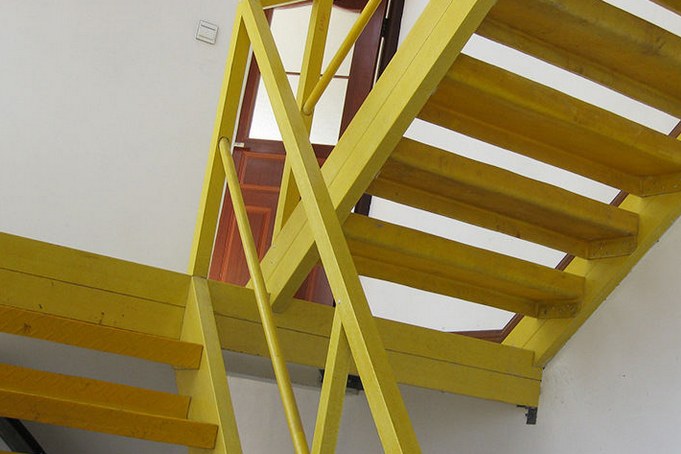
Stairs concentrate every slip-risk factor at once: a steep slope, a narrow contact patch, one hand briefly on a rail and attention on the load being carried. A fall on a stair is far more likely to cause injury than a slide on a flat walkway, which is why slip resistance deserves to be specified — not assumed — for FRP stair treads.
This guide explains how anti-slip performance is measured, how grit surfaces are built into molded and pultruded FRP treads, how to match surface to environment, and the details (nosing, span, fixings) that decide whether a tread stays safe after five years of traffic.
1. Why Stairs Are the Highest-Risk Surface
On a flat deck, a shoe slides forward and the walker usually recovers. On a stair, the leading foot lands on the nosing with the heel off the tread and the body's momentum already committed downward. Water, mud, ice or algae on a 25°-35° slope can turn that landing into a fall. Standards bodies therefore treat stairs separately from flat walkways, and specifiers should demand higher friction values for treads than for the adjoining platform.
2. The Test Standards Behind "Anti-Slip"
"Anti-slip" is a marketing word until it is tied to a number. Three test methods cover most FRP tread specifications:
| Standard | What it measures | How it is used |
|---|---|---|
| ASTM E303 (pendulum) | Slip resistance as Pendulum Test Value (PTV) using a rubber or leather slider | Site and lab verification; the value most walkway specs quote |
| ANSI A326.3 (DCOF) | Dynamic coefficient of friction on horizontal samples | Common in North American architectural specs (≥0.42 wet interior baseline) |
| EN 13036-4 / UKSRG bands | Same pendulum method, European reporting | PTV bands used to classify slip risk in the UK/EU |
When comparing suppliers, always ask which method, which slider (rubber 57 vs leather 96) and which condition — dry, wet or contaminated — the quoted value refers to. A "0.9 anti-slip" claim measured dry on a clean sample tells you little about an outdoor tread after rain.
3. How FRP Treads Build Grip
Molded grating treads get their grip from the manufacturing process itself: a meniscus (concave) top surface with quartz or bauxite grit embedded into the resin while it cures. Because the grit is locked into the laminate — not glued on — it wears with the surface instead of delaminating. Open-mesh profiles also let water, mud and snow drain straight through instead of pooling on the nosing.
Pultruded treads and covered panels are smooth as-extruded, so grip is added: a factory-bonded silicon carbide grit strip on the nosing zone, a full-width applied grit surface, or a nosing cover in a contrasting colour. Bonded systems are effective but are a consumable — plan inspection and replacement intervals from day one.
4. What PTV Numbers Mean in Practice
| PTV (pendulum) | Slip risk | Typical acceptability |
|---|---|---|
| 0–24 | High | Not acceptable for stairs |
| 25–35 | Moderate | Flat, controlled indoor areas only — marginal for stairs |
| 36+ | Low | Widely accepted target for stairs in wet conditions |
A well-made grit-surfaced molded tread typically tests well above 55 PTV wet when new; the specification question is what it tests after abrasion, UV and chemical exposure — ask for aged or worn-surface data, not just as-supplied values.
5. Matching Surface to Environment
- Indoor, dry, clean: fine-grit molded meniscus surface is usually sufficient; comfort underfoot matters for staff routes.
- Outdoor, rain and algae: coarse integrated grit plus open mesh for drainage; grit tape alone is a maintenance liability.
- Chemical washdown (CIP areas, plating shops): verify resin (isophthalic or vinyl ester) and grit binder against the chemical list; some grit adhesives fail before the FRP does.
- Oily zones (compressor rooms, workshops): specify the highest grit density and a cleaning regime — no surface survives oil film without housekeeping.
6. Nosing, Span and Fixings
Grip fails as often from poor detail as from weak surface. Keep three points in mind. First, nosing: a contrasting (usually yellow) nosing or nosing strip improves visibility and positions the foot; it is part of most stair codes, not a decoration. Second, bearing: a grating stair tread should bear at least 25–40 mm on each stringer — short bearing is the classic cause of "loose sounding" treads. Third, fixings: use the supplier's Z-clips or bolt-down cleats at both ends; a tread held only by gravity will work loose, rattle and eventually tip.
7. Load Notes for Stair Treads
Stair loads are point loads — a foot, then a loaded person — applied across a short span, so tread selection is usually governed by deflection feel rather than ultimate strength. Molded 38 mm grating treads and pultruded panels both serve typical 600–1000 mm stair widths, but span capability differs sharply between the two. Read the supplier's load table the same way you would for flat grating; we explain that method in our FRP grating load tables guide.
8. Keeping the Grip: Wear and Maintenance
Integrated grit wears with the resin, so the surface keeps its profile for years; the enemies are instead clogging (mud packed into mesh), film contamination (oil, grease, process dust) and mechanical damage from dragging steel over the nosing. Sweep in winter, hose in summer, and re-test high-traffic stairs with a pendulum once a year — five minutes per flight buys you the data to defend the specification.
9. Specification Checklist
- Test method and condition quoted (ASTM E303 PTV wet, or DCOF per ANSI A326.3)
- Grit type and integration method (embedded vs bonded)
- Resin system matched to chemical exposure
- Nosing colour/contrast and fixing system included
- Bearing length on existing stringers confirmed
- Aged or in-service friction data, not just as-new values
10. Common Mistakes
- Specifying "anti-slip" with no test method or condition attached.
- Using grit tape as the primary surface outdoors, then discovering it lifts after one winter.
- Ordering pultruded panel treads smooth and planning to "paint on grip" on site.
- Ignoring bearing length, so treads sit on the mesh instead of the edge.
- Comparing a dry PTV from one vendor with a wet PTV from another.
Browse our FRP grating and stair treads within the wider plates & gratings range; for material choice see FRP vs metal grating and the load table reading guide.
Need help selecting FRP products?
Our engineers answer technical questions free of charge.
Ask an Engineer on WhatsApp