
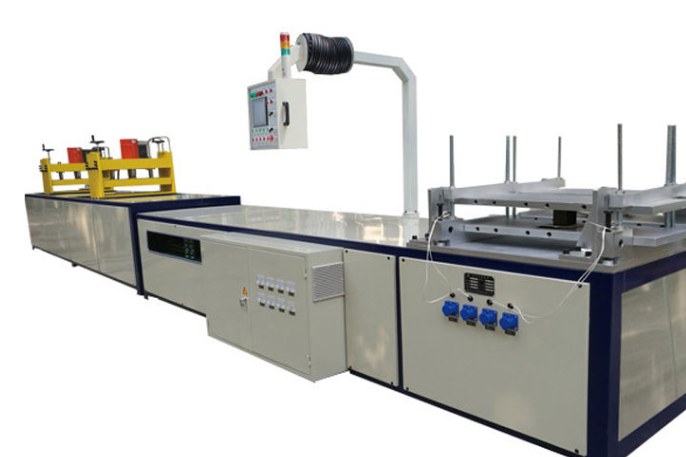
GFRP rebar has moved from niche to specification: non-corroding reinforcement for bridges, marine structures, tunnels and slabs exposed to chlorides. But the market now spans excellent bars and dangerous ones, and the difference is made in two places — raw material selection and the QC discipline behind the pultrusion line. This guide covers both, with the test list that separates a real producer from a re-seller with a machine.
1. The Material System
GFRP rebar is pultruded from continuous glass fibres in a thermosetting resin, with a surface deformation (sand coating or ribbed spiral) for bond to concrete. Typical composition: 75–82% glass by weight, the balance resin and additives. Every durability claim reduces to one question — how the glass and resin survive the high-pH concrete environment over decades.
2. Glass Selection: Why Alkali Resistance Decides Everything
Ordinary E-glass loses strength in alkaline pore water: hydroxyl ions attack the silica network, etching fibres within the matrix. Rebar-grade production therefore uses AR-glass (alkali-resistant, zirconia-modified) or at minimum verified-durable E-CR glass. Resin choice pairs with it: vinyl ester is the default matrix for its hydrolysis resistance; polyesters are the economy option with real durability trade-offs. If a supplier cannot name the glass type and resin system in writing, walk away — this single disclosure predicts field performance better than any brochure.
3. The Pultrusion Line for Rebar
Rebar runs on multi-die pultrusion lines: fibre rovings and mats are wetted, formed around a central forming core that creates the bar's rod body, cured through heated dies, pulled continuously, and surface-treated in-line — spirally wound rib yarn and/or sand coating applied at a sanding station before or after a secondary curing section. Lines then cut to length (3–12 m typical). The continuous nature means quality is statistical: every metre must be assumed sold, so process stability, not end-of-line inspection, carries the quality burden.
4. Process Variables That Move Properties
| Variable | Effect if wrong |
|---|---|
| Glass content (target 75–82% wt) | Low glass = low tensile capacity, higher creep |
| Die temperature profile | Under-cure = soft bars, poor sand adhesion; over-cure = brittle |
| Pull speed | Too fast starves cure at the core |
| Fibre alignment & tension | Poor alignment drops tensile strength; loose rovings give fuzzy bars |
| Sand application | Uneven coating = bond failure in pull-out tests |
5. Standards and What They Require
| Standard | Coverage |
|---|---|
| ASTM D7957 | US material spec for GFRP bars: tensile, transverse shear, bond, dimensions |
| ACI 440.6 / ACI 440.1R | Specification and design guidance for FRP reinforcement |
| CSA S807 (Canada) | Manufacturing and durability requirements incl. alkaline resistance |
| ISO 10406-1 | Test methods for FRP bars |
6. The QC Checklist That Matters
| Test | Frequency | Catches |
|---|---|---|
| Tensile strength & modulus (per ASTM D7205-style) | Per batch/shift | Glass content, cure, fibre alignment errors |
| Barcol hardness | Every bar length (fast) | Under-cure in seconds |
| Glass content by burn-off | Daily | Resin drift, roving starvation |
| Transverse shear | Per batch | Matrix/interphase quality |
| Bond (pull-out) test | Periodic + after sand changes | Surface deformation adequacy |
| Durability (alkaline immersion retention) | Type testing / periodic | Glass & resin durability claims |
| Dimensions & straightness | Continuous visual + gauges | Die wear, rib pitch variation |
7. Reading a Supplier's Certificate Like an Auditor
Three tells of a serious producer: the certificate names glass type (AR/E-CR) and resin system, not just "GFRP"; tensile results are reported as mean and characteristic value with test method references, not a single hero number; and durability (alkaline resistance per CSA S807-style retention tests) appears in the type-test file. Ask also which parameters are measured per batch versus per year — batch-tested tensile with daily burn-off is the operating discipline that keeps type-test claims true.
8. Handling, Storage and Site Notes
GFRP bars are light and corrosion-proof but vulnerable to abuse: avoid dragging over sharp edges (fibres are strong along the axis, brittle across), stack on flat bearers out of prolonged direct sun, and cut with abrasive or diamond blades — no rebar cutters that crush the matrix. Bars must not be bent after curing; bent shapes are produced to order during manufacturing, so order couplers and stirrup shapes with the straight bars.
9. RFQ Checklist for Buyers
- Glass type (AR / E-CR), resin system, and glass content by weight in writing
- Governing standard and test reports: tensile per batch, bond, alkaline durability
- Bar sizes, densities and characteristic tensile values per size
- Surface type (sand-coated / ribbed) and bond test data
- Bent shapes and couplers quoted with the straight bars
- Factory audit or third-party inspection option
10. Common Mistakes
- Buying on tensile hero numbers without durability data — the bar corrodes chemically, not mechanically.
- Assuming "GFRP" is one material; AR-glass/vinyl-ester and E-glass/polyester are different products.
- Ordering bent shapes late — they cannot be formed on site.
- No batch traceability, so a field failure cannot be isolated to a production day.
See our GFRP rebar pultrusion lines, rebar rod production machines, anchor bolt pultrusion lines (4–32 mm) and the full machinery & production lines range; related: pultrusion machine guide.
Need help selecting FRP products?
Our engineers answer technical questions free of charge.
Ask an Engineer on WhatsApp