
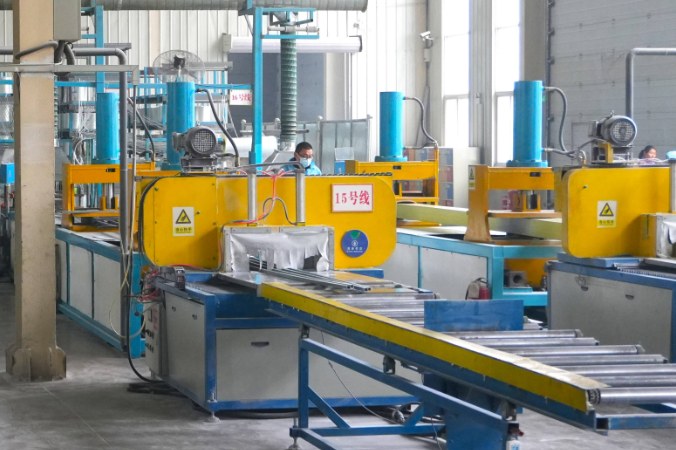
A pultrusion line looks simple — fibres go in one end, profiles come out the other — but everything that decides profit and quality lives in three places: the die's heating zones, the pulling system, and the die itself. Buyers who understand those three can read a machine quotation critically; those who don't end up comparing frame weights. This guide explains each element and what to verify before purchase.
1. Anatomy of a Pultrusion Line
From back to front: a creel holding fibre rovings and mats; a resin bath or injection box for wet-out; preforming guides that shape the wet fibres; the heated die where cure happens; one or more heating zones along the die; the pulling system (clamps that grip and advance the profile); and a flying or reciprocating cut saw with length control. Supporting systems: resin circulation, temperature control, extraction for styrene vapours, and the control PLC tying it all together.
2. Heating Zones: Where Cure Is Won or Lost
The die is heated in zones — typically two to four along its length — with setpoints roughly in the 120–180°C band for polyester resins and lower for vinyl ester and epoxy systems. The principle: zone 1 preheats and activates the initiator, middle zones drive the cure front, and the exit zone finishes the surface. Temperature profile must match the resin chemistry and line speed together; the same die at two speeds needs two profiles. Quality indicators of a good thermal design: multiple independently controlled zones, thermocouples positioned in the die body (not just the heaters), and a controller that logs profiles — because when surface quality drifts, the fix is in the zone data.
3. Pulling Speed: Throughput vs Cure Quality
| Section type | Typical line speed | Limiting factor |
|---|---|---|
| Small solid rods | ~0.5–1.5 m/min | Heat penetration to core |
| Standard profiles (angles, tubes) | ~0.3–0.8 m/min | Cure completion at exit |
| Large / thick sections | ~0.1–0.4 m/min | Exotherm control, core under-cure |
Speed is the temptation that ruins quality: push past the cure window and you get gummy cores, dimensional drift and post-cure warp. The right question for a machine vendor is not "how fast" but "how fast at my heaviest section with my resin, verified by a DSC or hardness check at exit."
4. Dies: Design, Materials and Life
The die is precision-machined hardened steel, typically 600–1,200 mm long (longer for thick sections to complete cure), with cavity surfaces hardened and polished — often chrome-plated — to survive abrasive glass contact. Die design encodes shrinkage, draft and resin injection points where applicable. Dies last for very long production lives with care; their enemies are scratch damage during threading and local overheating from a failed zone. When buying a line for custom profiles, treat die supply as part of the package: who machines them, what the lead time is, and what re-polishing service exists.
5. Resin Bath vs Injection Box
The classic open bath wets fibres in a resin tray before the die — simple, cheap, and messy: styrene evaporation, frequent cleanup, and open resin inventory. An injection box meters resin directly into the fibre bundle at the die entrance — lower VOC, less waste, cleaner product and faster steady-state changeovers. Injection dominates new lines in Europe and North America; baths remain common where capital is tight and styrene management is handled by extraction. Whichever you choose, resin hold-up volume and changeover procedure deserve a demo during acceptance.
6. Clamping and Pulling Systems
Two families: reciprocating clamp-pullers (grip, pull, return — strong grip for heavy sections, slight pause at turnaround) and continuous caterpillar tracks (constant motion, ideal for high-speed small sections). Clamping pressure must be adjustable and pad surfaces matched to profile geometry — crushed corners on hollow sections are the classic sign of wrong pads or pressure. The cut saw must synchronise with line motion (flying cut) so lengths stay consistent at speed.
7. Automation and Control
Modern lines close the loop: die temperatures auto-trimmed against exit-cure feedback, line speed synced to pull force trends (rising pull force flags friction or cure drift), and cut-to-length managed by the PLC with batch counting. Ask for the data layer — logging zone temperatures, speed, force and length to export — because that history is how you qualify new resins and debug quality issues in days instead of weeks.
8. Machine Selection Checklist
| Specification | What to verify |
|---|---|
| Pulling force & clamp type | Sized to your heaviest section; pads for hollow profiles |
| Heating zones | Count, independent control, logging |
| Die supply | Who machines, lead time, re-polish service |
| Resin system | Bath or injection; styrene management |
| Cut system | Flying saw accuracy at line speed |
| Throughput proof | Speed at YOUR section + resin, with cure verification |
9. Commissioning, Spares and Training
Acceptance should be a production run of your profile, not a demo part: dimensional report, surface check, and post-cure verification. Confirm spares for wear items — clamp pads, saw blades, heaters, thermocouples — with lead times, operator training for both running and die-change procedures, and remote support. Pultrusion rewards disciplined houses; the machine vendor's training quality shows up in your scrap rate for the first year.
10. Common Buying Mistakes
- Comparing machines by frame size instead of thermal design and control quality.
- Buying bath lines while planning for VOC limits that require injection.
- No acceptance run on the buyer's own profile and resin.
- Treating dies as an afterthought — lead times shape your product roadmap.
- Ignoring extraction and styrene compliance until the inspector arrives.
See our pultrusion production lines, fully automatic profile lines, GFRP rebar pultrusion lines and the full machinery & production lines range; related reading: custom pultruded profiles guide and the pultruded profiles application guide.
Need help selecting FRP products?
Our engineers answer technical questions free of charge.
Ask an Engineer on WhatsApp