
Cables are a fire's favourite highway: plastic jackets burn, flame spreads along trays through walls and floors, and a single burning route can take out power, control and safety circuits in one event. Active systems (sprinklers, suppression) react; passive fire protection (PFP) builds the resistance into the installation so spread never starts and penetrations never open. This guide covers the passive toolkit — coatings, blankets/wraps, penetration putty and barriers — and the standards behind them.
1. The Failure Chain You Are Breaking
Unprotected, a cable fire follows a script: local ignition (overload, joint fault) → flame spreads along grouped jackets → hot-gas layer in the tray corridor ignites the next group → fire penetrates walls through cable penetrations → circuits fail in cascade. Passive measures interrupt this chain at three points: on the cable surface (coatings/wraps), at penetrations (seals), and along the route (barriers and segregation).
2. The Passive Toolkit
| Product | Function | Typical standard test |
|---|---|---|
| Intumescent cable coating | Char layer stops flame spread along jackets | IEC 60332-3 style grouped-flame tests |
| Ceramic fiber wraps/tapes | Thermal barrier for single runs & circuits | Furnace curve wrap tests (e.g. UL 2196-style circuit integrity) |
| Putty pads / sealants | Re-seal cable penetrations through walls/floors | EN 1366-3 / ASTM E814 (UL 1479) |
| Coating mortars / bags | Large or frequently-opened penetration seals | EN 1366-3 with cable loading |
| Fire barriers / stops | Section the tray route | Route-level furnace tests |
3. Cable Coatings: Cheap Coverage, Verified by Test
Intumescent coatings (applied by brush/spray to installed trays) swell into an insulating char in fire, breaking the flame-spread chain along grouped cables. They add millimetres, not construction work — the most economical route-wide measure. The discipline is in application: jacket must be clean, thickness verified with a gauge (usually 0.5–1.5 mm systems), and the specific coating's test report must match the cable grouping and tray configuration on your site. Coating replaces neither segregation nor penetration sealing; it complements them.
4. Wraps and Blankets: Circuit Integrity Where It Counts
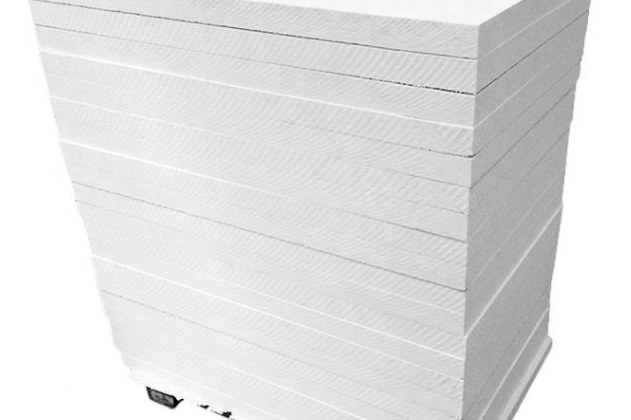
When specific circuits must keep working through a fire — fire-pump feeders, emergency lighting, control to shutdown valves — ceramic fiber tapes and blanket wraps buy time-rated circuit integrity. Wrapping a feeder in high-temperature ceramic fiber tape inside conduit or on tray delays conductor temperature rise past the melt point of the insulation for the rated period. For higher ratings, cables run inside protected channels or buried in cabinets lined with ceramic fiber boards. Match the wrap to the circuit's required survival time, not to a generic "fireproof" label.
5. Penetration Seals: Where Most Installations Fail
Every cable pass through a wall or floor is a hole that fire and smoke will find. Penetration seals — putty pads for small grouped penetrations, sealant/mortar/bag systems for larger openings — restore the wall's rating around the cables while remaining re-openable for future cabling (a genuine advantage of putty pads: add a cable, re-knead, re-seal). The non-negotiable rule: use a tested system for the actual penetration configuration (cable count, tray size, wall type) — an untested combination is an unrated wall.
6. Route Design: Segregation Beats Everything
The cheapest passive protection is routing: separate safety-critical circuits from general power (different trays, rooms or routes), section long tray runs with fire barriers at fire-compartment boundaries, and keep cable corridors clear of combustible storage. Where routes must coexist, physical barriers between tray groups plus coated jackets give a defensible layered design. Enclosed cable routing in non-combustible channels (for example, FRP cable trenches) adds corrosion-free physical protection along the same logic.
7. Standards Map
| Standard | Covers |
|---|---|
| IEC 60332-1 / -3 | Flame spread on single / bunched cables |
| EN 1366-3 + EN 13501-2 | Penetration seal fire testing and classification |
| ASTM E814 / UL 1479 | Through-penetration firestop tests (US) |
| UL 2196 / equivalent | Circuit integrity of fire-resistive cable systems |
8. Specification Checklist
- Circuits classified: which must survive fire, for how long
- Coating system with thickness spec and grouped-cable test report
- Wrap/circuit-integrity products rated to the required survival time
- Penetration seal schedule: every opening, wall type, tested system reference
- Barrier positions at fire-compartment boundaries
- Maintenance rule: every new penetration re-sealed same-day, logged
9. Common Mistakes
- Coating applied to dusty jackets — it delaminates and takes nothing with it.
- Penetrations foamed with generic filler — foam burns; use tested firestop systems.
- "Fireproof" wraps with no circuit-integrity rating.
- Barriers installed but cable groups re-merged downstream.
- No re-seal discipline after later cabling work.
See our 1260°C ceramic fiber blankets for wrap and barrier insulation, rock wool boards for barrier infill, and the full refractory & fireproof materials range; related: ceramic fiber forms guide.
Need help selecting FRP products?
Our engineers answer technical questions free of charge.
Ask an Engineer on WhatsApp