
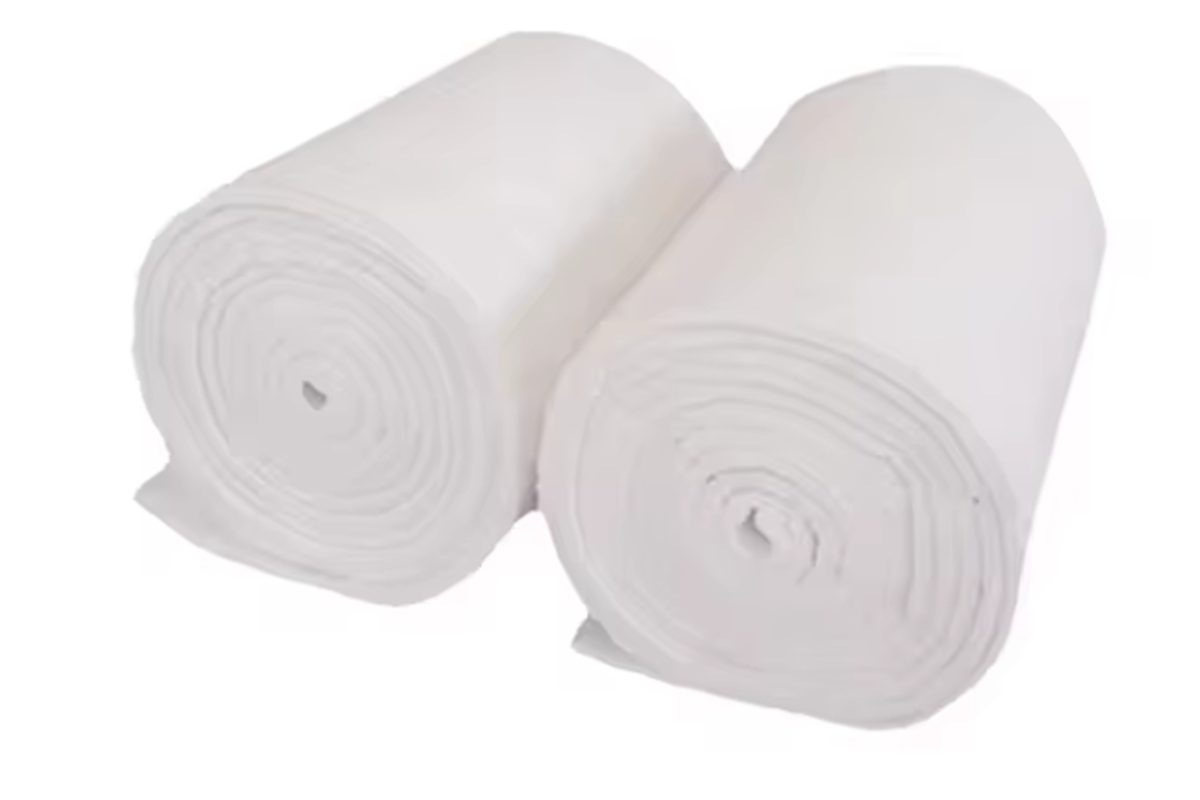
Furnace linings get the attention, but thin ceramic fibre products quietly do the jobs that keep furnaces tight: the gasket under an inspection door, the expansion joint between castable panels, the seal around a thermowell, the curtain across a rotary kiln inlet. Paper, cloth, tape and rope are the smallest line items in a refractory package and the most common cause of "small" problems - smoke at a door edge, a hot spot at a joint, a cracked panel corner - when chosen or fitted carelessly.
1. The Product Family and What Each Does
| Product | Typical Thickness | Typical Jobs |
|---|---|---|
| Ceramic fiber paper | 1-6 mm | Joints between boards, gaskets, backing strips, combustion-chamber seals |
| Fibre cloth / fabric | 1.5-3 mm | Door seals, flexible connectors, curtains, welding blankets |
| Tape (with wire or fiberglass insert) | 2-5 mm | Wrapped joints, lagging, firestop packing |
| Twisted rope / braided square rope | 6-50 mm | Expansion joints, door and damper seals, kiln car seals |
| Vacuum-formed shapes | Custom | Complex gaskets and burner sealing rings |
Standard alumino-silicate fibre grades serve to 1260 C continuous; high-alumina and zirconia grades extend to 1400-1600 C; biodegradable sol-free grades exist where worker-exposure rules demand them. Reinforced textiles use fiberglass or Inconel wire inserts - the insert sets the temperature ceiling of the textile, not the fibre.
2. Density and Compressibility: The Selection Logic
Seals work by compression, so density and compressibility drive selection. Low-density paper (150-200 kg/m3) compresses easily and fills wide, sloppy gaps but has little strength; higher-density paper (250-350 kg/m3) resists gas flow and erosion but needs more closing force. For a bolted gasket joint, choose a density and thickness combination that compresses 20-30 percent at the available bolt load - a 3 mm paper compressed to 2.2 mm seals far better than an 8 mm rope crushed to 3 mm in a joint designed for paper. For expansion joints, the rule inverts: the rope must be oversized (30-50 percent larger than the gap) so it stays in compression across the full thermal cycle.
3. Expansion Joint Design Practice
Castable and board linings need joints every 1.5-2 m in both directions; the joint is filled with ceramic fibre paper or rope compressed into the gap, so adjacent panels can move independently through heat-up and cool-down. Practical points: fill the joint full-depth, not just the face - a shallow fill lets debris pack in and bridge the panels; rope diameter roughly 1.3-1.5x the gap width; and around penetrations (burners, thermowells, doors) joint collars go in before the lining is cast or fixed, because retrofitting a joint into a cracked panel is a repair, not a joint.
4. Gasket Joints: Doors, Dampers and Casings
| Application | Recommendation | Watch-Outs |
|---|---|---|
| Inspection doors to 900 C | 3-5 mm paper strip or square rope in retained groove | Groove depth = 60-70% of rope diameter |
| Damper blades in hot gas | Fibre rope with wire insert, replaceable per shutdown | Gas velocity erodes exposed fibre edges |
| Casing flanges (cold side) | 2-3 mm paper with adhesive tack | Verify bolts pull flanges flat before cure |
| Kiln cars / bogies | Braided square rope, mechanical retaining strip | Abrasion from rails; inspect per cycle |
| Flexible connectors | Fibre fabric bellows with clamping bands | Insert wire sets the max temperature |
Where the media is gas at velocity, protect exposed fibre edges with a metal retention strip; where the joint is walked or brushed, the same applies - fibre products seal beautifully and abrade just as beautifully.
5. Handling, Cutting and Fixing
Thin fibre products cut with a sharp knife and straightedge - no power tools needed, and blades stay sharp. Handle sheets flat; paper tears from a corner faster than it cuts. Fixing: water-based ceramic adhesive for permanent joints, mechanical retaining strips where movement or service replacement is expected, and tack welding of wire-insert tape ends where the substrate is steel. Store products dry and flat; fibre paper that has taken a moisture set or a corner crease never lies flat again in the joint.
6. Firestop and Passive Protection Uses
The same fibre textiles serve passive fire protection: packing cable penetrations through fire-rated walls (with the certified backing material system - fibre alone is not a rating), wrapping plastic pipe penetrations where the system calls for it, and smoke-seal applications at high temperature. The rule that keeps inspectors friendly: firestop uses follow a listed system drawing exactly; improvising with generic rope converts a certified installation into an unverified one, whatever the material.
7. Common Failures and Fixes
| Failure | Cause | Fix |
|---|---|---|
| Door seal gone in weeks | Exposed rope abraded by door movement | Retain with metal strip; check door alignment |
| Joint panels cracked at corners | Joints omitted or under-filled | Full-depth fibre fill, collars at penetrations |
| Smoke at flange of new casing | Paper too low density for gap; bolts not drawn flat | Higher-density paper, verify flange flatness |
| Textile fell apart at temperature | Fibreglass insert near its limit | Inconel insert or monolithic rope |
| Shrinkage gaps after first firing | Contraction of unfired fibre at joint faces | Pre-fire joints where possible; pack second pass |
Small products, big consequences: specify fibre sealing goods with the same seriousness as the lining, and the furnace stays tight from the first heat-up.
Related reading: fibre blanket vs board vs module, refractory anchor systems, and our 1260 C ceramic fibre blanket.
Need help selecting FRP products?
Our engineers answer technical questions free of charge.
Ask an Engineer on WhatsApp