
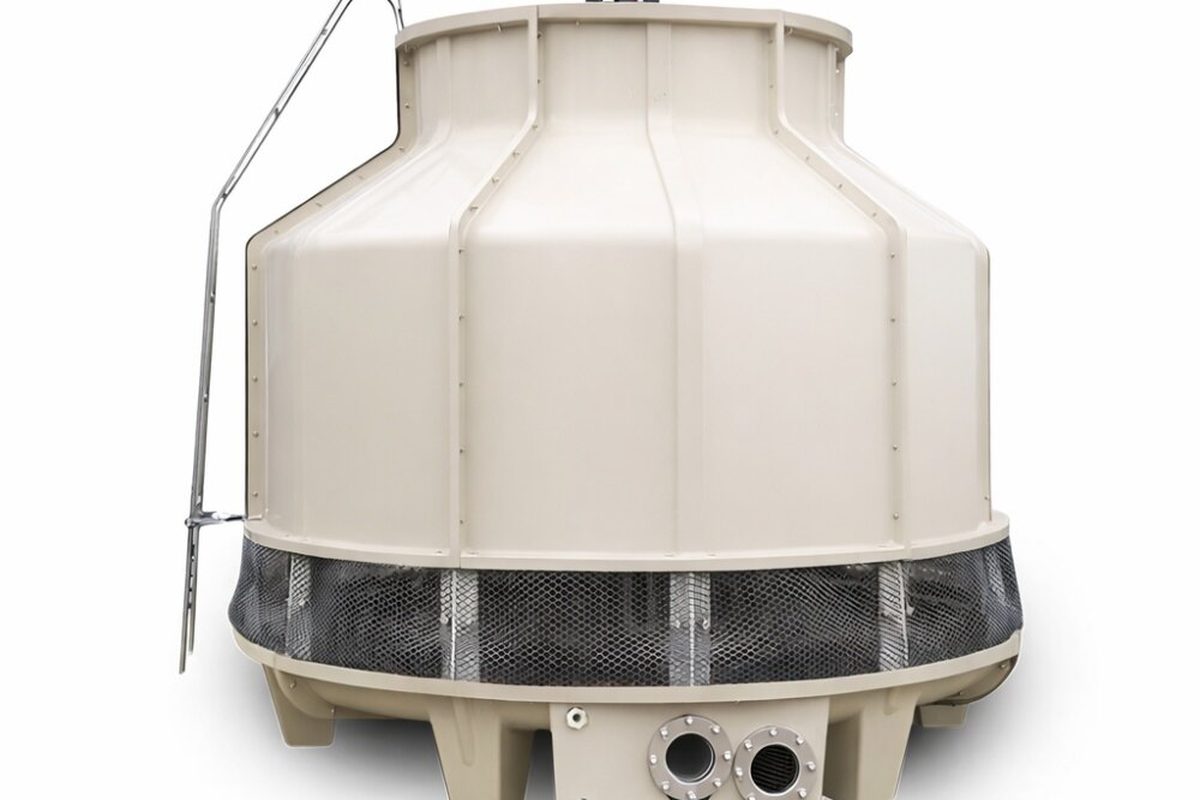
Summer is when cooling towers work; winter is when they break. Ice in a tower is not just an operational nuisance - it bends fill packs, splits basin walls, seizes fans and tears louvres off their clips. The physics is unforgiving: a tower is a machine that maximises air-water contact, and in freezing weather that same contact surface is an ice factory. Winterization is therefore a design task with two distinct cases - towers that shut down for the season, and towers that must keep running through it.
1. Where Freezing Actually Damages a Tower
| Location | Freeze Mechanism | Result |
|---|---|---|
| Fill pack | Low water flow + high air = ice bridges between sheets | Collapsed or blocked fill, maldistribution after thaw |
| Basin and walls | Static water freezes, expands against FRP | Cracked basin, distorted walls, failed seams |
| Distribution system | Water standing in headers, spray nozzles, pumps | Split pipes, cracked nozzles, seized pump seals |
| Louvres and air path | Recirculated moist air condenses and ices on louvres | Torn louvres, blocked air inlets, structural loading |
| Fan gearboxes | Condensation in oil, ice in bearings | Gear damage at first spring start |
FRP basins themselves tolerate cold well - the material is not the problem - but FRP is not elastic enough to survive a solid basin of expanding ice, and everything mechanical attached to the tower is far more vulnerable than the casing.
2. Seasonal Shutdown: The Drain-Down Strategy
For towers that stop in winter, the design rule is simple: no water anywhere gravity can collect. Drain the basin completely (verify with the drain valve open and a torch - low-point sumps hold surprises), drain or blow out distribution headers and spray lines, open pump and suction line low points, and leave drain valves open and tagged over the winter. Pump out and protect the pump: drain the volute, and for outdoor pumps, insulate or trace the casing. Gearboxes get an oil check before shutdown and again before spring start - condensation in gearbox oil is a classic spring surprise. Finally, secure fans and lock-out the electricals; a iced fan that someone tries to free-run bends blades.
3. Towers That Must Run: Heat and Bypass Design
Continuous winter operation needs deliberate heat management, chosen from a small toolbox:
| Measure | How It Works | Best For |
|---|---|---|
| Basin heater (electric or steam coil) | Keeps basin water above freezing when the tower idles | All winter-operating towers; thermostat + low-water cutoff |
| Heat tracing on exposed pipework | Self-regulating cable + insulation on small lines | Makeup lines, pump suction, instrument lines |
| Fan cycling / VFD reversal | Short reverse runs melt intake ice; low speed reduces icing | Cold-climate operation standard practice |
| Hot-water bypass to basin | Warm return water keeps basin and intake above freeze | HVAC towers at low winter load |
| Reduced airflow (fan staging, pitch) | Warmer leaving water, less ice in fill | Process towers with winter load reduction |
The design intent for running towers: keep water moving through the fill (moving water resists freezing), keep the basin warm (static water is the vulnerable inventory), and keep ice off the air path (reversal cycles and louvre inspection).
4. Insulation and Tracing: Where to Spend
Insulate the small, static, exposed things - makeup lines, level controls, chemical lines, pump casings - with closed-cell insulation plus self-regulating trace cable and a thermostat per circuit. Do not insulate the basin walls themselves: the tower's job is heat rejection, and basin heat loss is minor against the water inventory a basin heater manages. Trace cable discipline: self-regulating type, rated for wet locations, with power-feed glands rated outdoors, and a as-built sketch of every circuit so the next crew knows where the cables are.
5. Operating Adjustments Through the Cold Season
Winter operating discipline for running towers: run more towers at low fan rather than fewer towers at high fan (water moving everywhere beats water concentrated anywhere); use fan reversal cycles on a schedule in freezing fog or snow conditions; keep design flow through the fill - throttling flow to "save" winter energy is the classic path to iced fill; and walk the tower daily in hard freeze, looking at louvres for ice buildup and listening for a fan touching its shroud. Log basin temperatures - a basin heater that failed last night shows up as a trend before it shows up as a crack.
6. Spring Restart Checklist
Before spring restart: inspect fill packs for ice damage and fallen sheets (re-seat or replace per manufacturer clip system); check basin, walls and seams for crack or delamination signs; open and inspect distribution nozzles; run gearboxes through an oil check and brief uncoupled rotation; verify heater and trace circuits before de-energising for summer; flush the basin and refill; and start fans at low speed with the crew watching for vibration - a fan that survived winter roughly starts smoothly, and one that did not announces itself immediately. Twenty minutes of checklist buys a season of quiet operation.
7. The Cost Logic
Winterization hardware - heaters, tracing, bypass valves, VFD logic - costs a small fraction of one fill-pack replacement plus one emergency outage. The plants that suffer winter damage are almost never the ones that lacked options; they are the ones that treated winterization as a to-do rather than a design. Specify it when the tower is purchased, commission it when the first cold snap arrives, and log it with the same discipline as the tower's summer performance tests.
Related reading: counter-flow vs cross-flow towers, cooling tower fill and maintenance, and our low-noise FRP cooling towers.
Need help selecting FRP products?
Our engineers answer technical questions free of charge.
Ask an Engineer on WhatsApp