
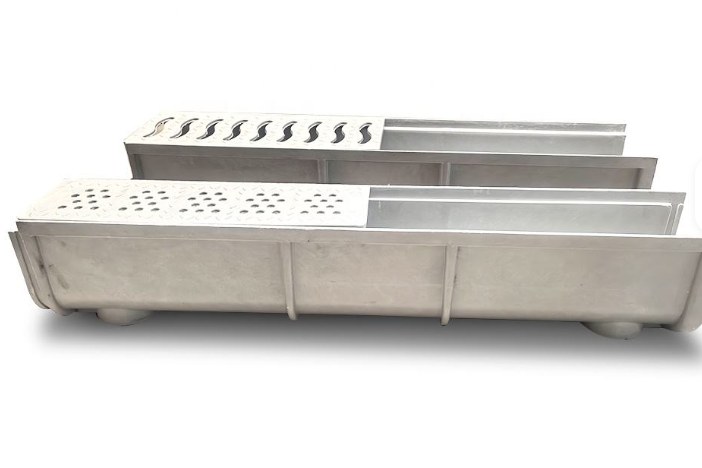
Industrial floors rarely fail where people walk — they fail where water goes. Ponded process water, spilled chemicals and cake grease turn floors slippery, attack concrete joints and breed hygiene problems. A drainage channel that is undersized, wrongly grating or badly detailed will be the part of the floor everyone curses within a year.
This guide covers how FRP drainage channels and grates are chosen for industrial flooring: channel types, grate selection, sizing basics, load classes, chemical exposure and the installation details that keep the system working.
1. Why FRP for Drainage?
Channels sit in the wettest, most chemically aggressive zone of a floor — the exact environment where steel corrodes and concrete deteriorates. FRP (fiberglass reinforced plastic) channels and grates do not rust, resist the dilute acids, alkalis and salts typical of food, plating, chemical and wastewater floors, and weigh a fraction of cast-iron equivalents, so one person can lift a grate section during cleaning. In washdown areas they also stay slip-resistant because grit surfaces can be molded directly into the grate.
2. Channel Types: Linear, Slot and U-Channel
| Type | Form | Best suited to |
|---|---|---|
| Linear trench channel | Precast FRP body, 100–300 mm internal width, grate on top | Production halls, kitchens, plating lines — continuous collection |
| Slot channel | Narrow throat (10–20 mm) with hidden body | Areas needing forklift-friendly, near-seamless floors |
| U-channel / open trench | Open U profile, removable grate covers | Outdoor yards, plant rooms, cable-and-water combined routes |
The classic FRP form is the U-channel with a detachable grate cover: the channel body is pultruded or hand lay-up, corner-radius inside for cleanability, and the cover doubles as walking surface.
3. Grate Options and Where Each Fits
| Grate type | Opening character | Typical use |
|---|---|---|
| Slotted / vane grate | Long slots with directional vanes | High-flow washdown areas; sheds water fast |
| Perforated / drilled plate | Small round holes | Heel-safe pedestrian routes, food areas (easy hosing) |
| Molded mesh grating | Open square mesh (38 mm typical) | Outdoor trenches, cable-and-water routes, high flow |
| Solid cover with grit | Sealed top | Where nothing may drop into the drain (clean rooms, courts) |
Match opening to the contaminant: hair, labels and fibrous waste clog fine slots; heavy solids call for a catch basin upstream of the slot.
4. Sizing Basics: Flow, Width, Slope
Sizing is hydraulic, not aesthetic. Three practical rules: floor falls of 1–2% toward the channel; channel capacity roughly proportional to cross-section and longitudinal slope (0.5–1% typical); and a safety margin of 2–3× for blockage and surge events like tank washdown. As a feel for scale, a 200 mm-wide channel at 1% slope handles far more than a typical washdown bay needs — undersizing almost always comes from too little depth or too flat a fall, not from width. For critical lines, have the supplier run the flow calculation with your actual peak discharge.
5. Load Class: the Grate Is the Floor
The grate must carry the traffic that rolls over it — the channel rarely fails first. Match grate class to wheel loads:
| Exposure | Reasonable grate class (EN 124 logic) |
|---|---|
| Pedestrian only | A15 |
| Cars, light trolleys | B125 |
| Kerb sides, delivery vans | C250 |
| Forklift aisles, truck areas | D400 (reinforced composite designs) |
Ask for the test report, not the class letter: molded FRP grates vary widely between molding plants. Point loads from forklift wheels are the usual failure mode, not distributed load.
6. Chemical and Temperature Exposure
Select resin like you select the floor coating: isophthalic resin covers most food and municipal service; vinyl ester is the default for plating shops, pickling lines and aggressive effluent. Two cautions: hot CIP (caustic at 60–80°C) accelerates attack on any polymer — check the supplier's temperature-derated strength data; and oxidising agents (hypochlorite, chromic acid) need verified vinyl ester grades. FRP also avoids the galvanic and stray-current corrosion that destroys stainless steel channels near electrical equipment.
7. Installation Details That Decide the Outcome
- Bedding: full-length support under channel walls — point support causes the "clicking" joints that fail first.
- Jointing: seal channel-to-channel joints with the supplier's gasket or flexible sealant; rigid mortar cracks with thermal movement.
- Frame anchoring: anchor edges of openings into the slab with chemical anchors so wheel loads cannot work the channel loose.
- Fall continuity: keep the floor fall uninterrupted into the throat — a lip at the grate edge holds water and trips wheels.
- End details: close channel ends properly; open ends collect debris and rods.
8. Maintenance and Cleaning
FRP's smooth gel or grit surfaces rinse clean with hot water and mild detergent; avoid aggressive scraping with steel tools, which chews the grit layer. Lift grates on the scheduled interval (weekly in food areas, monthly elsewhere), flush the channel body, and check anchors. If biofilm or scale builds up, a soft-bristle wash restores flow without damage.
9. Specification Checklist
- Channel internal width/depth and longitudinal slope
- Grate type, opening size and load class with test report
- Resin system matched to the chemical and temperature list
- Grit surface on pedestrian grates (see our stair tread slip resistance guide for friction standards)
- Anchoring and jointing accessories included in supply
- Catch basins / silt boxes at low points
10. Common Mistakes
- Choosing width from a catalogue photo instead of flow + slope calculation.
- Putting pedestrian-grade grates in forklift aisles to save cost.
- Specifying fine slots in areas with fibrous or stringy waste.
- Bedding channels on spaced blocks, then wondering why joints leak.
- Ignoring the frame: a good grate in a loose frame still fails.
See our FRP U-shaped drainage channels, anti-slip drain grates, adjacent FRP cable trenches and the full plates & gratings range; for the walking surfaces around them, read the grating load table guide.
Need help selecting FRP products?
Our engineers answer technical questions free of charge.
Ask an Engineer on WhatsApp