
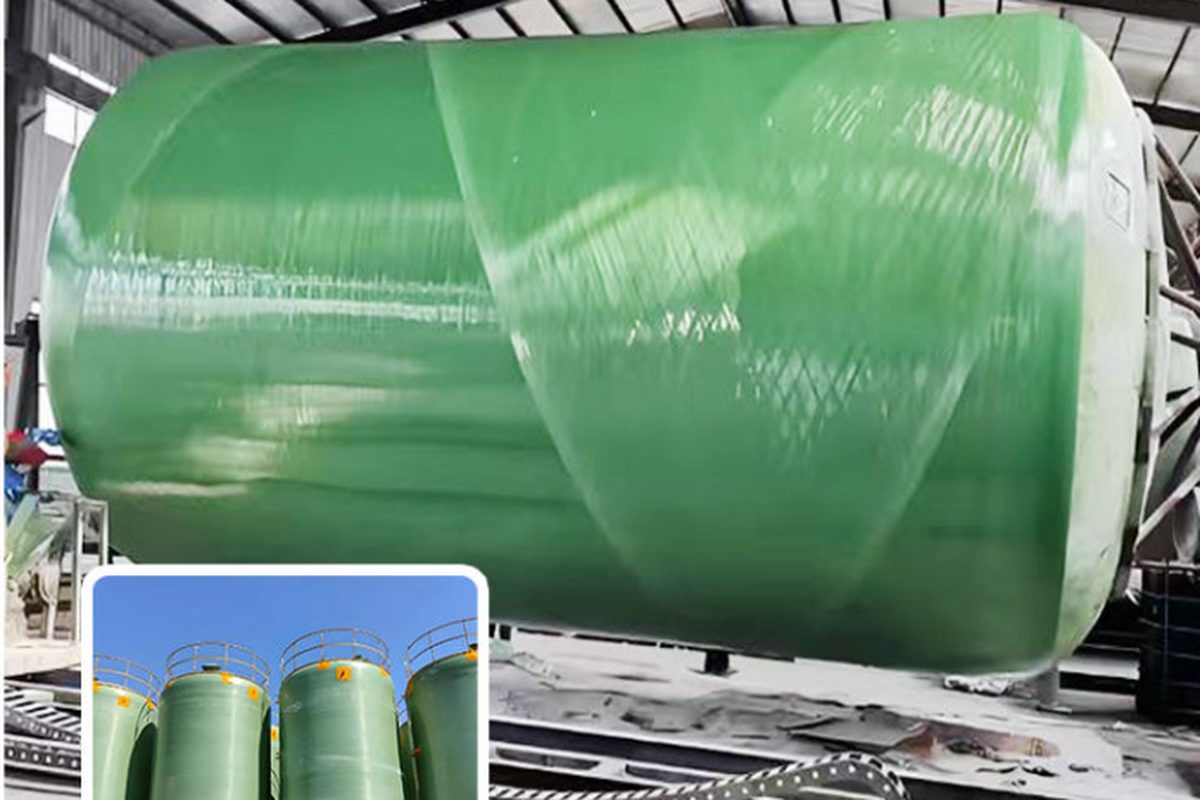
A filament-wound tank or a complete pultrusion line can survive twenty years of service and still arrive at site dented, cracked or rust-spotted - because it spent five weeks at sea resting on the wrong saddle, breathing humid air, or loaded under twelve tonnes of somebody else's cargo. Export packing for FRP equipment is a design task with the same seriousness as the equipment itself: the loads are known, the failure modes are known, and nearly all of them are preventable.
1. Vessels and Tanks: Saddle the Load, Never Strap the Shell
Rule one for shipping any FRP vessel: it rests on properly designed saddles or cradles that match its diameter, exactly as installed - never directly on the shell, and never secured by straps cinched over the laminate. Shipping saddles carry the vessel above the container floor so slings and forklifts act on steel, not fibreglass. Key points: saddle contact width at least 200 mm with an elastomer pad; vessel secured to saddles with over-centre lashing through the saddle steel, or by blocking fore-and-aft at the saddles; and blanked-off nozzles positioned so nothing loads them. Lashing over the shell, where unavoidable for tall vessels, goes over a spreader with soft slings and padding, tensioned to hold - not to compress.
2. Nesting and Dunnage for Pipes, Ducts and Profiles
| Product | Packing Method | Key Rule |
|---|---|---|
| Pipes DN100-DN600 | Nested in bundles, bell/spigot interleaved with foam | Bells never support weight; straps over padding only |
| Large ducts | Individual saddles + internal bracing at open ends | Roundness is the product - brace against ovalisation |
| Pultruded profiles | Bundle-packed, paper interleaved, edge-protected | Profile ends capped; bundles strapped to timber bearers |
| Molded grating | Flat-packed face-to-face with interleaves | Surface faces protected; banding over soft corner guards |
| Covers, panels | Vertical in A-frames or flat with full-face protection | No point loads on flat laminate - ever |
Timber bearers keep bundles off the floor and lift as units; dunnage bags fill long gaps so cargo cannot shift, but they must bear on rigid structure, not on laminate surfaces.
3. Machinery: Crating That Survives the Voyage
Complete machines - winding machines, pultrusion lines, mixers - travel in steel-framed plywood crates with the machine bolted to the frame through its own feet or skids. Sensitive items (PLC cabinets, HMI panels, servo drives) travel in their own inner boxes with desiccant; loose components bagged, labelled and boxed against a packing list that matches the machine's shipment checklist. Remove or secure anything that can swing, slide or rattle: tool drawers locked and emptied, rollers wrapped, moving carriages blocked with painted-red removal tags so site crews know what to unblock. Control cabinets ship upright with shock-tilt indicators on anything electronic - cheap indicators that settle arguments on arrival.
4. Moisture: The Quiet Destroyer
Five weeks in a container is five weeks of condensation cycles. FRP itself does not corrode, but everything bolted to it does, and plywood crates grow mould that offends even clean shipments. Countermeasures that work: sealed machine crates lined with barrier foil and desiccant sized to the volume; VCI paper for machined steel surfaces; containers stuffed dry (check the floor - a wet container floor is the number-one source of damage claims); ventilation containers for non-machine cargo where condensation is the main risk; and silica bags in every cabinet and gearbox housing, logged on the packing list so they are found and removed at installation.
5. Loading Plans and Lashing Discipline
Plan the container or flat-rack load on paper before the first crate moves: weight along the floor, heavy items low and over axles, no point loads on tank shells, and a loading sequence that unloads in reverse order of site need. Lashing goes to container lashing rings with webbing straps and edge protectors - chains bear on timber framing only. Respect the axle weight limits of the receiving country: a container legal at 24 t in one jurisdiction may be illegal at destination, and the cost of trans-loading dwarfs the cost of planning. Photograph every layer as loaded - the photo set below is your insurance file.
6. Documentation That Settles Claims
| Document | Content | Why It Matters |
|---|---|---|
| Packing list per crate | Every component with box number | Site install starts without "missing part" chaos |
| Loading photo set | Layers, lashing, dunnage, desiccant placement | Evidence of good order at stuffing |
| Pre-shipment inspection | Third-party or buyer witness report | Draws the line between factory and transit |
| Shock/tilt indicator log | Device numbers on electronics crates | Objective trigger for opening inspection |
| Carrier notes | Any container damage noted at stuffing | Liability sits with the right party from day one |
7. Arrival and Unpacking Protocol
Ship the protocol with the equipment: inspect exterior before signing; photograph anomalies immediately; open crates with the shock indicators still in view; unblock tagged restraints before power; dry-run blow out desiccant and packing dust; and reconcile the packing list before the crew leaves site. Damage discovered at unpacking, photographed the same hour with the indicator log, is a claim that settles - damage discovered at commissioning three months later rarely does.
Related reading: FRP tank transport and installation, filament winding machine buyer's guide, and our CNC filament winding production lines.
Need help selecting FRP products?
Our engineers answer technical questions free of charge.
Ask an Engineer on WhatsApp