
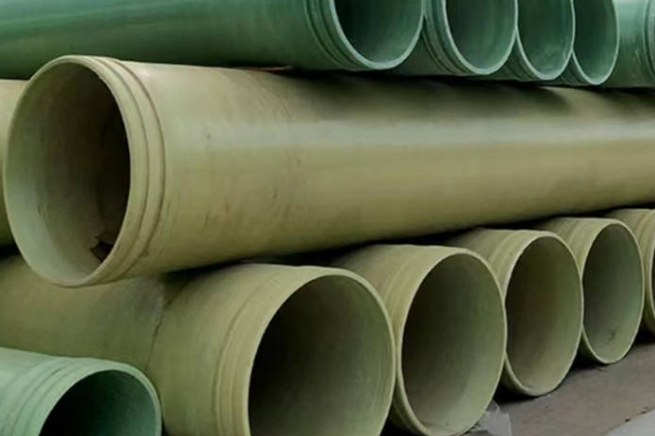
When a water or sewage project moves past concrete and ductile iron, the procurement debate almost always narrows to two plastics: FRP/GRP (fiberglass) and HDPE (polyethylene). Both are corrosion-resistant, both are lighter than steel, and both can last decades — but they are engineered for different compromises, and choosing between them on price alone is how projects end up with the wrong pipe.
This guide compares the two across the decisions that actually matter — pressure and long-term strength, temperature, diameter economics, installation, chemical resistance and lifecycle cost — and gives a clear rule for when FRP is the better call.
1. Two Different Engineering Materials
- HDPE is a thermoplastic: it is extruded in one piece, joined by heat fusion, and behaves as a flexible pipe that must be supported by good compaction and restrained against movement.
- FRP/GRP is a thermoset composite: continuous glass reinforcement gives it high specific strength, and it is a stiffer pipe that can carry load from the wall itself, with a resin system chosen for the medium.
The stiffness difference is the first practical one: a buried GRP pipe with SN 5000+ carries a share of the soil load structurally, while HDPE relies heavily on the surrounding bedding for its strength.
2. Pressure and Long-Term Strength
Both pipes are rated on 50-year hydrostatic data, but the failure logic differs:
| Property | HDPE (PE100) | FRP/GRP |
|---|---|---|
| Long-term basis | MRS 10 MPa → design stress with safety factor | Regression-tested hoop strength ÷ design factor (≥6 typical) |
| Burst : working ratio | Moderate (ductile yielding) | Typically 4–6× rated pressure |
| Oxidants / chlorine | Chlorine accelerates PE degradation — use chlorinated-water grades and check the spec | Resin liner chosen for the medium; no oxidative ageing of the glass structure |
| Surge behaviour | Flexible — absorbs some surge | Stiffer — surge allowance must be in the class selection |
For raw water and sewage both perform well. For chlorinated potable water, confirm the HDPE grade is rated for the disinfectant dose, or GRP with an NSF/ACS-approved liner becomes the safer default.
3. Temperature Limits
- HDPE pressure ratings derate sharply above 20 °C and are generally not used for sustained pressure above ~40–45 °C.
- FRP/GRP handles higher service temperatures by resin choice — standard polyesters up to ~50–60 °C and vinyl esters or epoxies well beyond, depending on the chemical compatibility table.
If the line carries warm process water, condensate or aggressive chemical streams, temperature alone often eliminates HDPE.
4. Diameter and Wall Economics
For a given flow, wall thickness and cost scale differently:
- In large diameters (roughly DN 600 and up), GRP's composite wall is thinner and lighter than a pressure-rated PE wall, so GRP usually wins on both material cost and handling weight.
- HDPE's advantage sits in small to medium diameters, mass production and its fusion jointing — up to a few hundred millimetres it is very hard to beat on price.
- GRP offers high ring stiffness (SN 5000–10000) for shallow cover and traffic loads; HDPE needs more careful bedding and, in high-load crossings, the thicker wall or a protective sleeve.
5. Installation and Joints
| Aspect | HDPE | FRP/GRP |
|---|---|---|
| Jointing | Butt-fusion — needs trained crews, fusion machines and power; joints are as strong as the pipe when done right | Mechanical couplings or bell-and-spigot with gaskets — fast, no power, easy to inspect |
| Bedding | Flexible pipe: uniform compaction critical; poor bedding → ovality and failure | SN-matched bedding; stiffer wall tolerates more installation variance |
| Thrust at fittings | Fusion joints carry thrust; bends usually fine without anchors in fused systems | Mechanical joints need thrust blocks or restrained fittings at changes of direction |
| Above-ground use | Requires UV stabilisation and continuous support | UV-stabilised gelcoat; suited to exposed racking |
6. Chemical Resistance: Where FRP Pulls Ahead
HDPE resists many chemicals at ambient temperature, but its resistance window narrows with concentration and temperature, and it can suffer environmental stress cracking with certain surfactants and solvents. GRP's resin system — polyester, vinyl ester or epoxy — is selected for the specific medium, which is why chemical, acid, flue and solvent lines are overwhelmingly specified in FRP rather than PE.
7. Decision Guide
- Choose HDPE for: small-to-medium buried water and gas mains, long runs with skilled fusion crews, areas with ground movement where flexibility is an asset.
- Choose FRP/GRP for: large-diameter water and sewer mains, chemical and process lines, warm or chlorinated media, shallow-cover and traffic-loaded crossings, above-ground racking, and projects where installation speed with mechanical joints matters.
Still unsure about the material side? The companion comparison FRP vs stainless steel covers the metal alternative, and the diameter and wall selection guide explains how to size whichever material wins.
8. Cost Reality Check
- Compare installed cost, not pipe price: jointing labour, bedding and thrust restraint often exceed the pipe price difference.
- Check the 50-year basis of both quotations — and that the HDPE grade matches the disinfectant/chemical duty.
- Ask both suppliers for surge analysis on long lines — the pipe that handles your surge with the cheaper class wins.
- For DN 600+, ask for a GRP alternative quotation even if you started with PE — the crossover point is closer than most expect.
Browse our FRP water pipes, pressure pipes and the full GRP pipes & fittings range with pressure and stiffness data for your size.
Need help selecting FRP products?
Our engineers answer technical questions free of charge.
Ask an Engineer on WhatsApp