
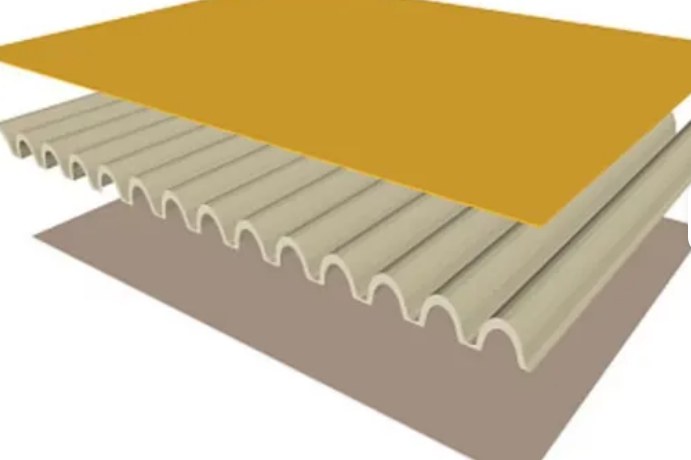
A sandwich panel is a simple mechanical idea with outsized consequences: two thin, strong FRP skins separated by a lightweight core behave like an I-beam laid flat — the skins carry bending, the core carries shear, and stiffness grows with the cube of the panel thickness at a fraction of the weight. That is why sandwich construction dominates lightweight walls, truck bodies, marine bulkheads and cleanroom partitions.
This guide compares the three panel families we supply — corrugated/honeycomb-core, rock-wool-core and solid laminate — and shows where each earns its place.
1. The Core Line-Up at a Glance
| Core type | Structure | Strengths | Typical use |
|---|---|---|---|
| Corrugated / honeycomb FRP core | Wave-form or honeycomb FRP core between skins | Highest stiffness-to-weight, fully synthetic, no water uptake | Partitions, vehicle bodies, marine panels, doors |
| Rock wool core | Mineral wool between FRP skins | Fire rating (A1 core) + thermal insulation + sound | Exterior walls, energy-saving facades, technical rooms |
| Solid laminate (no core) | 3–6 mm glass-resin sheet | Maximum chemical resistance, easy clean, formable | Linings, cladding, hygienic surfaces |
2. Honeycomb / Corrugated-Core Panels: the Stiffness Champions
Separating the skins is what buys stiffness, and a synthetic core does it at the lowest weight — panels of 20–50 mm deliver rigidity that solid sheet of equal weight cannot approach. Because the whole panel is FRP, there is no core to rot, absorb water or corrode: these panels suit wet and marine environments (bulkheads, boat fit-out), vehicle and trailer bodies, doors and portable buildings. Watch-outs: point loads concentrate in thin skins (use inserts or closeout ribs at fixings), and edge sealing must be detailed so the core edge is closed.
3. Rock-Wool-Core Panels: Fire and Thermal in One
Where building code demands fire performance and insulation, a rock wool core between FRP skins is the workhorse: the mineral core is non-combustible (A1) and insulating, while the skins supply weathering, washability and impact face. Typical duties: exterior wall cladding, roof and wall panels for energy-saving industrial buildings, partition walls of technical rooms, and cold-store internals. The design question is always the face contribution to fire class — the core is A1 but the composite is classified by the whole system, so ask for the panel's EN 13501-style test, not the core's datasheet alone.
4. Solid FRP Sheets: When You Only Need the Skin
Solid laminates — high-gloss smooth sheets, flexible fire-resistant flat panels — are the material behind tank linings, chemical-resistant cladding, hygienic wall panels and formed shapes. No core means no delamination risk and full resin chemistry to the surface: gel-coat faces wipe clean, resist the cleaners that fog polycarbonate, and can be post-formed on gentle radii. For linings over concrete or steel, solid sheet is the specification; for self-supporting spans, move up to a sandwich.
5. Face Sheet Engineering
The skins decide weathering and appearance. A UV-stabilised gel coat or surfacing veil protects against chalking (the same logic as our daylighting panel guide); glass content and veil quality decide surface fibre bloom; and colour is in the gel coat, so repairs blend. For food and pharma-adjacent projects, specify smooth gel-coat faces without texture — cleanability lives in the surface finish.
6. Mechanical Checks Before You Order
| Check | Method |
|---|---|
| Span & deflection | Supplier's span table at your support spacing and wind/pressure load |
| Point load (fixings, fixtures) | Insert plates or load-spreading washers at mounts |
| Core-skin bond | Flatwise tensile / shear data; verify no voids at edges |
| Edge closure | Closed edges (profile or trim) in wet applications |
| Fastening system | Compatible fixings, over-tightening limits stated |
7. Installation Notes
Support framing follows the span table, not guesswork; panels butt with sealed joints or proprietary profiles; and fasteners clamp — never crush — the face. For rock-wool panels, keep the joint system from the panel's fire test; for honeycomb panels in wet areas, seal all cut edges before erection. Cutting is standard carbide-blade work with the panel supported flat.
8. Specification Checklist
- Core type, thickness and density; total panel thickness
- Skin build: gel coat/veil, glass content, colour
- Span table for your framing and loads (wind, point, walk)
- Fire classification of the assembled panel (not just the core)
- Edge detailing for the exposure (wet / exterior / hygiene)
- Fixing system and torque limits
9. Common Mistakes
- Quoting core A1 rating as the panel's fire class.
- Mounting heavy fixtures on unsupported skin without inserts.
- Open honeycomb edges in wet service — wicking and delamination follow.
- Choosing solid sheet for spans that need a sandwich (or the reverse).
- Ignoring thermal movement on long exterior runs.
See our UV-resistant honeycomb sandwich panels, structural rock wool sandwich panels, high-gloss solid FRP flat sheets and the wider plates & panels range; related: FRP vs wood vs aluminum and the daylighting panel guide.
Need help selecting FRP products?
Our engineers answer technical questions free of charge.
Ask an Engineer on WhatsApp