
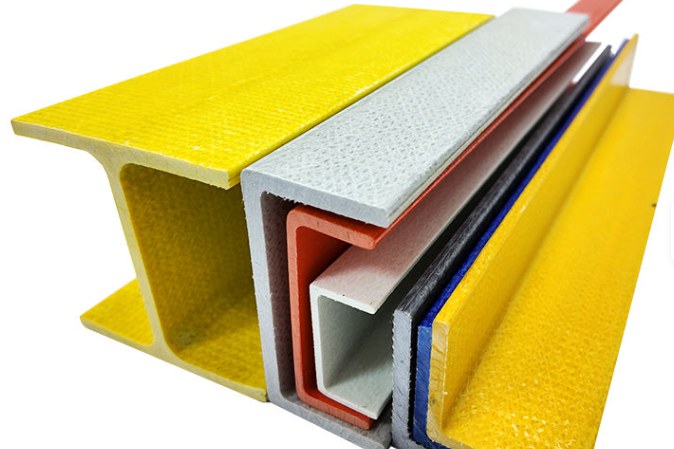
Wood, aluminum and FRP all compete for the same outdoor structures — decks, pergolas, walkways, frames, enclosures and equipment platforms — and every supplier's brochure makes their material look unbeatable. The truth is that each wins a specific band of applications, and the failures we see usually come from choosing on first cost alone.
This comparison sets out how the three materials actually behave outdoors: how they age, what they cost over a lifecycle, and where each is the right answer.
1. The Head-to-Head Table
| Property | Pultruded FRP | Wood (treated/hardwood) | Aluminum |
|---|---|---|---|
| Density | ~1.8 g/cm³ | 0.5–0.9 g/cm³ | 2.7 g/cm³ |
| Corrosion / rot | Immune | Rot, insects; treatment leaches | Pits in chloride (coastal, de-icing salts) |
| Maintenance cycle | Wash only | Seal/stain every 1–3 years | Wash; anodising ages |
| Electrical | Non-conductive | Conductive when wet | Conductive |
| Thermal movement | Low | High (moisture + heat) | High (2× FRP expansion) |
| First cost | Medium | Low–medium | High |
| Fire behaviour | Thermoset, will char | Combustible | Non-combustible, softens |
| End of life | Limited recycling | Biodegradable / reuse | Fully recyclable |
2. How Each Material Ages Outdoors
Wood fails biologically and hydrologically: rot at end-grain and fixings, checking from wet-dry cycling, and UV grey surface fibrosis. Treatment chemicals extend life but leach and complicate disposal. Aluminum's enemy is chloride: coastal air and de-icing salts pit the oxide layer, and crevices under bolts corrode invisibly. FRP's failure modes are mechanical, not chemical — impact damage, abuse and (rarely) exceedance of design loads. Its resin surface UV-chalks cosmetically over the years but the laminate does not rot, rust or pit.
3. Strength-to-Weight and the Deflection Catch
FRP pultrusions deliver steel-class strength at a quarter of steel's weight, and typically outperform aluminum profiles of equal weight on strength. But stiffness is the honest caveat: FRP's modulus (~25 GPa vs aluminum ~69 GPa) means an FRP member of equal geometry deflects more — so good FRP design uses deeper sections, smarter shapes (I-beams, hat sections) or closer supports. The win is that you can go deeper cheaply, because material weight barely matters. Our sheet pile and walkway guides show the same principle in practice.
4. Lifecycle Cost: Where the Money Actually Goes
| Cost line (20-yr view) | FRP | Wood | Aluminum |
|---|---|---|---|
| Initial supply + install | Medium | Low–medium | High |
| Coating / sealing cycles | None | 5–10 cycles | Occasional |
| Board/member replacement | Rare | Routine | Occasional (pitting) |
| Access equipment for upkeep | Rarely needed | Recurring | Recurring |
For structures at height or over water — where every maintenance visit means scaffolding, boats or closures — the "no repaint, no replace" profile of FRP dominates the lifecycle arithmetic even when first cost is double wood's.
5. Safety Properties People Forget
Three often-unlisted properties favour FRP outdoors: it is non-conductive (matters near lighting, signage and power infrastructure), non-magnetic and RF-transparent, and grit surfaces can be integrated for slip resistance in a material that stays comfortable underfoot in sun — aluminum decks become too hot to touch, and wet treated timber turns slippery. For fire, aluminum is non-combustible and wood can be treated; FRP thermosets char and self-extinguish but must be specified with the project's fire requirements in view.
6. Sustainability: A Louder Argument Than Expected
Wood wins on renewable sourcing and end-of-life; aluminum on infinite recyclability — at a heavy energy cost for primary metal. FRP's honest weakness is end-of-life recycling, set against a strong case of avoided maintenance: no paint solvents, no preservative leachate, and decades of service without replacement shipments. Where a structure outlives two cycles of timber replacement, the total material throughput favours FRP.
7. Where Each Material Is the Right Answer
- Wood: low structures with easy access, natural aesthetics required, budget-critical, short-to-medium service expectation.
- Aluminum: non-combustible requirements, architectural finishes, inland dry environments, recyclability mandates.
- FRP: coastal/chemical/wet exposure, electrical insulation, structures over water or height where access for upkeep is costly, long design life with minimal maintenance.
8. Specification Checklist
- Exposure class named (marine salt, de-icing, chemical, UV)
- Span, load and deflection limit stated — sections sized to them
- Connection hardware: 316 stainless for FRP and aluminum, coated for timber
- Fire requirement matched to code for the application
- Surface: grit or textured for walking surfaces
- 20-year maintenance plan written into the tender
9. Common Mistakes
- Comparing first-cost only, especially for structures needing access equipment to maintain.
- Copying aluminum geometry into FRP without deflection checks.
- Using plain steel fixings with any of the three materials.
- Specifying FRP where fire code forbids combustibles — then arguing with the AHJ.
- Forgetting thermal movement: long aluminum runs need sliding fixings; FRP rarely does.
See our high-strength FRP I-beams, H-beam retaining wall profiles and the full profiles & structural components range; related reading: FRP vs stainless steel and FRP profiles in wastewater plants.
Need help selecting FRP products?
Our engineers answer technical questions free of charge.
Ask an Engineer on WhatsApp