
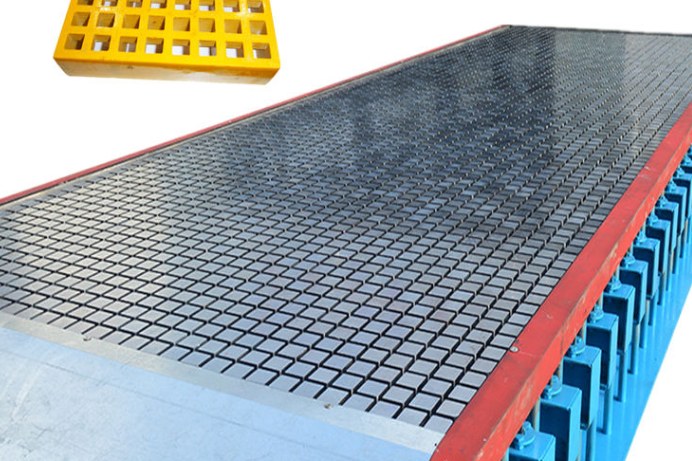
"FRP grating" covers two products made by entirely different processes, and the difference is not cosmetic: molded and pultruded gratings behave differently under load, span differently, cost differently and fail differently. Buying one when your application needs the other is the most common — and most avoidable — grating mistake.
This guide walks through how each type is manufactured, how the process shapes the properties, and a decision framework for choosing between them (plus a note for buyers considering making grating themselves).
1. How Molded Grating Is Made
Molded grating is produced in matched metal molds: continuous rovings and mats are layered with resin in a heated mold cavity, then compressed and cured — one panel at a time. The result is a bi-directionally reinforced panel: glass runs in both directions, so strength and stiffness are similar across and along the panel. Mesh openings are formed by the mold (typically 38×38 mm), the meniscus top surface carries integrated grit, and resin-rich surfaces give the corrosion resistance. Panel sizes are set by the mold — 1×4 m, 1.22×3.66 m and similar standards.
2. How Pultruded Grating Is Made
Pultruded grating starts as continuous pultruded bars: I-bar bearing elements and round cross-rods, all pulled through dies with high glass content (up to ~80% by weight). The bars are then drilled and mechanically joined into panels with clips. The result is a unidirectionally optimised panel: nearly all the glass runs along the bearing bars, so the panel is very strong across its supported span — and much weaker in the cross direction, which is why panels must be installed with bearing bars perpendicular to the supports.
3. Process vs Properties: the Comparison Table
| Property | Molded | Pultruded |
|---|---|---|
| Glass content | ~25–35% wt | ~65–80% wt |
| Load direction | Bi-directional (either way) | Along bearing bars only |
| Span capability | Moderate (≤1.5 m typical) | Long spans (2–3 m+ with deeper sections) |
| Open area | ~65–70% | ~70–80% (tighter options available) |
| Cut panels on site | Cuts anywhere, strength retained both ways | Cuts must respect bearing-bar direction |
| Relative cost | Lower per m² | Higher (more glass, more assembly) |
| Impact behaviour | More forgiving (resin-rich, flexible) | Stiffer, sharper local failure |
4. Load Behaviour: Isotropic vs Directional
The practical consequence of fibre direction shows up in three everyday situations. Cut-outs for pipes and equipment: a molded panel keeps working around a hole; a pultruded panel with a severed bearing bar loses that load path — plan cut-outs between bars or add support steel. Point loads between supports: pultruded panels deflect less on long spans, molded panels distribute foot traffic comfortably on short ones. And orientation errors: a pultruded panel turned 90° carries a fraction of its rated load — our grating load table guide explains how to read the span tables both types publish.
5. Where Molded Grating Wins
- Walkways, platforms and drainage covers with frequent cut-outs and direction changes
- Chemical plant floors where resin-rich surfaces and meniscus grit grip matter
- Budget-driven medium-load applications on ≤1.2 m spans
- Applications needing high fire ratings (Class 1 flame-spread formulations are standard in molded lines)
6. Where Pultruded Grating Wins
- Long unsupported spans (2–3 m) and heavy wheel loads — the high glass content carries them
- Structural platforms where the grating also acts as bracing
- Environments demanding maximum stiffness-to-weight, e.g. offshore and marina decking
- Concentrated line loads across multiple bearing bars with proper cross-rod spacing
7. Considering Making Grating? The Two Production Routes
For buyers entering grating production: the processes mirror the products. A molding line (hydraulic press, matched molds, resin mixing, curing) turns out finished panels per cycle with moderate tooling cost per panel size — flexible for colour and mesh variants; see our automatic grating molding machines and molded grating production equipment. A pultrusion grating line produces bearing bars and rods at high speed, with panel assembly as a second operation — better economics at volume for standard meshes; see the high-speed mesh grating lines. The machine choice should follow your market's span demands and panel standardisation, not the other way round.
8. Specification Checklist
- Process named (molded / pultruded) — never accept just "FRP grating"
- Span table with deflection limits for YOUR support spacing
- Resin system for the chemical exposure (isophthalic vs vinyl ester)
- Grit surface integrated (molded) or applied (pultruded) — and wear expectation
- Fire rating (Class 1 / local code) where required
- Panel sizes planned around cut-outs before ordering
9. Common Mistakes
- Buying pultruded for its strength figures, then installing it across the weak direction.
- Cutting bearing bars for pipe penetrations in pultruded panels without adding supports.
- Using molded grating on 2 m spans because the panel "looked strong".
- Comparing prices across processes without normalising span capability.
Browse our molded ranges — high-density molded grating, colored molded grating — and pultruded options like the walkway & stair tread grating, plus the full plates & gratings range. Related: FRP vs steel grating TCO and the load table guide.
Need help selecting FRP products?
Our engineers answer technical questions free of charge.
Ask an Engineer on WhatsApp