
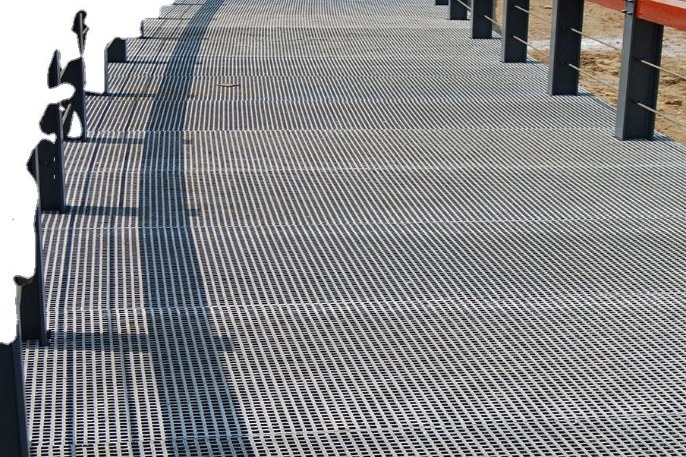
Most engineers first compare FRP grating with steel on corrosion and weight, and fire is the question that arrives later, usually from an insurer, an owner's specification or a local code official. Fibreglass reinforced plastic is a combustible material — the resin that protects the glass is an organic polymer — so the practical question is never "is it non-combustible?" but "how does it behave in a fire test, and is that behaviour documented well enough to defend on a project?" This guide explains how FRP grating is fire-tested, what the numbers mean, why "Class 1" on two different datasheets can mean two different things, and what to put in your specification so the panel you receive matches the rating you paid for.
Read the load and corrosion questions separately: span and load capacity are covered in our FRP grating load table guide, and the corrosion-vs-metal economics in our FRP vs steel grating cost comparison. Here we focus purely on fire performance.
1. Why Fire Performance Becomes a Selection Issue
Steel grating does not burn, so fire is never discussed — but in a serious fire steel loses strength rapidly above roughly 500°C and can collapse a walkway. FRP is the opposite: the panel does not support flame spread well when made with fire-retardant resin, but the resin itself is the fuel. The engineering question is therefore one of risk and test evidence. Chemical plants, offshore platforms, power stations, metro tunnels, cable galleries and wastewater pump stations increasingly require polymer products in escape routes and process areas to carry a documented flame-spread rating, usually backed by insurance requirements or an owner's technical specification rather than by a general building code.
2. What Actually Burns in an FRP Grating
An FRP grating is roughly 60-70% glass by weight in a pultruded bearing bar and resin-richer at the surface of a molded panel. The glass fibre is non-combustible and, once a resin layer is gone, it does not contribute fuel — but it also stops holding the panel together. The resin is the combustible fraction. Three families are used when fire performance matters:
- Standard orthophthalic/isophthalic polyester — economic, good corrosion resistance, but will support combustion unless modified. Not your first choice for rated areas.
- Fire-retardant polyester or vinyl ester — the mainstream answer. Flame retardance is built in through halogenated resin chemistry, usually brominated or chlorinated monomers, often combined with antimony trioxide as a synergist, and frequently with aluminium trihydroxide (ATH) filler that releases water vapour endothermically above roughly 220°C and dilutes the flame.
- Phenolic and specialty systems — very low flame spread and smoke with a charring behaviour, but more brittle, harder to mould into an open grid, and less common in standard grating catalogues.
Additives are not free: high ATH loadings raise cost and can reduce mechanical properties slightly, and heavily filled surfaces can be more abrasive to tooling. A genuinely fire-retardant formulation is a deliberate resin recipe, not a surface coating — a thin "fire retardant" paint layer over a standard resin panel will not survive the first hour of weather, let alone a flame test specimen.
3. Flame-Spread Classes and the ASTM E84 Test
The test most FRP datasheets reference is ASTM E84 (also published as UL 723 and NFPA 255), the Steiner tunnel test. A specimen roughly 24 ft (7.3 m) long and 20 in (508 mm) wide is mounted face-down on the ceiling of a tunnel, a gas burner at one end provides a flame, and the rate of flame spread along the specimen is recorded against time. The scale is calibrated so that red oak boards give a flame spread index of 100 and inorganic cement board gives 0. Smoke is measured separately as light obscuration, again calibrated against red oak at 100.
| Class | Flame Spread Index | Smoke Developed Index | Typical FRP grating requirement |
|---|---|---|---|
| Class A / I | 0 - 25 | ≤ 450 | Escape routes, process platforms, owner specs with the tightest limits |
| Class B / II | 26 - 75 | ≤ 450 | General industrial areas with a moderate requirement |
| Class C / III | 76 - 200 | ≤ 450 | Low-risk areas; rarely acceptable for rated egress |
When an FRP datasheet says "flame spread 25" or "Class 1", it is normally claiming a flame spread index of 25 or below on ASTM E84, which corresponds to Class A. Always ask for the actual test report: the class band matters less than the measured FSI number and the smoke index that sits next to it.
4. "Class 1" Depends on the Standard
The phrase "Class 1" is a trap because it means different things in different test systems:
- ASTM E84 / UL 723 (North America): Class I means flame spread 0-25; some suppliers write "Class 1" intending this.
- BS 476-7 (United Kingdom): Class 1 is the best surface spread of flame rating on that standard, widely used historically in UK offshore and rail specifications.
- EN 13501-1 (Europe): the modern system is Euroclass A1/A2/B/C/D/E with smoke (s) and flaming droplet (d) subscripts, determined mainly by the EN 13823 single burning item test — "Class 1" does not exist here.
- ASTM D635: a small horizontal burn test; a material described as "self-extinguishing (SE)" under D635 is not the same evidence as an E84 Class A, and D635 alone should not be marketed as a Class 1 building-material rating.
Marine and offshore work adds another layer: IMO FTP Code Part 2 (surface flammability) applies to shipboard and some offshore installations, and its pass criteria are different again from ASTM E84. When you specify, name the standard and the target number — "fire-retardant resin" or "Class 1" without a method is not a specification.
5. Smoke Development Is a Separate Pass/Fail
Flame spread gets the attention, but in an enclosed plant room or a tunnel, smoke is what kills and what prevents escape. ASTM E84 reports a separate Smoke Developed Index, and a panel can fail a specification on smoke even when its flame spread is excellent. This matters for resin choice: halogenated polyesters that extinguish flame well can produce more smoke under some conditions, while ATH-filled and phenolic systems tend to suppress both flame and smoke. If your application is an enclosed space, write both numbers into the specification: for example, "ASTM E84 flame spread index ≤ 25 and smoke developed index ≤ 450".
6. Molded vs Pultruded Behaviour in a Flame Test
The manufacturing process changes the fire picture because it changes how much resin is exposed and how the panel is built:
- Molded grating is made in a press from resin, continuous strand mat and surfacing veil. The surface is resin-rich, with more exposed resin area per square metre, and the panel is homogeneous in both directions. Fire-retardant molded grating commonly relies on an FR resin plus ATH to keep flame spread down.
- Pultruded grating bearing bars are pulled with a much higher glass content — often 60-70% by weight — so there is proportionally less resin fuel per bar. The open structure also lets heat and flame pass through rather than accumulating under a solid surface.
Neither process is automatically better in a tunnel test; the formulation and the test report decide it. But the difference explains why a pultruded bar and a molded panel from the same resin family will not necessarily carry the same FSI, and why you should not assume that swapping one process for another keeps the rating.
7. Grit, Colourants and Cut Edges: Site Effects on a Rating
Fire performance on a datasheet is measured on a clean factory specimen. Three site realities can change the real behaviour:
- Anti-slip grit is usually fused aluminium oxide, which is inert and non-combustible; a gritted surface actually presents less ignitable resin to the flame and is common on rated walkways for slip resistance as well.
- Pigments and fillers can alter burning behaviour slightly; keep to the supplier's standard colour if the rating is critical, because a custom colour may use a different pigment package.
- Cut edges expose bare glass and the interior of the laminate where the resin-rich surface has been removed. For corrosion this demands edge sealing; for fire the effect is minor, but on a rated panel, cut edges should still be sealed with matching fire-retardant resin so the edge does not wick or fray and the product matches the certified build.
8. Where Fire-Rated FRP Grating Is Actually Specified
General building codes rarely force FRP flooring to carry an interior-finish class, because flooring is not usually treated as a wall or ceiling finish. In practice, rated grating appears where the operator or insurer sets the bar:
- Oil, gas and chemical process platforms and escape routes;
- Offshore topsides and MODUs (often via owner specs referencing ASTM E84 or IMO FTP Code Part 2);
- Power plants and cable galleries where a polymer walkway sits above energised cable trays;
- Water and wastewater plants where chlorine service areas combine corrosion and fire risk;
- Tunnels, metro and rail facilities with their own fire strategies.
In these settings the specification usually reads like a risk requirement, not a building code citation, and the buyer is expected to produce third-party test evidence.
"Fire-retardant resin" on a datasheet is a claim. A flame spread index with a test method, a report number and a date is evidence. When a project's safety case depends on the panel's fire behaviour, buy the evidence — a generic word is not worth the paper it is printed on.
9. Specification Checklist
| Parameter | Why it matters | What to request |
|---|---|---|
| Test method | "Class 1" is meaningless without it | ASTM E84 / UL 723, or BS 476-7 / EN 13501-1 as applicable |
| Flame spread index | The actual pass number | Copy of the report; FSI ≤ 25 for rated areas |
| Smoke developed index | Separate pass/fail, critical in enclosed spaces | SDI from the same report, ≤ 450 |
| Resin system | FR polyester vs vinyl ester vs phenolic | Resin type and FR mechanism (halogen/ATH) |
| Process | Molded vs pultruded fire behaviour differs | Match the certified product, not a substitute |
| Sample basis | Open grid tested directly or as a flat laminate? | Confirmation the test specimen represents the product |
| Grit / surface | Grit is inert and helps slip and fire | Standard gritted finish unless specified otherwise |
10. What a Flame-Spread Rating Does Not Cover
A low flame spread index does not make FRP grating fireproof, and it does not make it structural in a fire. The resin softens well before steel loses its strength — glass transition temperatures for typical polyesters sit roughly between 60 and 120°C, and stiffness falls away as the laminate approaches those temperatures. Under a sustained fire, a rated panel can still soften, sag and eventually fall through its supports. Where a walkway must remain load-bearing during a fire, or where a falling panel would block an escape route, treat the grating as a combustible element that needs the area protected by sprinklers, fire-stopping or a non-combustible alternative. Flame spread class is a surface behaviour number; it is not a fire resistance rating in minutes.
HuanGang supplies Class 1 fire-resistant anti-slip FRP grating and molded and pultruded grating and stair treads across the wider plates & gratings range; for process choice between molded and pultruded see our molded vs pultruded comparison. Send your specification and required class to our engineers and we will confirm the formulation and test evidence before you order.
Need help selecting FRP products?
Our engineers answer technical questions free of charge.
Ask an Engineer on WhatsApp