
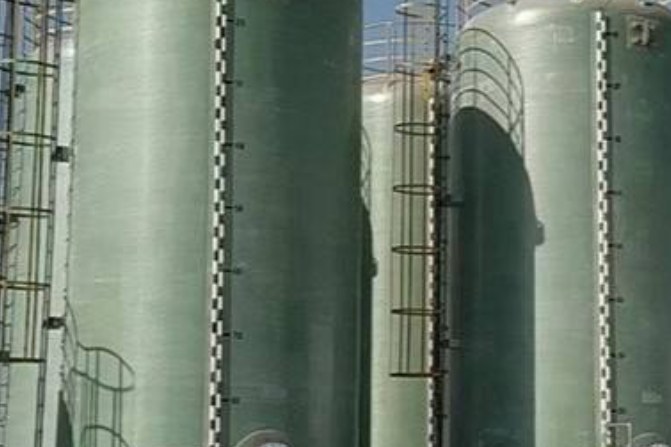
Two fabricators can quote the same 10 m³ tank, to the same drawing, in the same wall thickness, and one of the tanks will be in its second decade of service while the other is being relined. The difference is almost always the resin in the corrosion barrier - a line item that occupies a few per cent of the purchase price and decides most of the service life.
"FRP" is not a material specification. It states a construction method and a fibre, not a chemistry: glass-reinforced orthophthalic polyester, glass-reinforced isophthalic polyester and glass-reinforced vinyl ester are three different materials sharing one acronym, with different temperature ceilings, different resistance to the same chemical, and a price spread of roughly two to one at the resin drum. This guide sets out how to choose between them for pipes, tanks and vessels in chemical service, how to read the chemical tables properly, how the corrosion barrier is built, how to prove a choice with ASTM C581 immersion coupons, and what the design codes assume once a resin has been selected.
1. Why the Resin, and Not the Glass, Decides Service Life
The glass fibre is the strong phase and it does not change much between suppliers. The resin is the continuous phase: it is what the chemical actually contacts, it is what holds the fibres apart and transfers load between them, and it is the material whose mechanical properties collapse as temperature rises. Three consequences follow.
- The resin is the corrosion barrier. In a well-built laminate the chemical never reaches the glass. Chemical attack starts as resin swelling, hydrolysis and oxidative degradation at the wetted surface; the failure mode that shortens life is hydrolysis of the resin's ester linkages, not the strength of the fibre.
- The resin sets the temperature ceiling. A laminate does not fail at a single temperature: its modulus and strength fall as the resin approaches, and passes, its heat deflection temperature. The same wall that is comfortable at 25 °C can be marginal at 65 °C with no change in pressure.
- The resin decides whether the failure is recoverable. A barrier that blisters is a reline. Once hydrolysis has reached the structural laminate, it is a structural repair - a completely different cost and a completely different shutdown.
Numerically, the resin is not where the money is: isophthalic polyester sits in the region of USD 3.5-5 per kilogram and vinyl ester around USD 7-12 per kilogram, and the finished laminate carries a premium of roughly 25-40% when vinyl ester replaces isophthalic. Against a mid-life reline with scaffolding, surface preparation, a qualified laminating crew and lost production, that premium is small - but only where the chemistry actually requires it, which is why the resin decision has to be made medium by medium rather than as a house standard.
2. The Resin Families You Are Actually Choosing Between
Resin names are chemistry, not brands, and the differences that matter are all in the backbone of the polymer:
- Orthophthalic polyester (OP). Phthalic anhydride based. The ester linkages sit next to the aromatic ring and are sterically exposed, so hydrolysis is comparatively easy. Heat deflection temperature (HDT) is typically 65-85 °C, and with the usual margin for chemical service the practical continuous limit lands around 45-55 °C. Correct for water, neutral salt solutions, cooling tower components and ambient dilute acids; not for caustic above about pH 10, oxidizing acids, sodium hypochlorite or solvents.
- Isophthalic polyester (ISO). Isophthalic acid replaces the phthalic anhydride, spacing the ester linkages away from the ring and reducing hydrolytic attack rate by a factor of roughly two to five depending on the medium. HDT rises to 90-110 °C (practical continuous service about 65-80 °C), and iso gel coats bond better to the laminate, which matters in blister-prone duty. This is the default industrial grade: wastewater and water treatment, process water, secondary containment, dilute acid ductwork.
- Terephthalic and high-performance polyester. A further backbone modification that improves hot-water and some solvent resistance at moderate cost. It sits between iso and vinyl ester and is worth asking about where the medium is hot water or a light solvent rather than an acid.
- Vinyl ester (VE). An epoxy backbone capped with methacrylate groups. The vulnerable ester linkages exist only at the chain ends rather than along the backbone, which gives two to ten times the hydrolytic stability of isophthalic polyester in strong acids and a decisive advantage in oxidizers and caustic. HDT is 100-120 °C with a practical ceiling of about 80-95 °C in chemical service. This is the standard resin for hydrochloric acid, dilute sulphuric acid, sodium hypochlorite, chlorine dioxide bleaching, flue gas desulphurisation and caustic up to moderate concentration and temperature. It demands more cure discipline than a polyester: hotter exotherm, shorter gel time, and a post-cure that actually matters.
- Novolac and high-temperature vinyl esters. Higher cross-link density, better solvent and temperature resistance, and less elongation - useful for concentrated solvents, some oxidizing duty and higher-temperature acid service, at higher cost and with a more brittle laminate.
- Epoxy. The best of the mainstream thermosets in alkali, and the standard resin for glass-reinforced epoxy (GRE) piping under ISO 14692 in offshore and oil and gas duty. It is not the first choice for strong acids.
- Furan. Excellent against concentrated acids and solvents up to roughly 150 °C, but brittle and demanding to laminate and cure. Reserved for the duties where vinyl ester genuinely will not do.
- Phenolic. Chosen mainly for fire performance - low flame spread and smoke - rather than for the chemistry, which is good but not as broad as vinyl ester.
- Dual laminate. A thermoplastic liner (PVC, CPVC, PP, PVDF, PTFE) bonded into an FRP shell. When the medium is beyond what even vinyl ester can hold - concentrated hypochlorite, aggressive solvents, hydrofluoric acid - the answer is usually to stop asking the resin to resist it and to put a thermoplastic in front of it.
| Resin family | Acid resistance | Alkali resistance | Solvent resistance | Typical HDT | Practical continuous service* | Relative resin cost |
|---|---|---|---|---|---|---|
| Orthophthalic polyester | Limited | Limited | Poor | 65-85 °C | 45-55 °C | Lowest |
| Isophthalic polyester | Moderate | Moderate | Poor to fair | 90-110 °C | 65-80 °C | Low |
| Vinyl ester (bisphenol-A epoxy based) | Excellent | Good | Good | 100-120 °C | 80-95 °C | Medium |
| Novolac vinyl ester | Excellent | Good | Very good | above 120 °C | case by case | High |
| Epoxy | Good | Excellent | Good | about 120 °C | case by case | High |
| Furan | Excellent | Good | Excellent | up to about 150 °C | case by case | High |
* Practical continuous service temperature in chemical service is quoted as a guide, not a limit: it already allows for the loss of mechanical properties below the HDT and for the way chemical attack accelerates with temperature. The number that governs a project is the one supported by the resin supplier's immersion data at your concentration and temperature.
3. Temperature: The Variable That Moves Everything
HDT is measured on a neat resin bar, at a defined load and deflection, and it is a ranking tool rather than a service limit. Four reasons explain the gap between HDT and practical service temperature:
- Properties fall before HDT is reached. Strength and modulus decline progressively as the resin softens, so a laminate working just below its HDT is working with reduced mechanical properties while simultaneously carrying the full mechanical load.
- Chemical attack accelerates with temperature. Hydrolysis and oxidation both speed up as temperature rises, which is why a medium that rates "recommended" at 25 °C can rate "limited" at 60 °C on the same resin.
- Design codes derate explicitly. ISO 14692 scales its design envelope with a temperature partial factor; BS 4994 applies a factor that depends on the design temperature relative to the HDT class; thermal ageing data is used to predict stiffness loss over time.
- Equipment temperature is not product temperature. A dark tank in direct sun can run 10-15 °C above its contents, an insulated tank holding 70 °C product holds that heat for hours after the process stops, and a pipe next to a hot service or inside an enclosure sees more than the line temperature. Design temperature should be the hottest credible wall temperature, not the normal operating value.
Two thresholds are worth keeping in mind when a specification is written. The first is 45 °C: BS 4994 penalises laminates that are not fully post-cured far more severely above that temperature, because a partially cured resin will never reach its rated chemical resistance. The second is 82 °C (180 °F): ASME RTP-1 requires a resin with a heat deflection temperature of at least that value for the vessels it covers, which is a statement that general-purpose orthophthalic resin is outside the code's intent, not merely outside its comfort zone.
Resin selection is a two-dimensional problem. There is no such thing as a resin that is "good for hydrochloric acid"; there is only a resin that is good for a stated concentration at a stated temperature.
4. Chemical Resistance by Medium: A Working Screening Table
Three variables decide whether a resin survives: the concentration, the temperature, and whether the attack is hydrolytic or oxidative. The oxidizing media - hypochlorite, chlorine dioxide, nitric acid, chromic acid - are the class that takes polyester out of the running at almost any concentration, because oxidation attacks the polymer backbone rather than the ester linkages that iso resin was designed to protect.
| Medium | Concentration / condition | Orthophthalic | Isophthalic | Vinyl ester | Notes |
|---|---|---|---|---|---|
| Water, raw or potable | Up to 80 °C | Recommended | Recommended | Recommended | Any family works; iso is the standard industrial choice |
| Seawater and brine | Ambient to 80 °C | Limited | Recommended | Recommended | Iso for splash and ambient immersion, VE for hot or fully immersed duty |
| Hydrochloric acid | 10-37% | Not recommended | Limited (roughly ≤25-50 °C depending on concentration) | Recommended | VE is the standard choice; 316 stainless is outperformed here |
| Sulphuric acid | Up to 50% | Not recommended | Limited (roughly ≤20-60 °C) | Recommended | Temperature is the deciding variable much more than concentration |
| Sulphuric acid | 70-98% | No | No | Marginal | Use a dual laminate or a lined/brick-lined alternative |
| Sodium hydroxide (caustic) | Up to 50% | No | Limited (roughly ≤30 °C) | Recommended | Epoxy is also excellent and preferred in some hot caustic duty |
| Sodium hypochlorite | Up to 15% | No | No | Recommended | The classic vinyl-ester-only medium; above 15% or hot duty, go to a dual laminate |
| Nitric acid | Up to about 20% | No | No | Limited | Confirm against C581 data; use a synthetic veil |
| Hydrofluoric acid | Up to about 10% | No | No | Recommended only with a synthetic veil | Glass is attacked by HF: a glass surfacing veil is not acceptable |
| Phosphoric acid | Up to 85% | No | Recommended at lower temperature | Recommended | Fertilizer and food-grade duty; iso is often adequate |
| Acetic acid | Up to 50% | No | Limited | Recommended | Attack rises steeply with concentration and temperature |
| Flue gas / FGD scrubber duty | Wet, acidic, 50-70 °C | No | Limited | Recommended | VE is the industry default for absorber and duct linings |
| Chlorine dioxide (wet) | Bleaching duty | No | No | Recommended | Pulp and paper bleaching towers |
| Organic solvents | Concentrated, elevated temperature | No | Limited | Good | Novolac VE or furan where the solvent is concentrated and hot |
Read that table as a shortlisting tool and nothing more. Every rating in it assumes a stated concentration and temperature, and generic charts are normally written at ambient temperature: a resin rated "excellent" in dilute sulphuric acid at 25 °C may be only "good" at 60 °C and "limited" at higher concentration. The specification step is to obtain immersion data for the exact medium at the exact concentration and temperature, and to keep the reasoning in the project file so that a later process change can be assessed rather than guessed at.
5. The Corrosion Barrier: Thickness, Veil and the Resin-Rich Surface
Choosing the resin is half the decision. The other half is how much of it is put in front of the structure, in what form. In chemical service the wetted surface is built as a deliberately resin-rich corrosion barrier: a surfacing veil, which becomes a resin-saturated layer of roughly 0.25-0.4 mm, followed by one or two chopped strand mat plies, for a total of about 2.5 mm (100 mil) - the minimum called for by most codes and client specifications. Heavier duty takes it to 4-5 mm.
| Barrier build-up | Typical thickness | Resin content (by volume) | Suited to |
|---|---|---|---|
| Veil + 1 chopped strand mat | 2.5 mm | About 70-80% in the bulk, about 90% in the veil layer | Water, neutral solutions, dilute acid at moderate temperature |
| Veil + 2 chopped strand mat | 3.5-4.0 mm | As above; more resin per unit area | Hot dilute acids, hypochlorite, chemical process tanks and pipes |
| Synthetic veil + 2 chopped strand mat | 4.0-5.0 mm | Highest resin fraction at the surface | HF, strong hot alkali, aggressively oxidizing media |
Four rules keep the barrier doing its job:
- The veil is what makes it resin-rich. The surfacing veil defines the thickness of the resin-rich layer, reduces micro-cracking and provides a non-wicking surface. In an ASTM C581 test laminate a dry veil layer of at least 10 mil produces a resin-saturated layer of 10-15 mil per 10 mil of dry veil.
- The veil material must match the chemistry. Glass veil is normal; a synthetic (polyester) veil is required where hydrofluoric acid or strong hot alkali is present, because glass itself is attacked.
- The barrier is not structure. It is bonded to the structural laminate but is not counted in the stress calculation, and it carries no pressure rating. A thick barrier on a thin structural wall is a tank that resists the chemical and then fails mechanically.
- It must be the first layer laid. The resin-rich surface is created against the mould or mandrel. A barrier applied later, as a coating sprayed onto the inside of a cured shell, is not equivalent, because it lacks the resin-rich surface and the controlled laminate behind it.
The barrier is also what the design codes constrain from the inside. ASME RTP-1 limits the tensile strain in the corrosion barrier to 0.13% under sustained load - 0.10% where the resin's elongation is below 4% - and 0.20% under intermittent load. A resin with higher elongation buys more usable strain before cracking, which is one reason vinyl ester is specified not only for its chemistry but for its toughness in the barrier.
6. Proving It: ASTM C581 Immersion Coupons
ASTM C581 is the standard practice for determining the chemical resistance of thermosetting resins used in glass-fibre-reinforced structures intended for liquid service. It is the one method that answers the question directly: take a laminate built like the corrosion barrier, immerse it in the actual medium, and measure what happens to it for a year.
The test detail matters, because it is the buyer's best defence against a sales chart:
- The specimen is the barrier, not the bulk laminate. A standard C581 laminate uses two layers of 10 mil surfacing veil with three layers of 1.5 oz/ft² chopped strand mat, giving a total glass content of about 23.6% by weight (12.5% by volume), a cured thickness of 0.120-0.140 in (3.05-3.56 mm) and a hardness of at least 90% of the fully cured resin casting. That is a corrosion-barrier construction, which is exactly why the results transfer to the field.
- Exposure is controlled and long. Specimens are fully immersed, held vertical and at least 0.25 in apart, with the medium temperature controlled within about ±1 °C, and are inspected periodically - conventionally at 30, 90 and 180 days and at one year.
- Five things are measured. Barcol hardness (ASTM D2583, to about ±1 unit), weight change, thickness change, flexural strength and flexural modulus (ASTM D790), plus a visual assessment for surface cracking, gloss loss, etching, blistering, pitting, softening and fibre show-through. The condition of the immersion medium itself is recorded too: discolouration or a precipitate indicates that soluble components are being extracted.
- The trend matters more than any single value. A coupon whose hardness is still falling at 180 days has not stabilised, whatever the absolute number. Appearance failures are disqualifying in their own right: blistering or pitting at 90 days fails the medium for that resin even if the retained flexural strength still looks acceptable.
Two practical notes. First, C581 is used to select and qualify materials for new construction; it is not a method for assessing equipment already in service, where the recognised route is in-situ condition assessment of the barrier. Second, if the medium is unusual, the test takes twelve months and there is no shortcut that gives the same information. Where the project schedule cannot wait, that is an argument for choosing the resin with a larger margin and building a thicker barrier, not for skipping the test and hoping.
7. Reinforcement and Cure: Where a Good Resin Gets Wasted
Vinyl ester in the drum and vinyl ester in the wall are not the same material. The gap is made up of reinforcement selection and cure.
- Glass type. Standard E-glass is attacked by acids over time; ECR-glass is boron-free and markedly more resistant in acid service, and is often the difference between a five-year and a fifteen-year barrier in hot dilute acid. C-glass veils were the traditional chemical-resistant surfacing choice, and synthetic veils are used where glass itself cannot be exposed.
- Catalyst system and cure. Ambient-cured laminates use MEKP with a cobalt accelerator. The full chemical resistance of a vinyl ester is only developed after a proper post-cure - typically 80 °C minimum for equipment that will work above 45 °C. BS 4994 makes this explicit in its cure factor: 1.1 for a laminate post-cured at elevated temperature in the factory, 1.3 for service up to 45 °C without full post-cure, and 1.5 above 45 °C without full post-cure. That factor multiplies the required thickness, so skipping the post-cure is paid for in wall thickness.
- Cure verification. Barcol hardness to ASTM D2583 is the routine acceptance test: at least 90% of the resin manufacturer's fully cured value, a criterion used both in material qualification and in ASME RTP-1 inspection. A laminate that is 10 Barcol points soft is a laminate that has not finished reacting.
- Glass content. Measured by ignition loss to ASTM D2584. Hand lay-up structural laminates typically sit at 25-40% glass by weight; filament-wound structural layers reach 60-75%. A resin-rich structural wall is thicker, weaker and hides the fact that the specified glass was not delivered.
- Visual defects. ASTM D2563 classifies defects in reinforced plastic laminates; the corrosion barrier in particular must be free of dry fibre, pinholes, blisters, inclusions and resin-starved areas, because each is a path for the medium to reach the structure.
- Secondary bonding. The resin is also the adhesive. A joint overlay or a barrier repair must be made onto a properly prepared surface - abraded, cleaned and free of contamination - within the resin system's defined bonding window. Poor surface preparation and a lapse in that window are the two most common reasons a reline delaminates within a year.
- Fire performance. Where a flame spread or smoke requirement applies, that is normally met with a fire-retardant resin system or a phenolic laminate. Note that fillers added for fire performance - antimony trioxide is the classic example - can detract from chemical resistance, so a fire-rated laminate needs its own chemical resistance evidence rather than inheriting the base resin's.
8. Codes and Design Factors That Assume a Resin Choice
Once the resin and the barrier are chosen, the design code turns them into thickness, reinforcement and inspection requirements. Three frameworks do most of the work, and knowing which one applies explains why two fabricators can offer the same tank at very different weights.
- ASME RTP-1 covers reinforced thermoset plastic corrosion-resistant equipment up to 15 psig, built by contact moulding or filament winding. It requires a user's basic requirements specification covering design conditions, material selection and service limits; design factors of 10:1 for sustained loads and 5:1 for intermittent loads; a corrosion barrier with a minimum thickness of 100 mil (2.5 mm) and the strain limits described above; a resin HDT of at least 82 °C (180 °F); and verification by Barcol hardness (D2583), glass content (D2584) and thickness measurement, with a hydrostatic leak test typically at 1.5 times the maximum allowable working pressure.
- BS 4994 designs vessels in reinforced plastics on a minimum design factor of 8, built up as K = 3 × k1 × k2 × k3 × k4 × k5, where k1 reflects the manufacturing method, k2 the chemical environment - from about 1.2 with a thermoplastic lining to 2.0 - k3 the design temperature relative to the HDT class, k4 the level of cycling, and k5 the cure. The chemical environment and the cure both appear as multipliers on wall thickness, which is the clearest statement in any standard that resin selection is a structural decision, not a purchasing one.
- ASTM D3299 and D4097 are the product specifications for filament-wound and contact-moulded atmospheric chemical-resistant tanks respectively, covering materials, design, construction, dimensions, tolerances, workmanship and appearance, and limited to about ±14 inches water column of pressure or vacuum. They are not self-contained: a complete specification pairs them with ASTM D2563 for visual defects, D2583 for hardness and ASTM C582 for contact-moulded laminate requirements. EN 13121 covers GRP tanks and vessels for above-ground use, including the long-term stiffness prediction methods used for remaining-life assessment of equipment already in service.
The practical point for a buyer is that a resin choice without a named design code is a shop preference. "FRP tank, vinyl ester, 6 mm wall" tells you nothing about how the 6 mm was derived, and two suppliers quoting the same sentence can be a factor of two apart in the load they are actually designing for.
9. Cost, Lead Time and the Twelve-Year View
Resin cost is easy to compare and it is not the number that matters. The table below is an illustrative model for a 10 m³ vertical tank in 25% hydrochloric acid at 60 °C, over twelve years, with all assumptions stated so that they can be replaced with local figures. It is a model, not a quotation.
| Cost line | Isophthalic polyester option | Vinyl ester option |
|---|---|---|
| Tank, delivered (index; VE carries the standard 25-40% laminate premium) | USD 12,000 | USD 16,800 |
| Internal inspection with light surface work | Year 2: USD 1,200 | Year 6: USD 1,200 |
| Corrosion barrier reline (scaffold, surface prep, 2.5 mm VE barrier, qualified crew) | Year 5: USD 10,000 | Not required in the period |
| Inspection and NDT around the reline | USD 1,500 | - |
| Production shutdown (5 days lost contribution, assumed USD 3,000/day) | USD 15,000 | - |
| Contingency at 10% on the repair package | USD 2,650 | - |
| Twelve-year total | USD 42,350 | USD 18,000 |
The conclusion is not "always specify vinyl ester". It is that the resin premium has to be justified by the medium, and where it is not justified, paying it is waste: for water at ambient temperature, sewage and wastewater duty, secondary containment of dilute neutral solutions, cooling tower structures and architectural applications, isophthalic polyester is the correct engineering choice and a vinyl ester tank is simply more expensive for the same service life.
Two further commercial factors belong in the same discussion:
- Repair escalation. A polyester barrier that fails early fails by hydrolysis, and by the time blisters are visible the attack has often moved into the structural laminate. That converts a barrier reline into a structural repair, and it is the mechanism by which the cheaper tank ends up costing more - see our FRP tank repair guide for how the two repair categories differ.
- Lead time. Standard orthophthalic and isophthalic polyester are commodity materials. Novolac vinyl esters, furan and dual laminates are not: they can add weeks for resin supply, they require a laminator qualified for the system, and they may require a different post-cure schedule. A project that specifies a high-performance resin late will find the schedule rather than the budget is what fails.
10. Specification and Procurement Checklist
| Item to specify | What to state |
|---|---|
| Resin family and supplier system | Named chemistry (orthophthalic, isophthalic, vinyl ester, novolac VE) with the specific grade, not "chemical resistant resin" |
| Medium, concentration and design temperature | All three, plus any upset or cleaning conditions (steam, caustic wash, chlorine shock dosing) |
| Corrosion barrier build-up | Veil type and weight, chopped strand mat layers, total thickness, and the resin-rich surface requirement |
| Reinforcement | E-glass or ECR-glass, veil composition for HF or hot alkali duty, and the glass content expected per layer |
| Cure requirement | Post-cure temperature and duration, and Barcol acceptance (at least 90% of the resin's fully cured value to ASTM D2583) |
| Design code and design factors | The standard the thickness is derived from, and the design factor applied |
| Chemical resistance evidence | ASTM C581 immersion data for the actual medium, or qualification data from the resin supplier at the same concentration and temperature |
| Testing and inspection | Hydrostatic test pressure and duration, glass content by ASTM D2584, visual acceptance by ASTM D2563 |
| Fire requirement, if any | Classification required and evidence for the finished laminate with its fillers, not the base resin alone |
| Repair and maintenance scope | Bonding window, surface preparation standard and who is qualified to reline the barrier |
The mistakes that turn up most often, in roughly the order they cost money:
- Writing "FRP" or "GRP" on the datasheet with no resin family, no concentration and no temperature - three omissions that make the material undefined.
- Reading a "recommended" rating from a generic chart at ambient temperature and applying it to a 65 °C process.
- Choosing isophthalic polyester for hypochlorite, nitric acid or chlorine dioxide service, where only vinyl ester has a chance.
- Using a glass surfacing veil in hydrofluoric acid service, then replacing the barrier every two years.
- Counting the corrosion barrier as structural thickness, so the tank is 2.5 mm thinner in structure than the calculation assumed.
- Accepting a "heavier" laminate without glass content (D2584) or hardness (D2583) data - resin-rich walls are heavier, not stronger.
- Skipping the post-cure where the service temperature exceeds 45 °C, and paying for it in wall thickness or in early failure.
- Repairing a failed barrier with the same resin that failed, instead of asking why it failed. If the medium was misjudged, the repair will fail the same way.
HuanGang builds welded and wound FRP chemical equipment in the resin systems the duty requires, within our FRP storage tank and vessel range. The core products here are the filament-wound FRP chemical and HCl mixing tank for acid and mixing duty, the horizontal filament-wound FRP storage tank for water and process liquids, and the FRP horizontal storage tank range for general chemical storage, with filament-wound GRP process pipe for the transfer lines and 3240 epoxy glass laminate components where electrical insulation is also required. Send us the medium, its concentration, the design temperature, the volume and the applicable code, and we will return a resin recommendation with the barrier build-up and wall thickness worked out. For the structural side of the same decision, see filament winding angle design for FRP pipes and tanks, and for containment and venting practice see our FRP chemical tank safety guide.
Need help selecting FRP products?
Our engineers answer technical questions free of charge.
Ask an Engineer on WhatsApp