
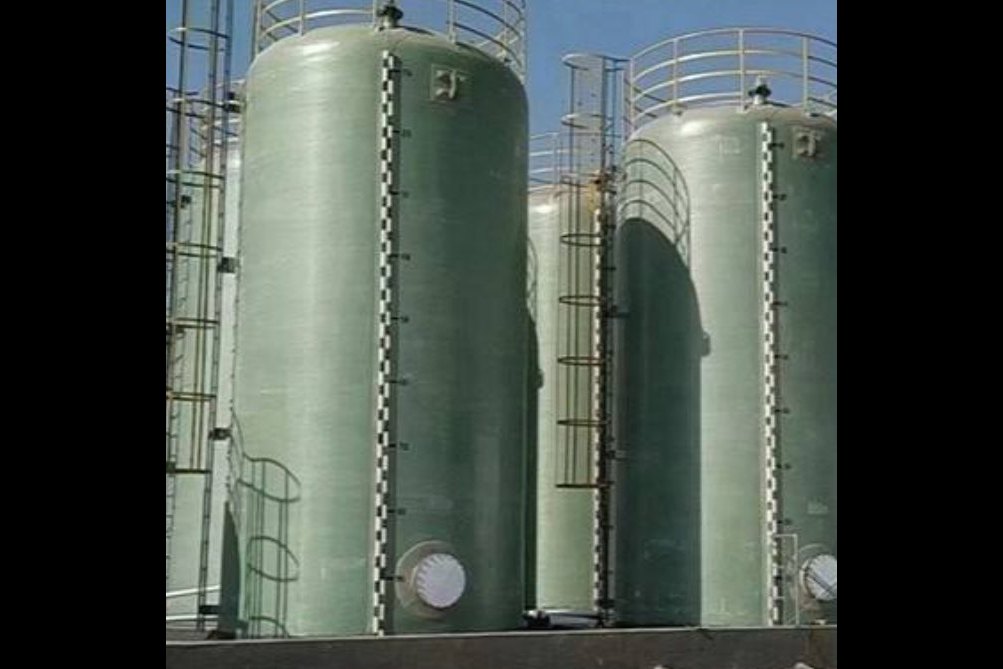
Sooner or later every fiberglass tank needs someone inside it: sludge to clear, liner surfaces to inspect, a level gauge to refit. Yet the same chemistry that makes FRP tanks corrosion-proof — resin-rich surfaces, styrene-based thermosets, gelcoat barriers — creates confined-space hazards that steel-tank crews never think about. Residual styrene evaporating from a film of unreacted resin can reach flammable concentrations from less than half a cup of liquid; a nitrogen-blanketed headspace can be lethal within one breath; and the old rule that "it's just water, it's safe" collapses the moment organic residues or hydrogen sulfide enter the picture. Tank entry is a permit-space operation by default, and this guide walks through the regulatory logic (OSHA 1910.146), the FRP-specific chemistry, the gas-testing sequence, the ventilation math, and the cleaning practices that respect the laminate you paid for.
1. A Fiberglass Tank Is a Permit Space Until Proven Otherwise
Under OSHA 1910.146 the classification logic is strict: a space is a permit-required confined space if it is large enough to enter, has limited entry and exit, is not designed for continuous occupancy, and contains or has the potential to contain a hazardous atmosphere, engulfment material, or other serious hazard. The regulation's operating default is blunt: all spaces shall be considered permit-required confined spaces until pre-entry procedures demonstrate otherwise. An FRP chemical tank meets every criterion on the day it is emptied — restricted through the manway, potentially holding styrene vapour from the liner, solvent residues from the last campaign, oxygen-displacing atmospheres from blanketing systems, and liquid or sludge that can engulf.
Host employers who bring contractors in for tank cleaning carry explicit duties under 1910.146(c)(8): inform the contractor that permit spaces exist, apprise them of the identified hazards and the host's experience with the space, and coordinate entry operations. If you buy tanks but outsource cleaning, the obligation to communicate does not outsource with the work.
A permit space is defined by what it can contain, not by what you measured last week. The empty FRP tank that tested clean in March is still a permit space in November, when a 20-year-old liner film starts outgassing under a closed manway.
2. The Regulatory Frame: How 1910.146 Thinks
The standard's hazard definitions set the numeric rules of the game. A hazardous atmosphere exists when flammable gas, vapour or mist exceeds 10% of its lower flammable limit; when airborne combustible dust obscures vision at 5 feet or less; when oxygen is below 19.5% or above 23.5%; when any substance exceeds its published permissible exposure limit in a way that could cause death, incapacitation or acute illness; or when any other condition immediately dangerous to life or health (IDLH) is present. Acceptable entry conditions are simply the state in which none of these exist and the permit authorizes entry.
Two structural ideas matter for tank work. First, ventilation controls but does not eliminate: the regulation states that controlling atmospheric hazards through forced air ventilation does not constitute elimination of the hazards — a space managed by ventilation remains a permit space, while a space whose hazards are physically removed (purged, cleaned, isolated) can be reclassified under (c)(7). Second, the permit is evidence: the completed permit must be posted at the entry portal so entrants can confirm pre-entry preparations, and it documents test results, isolation measures, rescue arrangements and duration. When the audit comes, the permit is the record.
| Atmospheric parameter | 1910.146 threshold | Field meaning |
|---|---|---|
| Flammable gas / vapour | > 10% of LFL | Entry prohibited; ventilate and retest |
| Oxygen | < 19.5% or > 23.5% | Deficiency (asphyxiation) or enrichment (fire) risk |
| Toxic substances | Above the published PEL/TLV with acute effects | Substance-specific control (styrene, H2S, CO) |
| Combustible dust | Concentration meeting or exceeding its LFL | Rare in tanks; relevant after powder handling |
| Any IDLH condition | Present in any form | No entry without full respiratory protection regime |
3. Isolation First: Blinding, Draining and De-Energising
Before anyone tests air, the tank must be isolated from everything that can fill it. The regulation's definition is precise: blanking or blinding means the absolute closure of a pipe by a solid plate covering the bore, capable of withstanding the line's maximum pressure with no leakage. Valves shut are not isolation — a single leaking seat can trickle solvent into a tank overnight and defeat your morning gas test. The isolation checklist for a typical FRP process tank: disconnect or blind all inlet and outlet nozzles (or break the flanged spools), lock out agitators and mixers at the disconnect, isolate and lock the blanketing nitrogen supply at a double-block arrangement or blind flange, drain and flush residues to the appropriate waste stream, and physically verify that the level instrument reads empty and that vent paths are open.
Isolation is also where FRP tanks differ from steel ones. The laminate is not rated for the same nozzle loads as steel, so blinds must be supported rather than levered into flange gaps, and bolt torques on FRP flanges follow the tank manufacturer's gasket schedule — this is not the place for the fitter's "one pull on the long bar" habit.
4. Atmospheric Testing: Order, Instruments and Thresholds
The standard fixes both the instrument and the sequence: the internal atmosphere shall be tested with a calibrated direct-reading instrument, in this order — oxygen content first, then flammable gases and vapours, then potential toxic air contaminants. The order is not ceremonial: an oxygen-deficient atmosphere can extinguish the pilot of a combustible-gas sensor and make an LFL meter read falsely safe, so the O2 check validates the instrument's ability to read everything else. Retest periodically as ventilation runs, monitor continuously while occupied, and give entrants (or their representatives) the opportunity to observe the testing, as the regulation explicitly requires.
Instrument calibration is a written expectation — calibrate to the manufacturer's schedule and bump-test before the campaign. For toxic gases in FRP service the headline actors are hydrogen sulfide (in wastewater and sludge service) and carbon monoxide (where combustion equipment has run inside); OSHA's own sewer-entry guidance treats 10 ppm H2S and 35 ppm CO, both as 8-hour averages, as the alarm points that pull crews out until conditions are re-evaluated. Hydrogen sulfide deserves special respect in FRP sewage and sludge tanks: it is 1.18 times heavier than air and pools in sumps and low points, which is why the probe goes to the bottom first and why "the reading at the manway was fine" is not a test.
- Test in order: O2 → LFL → toxics, top to bottom, at every level the worker will occupy
- Calibrated direct-reading instrument only; bump-test before each campaign
- Continuous monitoring during occupancy with audible alarms
- Any alarm: everyone exits immediately; the space is re-evaluated before re-entry
- Record results on the permit with names, instrument IDs and times
5. Styrene: The Hazard Only FRP Tanks Have
Styrene monomer is the reactive diluent in nearly every unsaturated polyester and vinyl ester resin, and uncured resin films inside a new tank, a recent relining or a repair patch keep emitting it. The occupational limits are layered: OSHA's table Z-2 permits 100 ppm as an 8-hour TWA with a 200 ppm ceiling and a 600 ppm maximum peak (5 minutes in any 3 hours); NIOSH's recommended limit is far stricter at 50 ppm TWA and 100 ppm ceiling; ACGIH's TLV, the value most modern specifications now chase, is 10 ppm TWA and 20 ppm STEL. Below those health limits sits the flammability line: styrene's LEL is 0.9 volume percent, so the 10%-of-LFL entry threshold is 900 ppm — comfortably above the acute health limits but reachable surprisingly fast.
How fast? For a DN3000 × 6 m tank (42.4 m³), the ideal-gas calculation says about 163 g — roughly 180 mL — of liquid styrene evaporating inside the tank saturates the headspace to exactly the 900 ppm alarm point. A film of wet resin left on a tool tray can carry that much. Ventilation is the countermeasure, and the arithmetic is unforgiving: with a single 3,050 m³/h blower (300 mm duct at 12 m/s) on the manway, steady-state dilution of 1 L evaporating over 10 minutes holds the tank at about 420 ppm — 46% of the alarm point — while about 2.15 L evaporating over the same ten minutes defeats that fan entirely. The practical conclusions: keep free styrene out of the tank in the first place, allow liner films to cure fully before entry, and size ventilation so that a plausible spill rate keeps the sensor below 10% LFL with margin, not on the line.
| Styrene parameter | Value | Source / basis |
|---|---|---|
| OSHA PEL | 100 ppm TWA / 200 ppm ceiling / 600 ppm peak (5 min in 3 h) | 29 CFR Table Z-2 |
| NIOSH REL | 50 ppm TWA / 100 ppm ceiling | NIOSH published recommendation |
| ACGIH TLV | 10 ppm TWA / 20 ppm STEL | Current TLV guidance |
| LEL | 0.9 vol% (9,000 ppm) | Flash-point data |
| 10% LFL entry threshold | 900 ppm | 1910.146 hazardous-atmosphere definition |
| Liquid to reach 900 ppm in a 42.4 m³ tank | ≈ 163 g (≈ 180 mL) | Worked ideal-gas example above |
6. Ventilation: Continuous, Directed and Sized With Arithmetic
Where a hazardous atmosphere is managed rather than eliminated, the regulation's requirements are specific: continuous forced air ventilation, directed to ventilate the immediate areas where employees are or will be present, supplied from a clean source that cannot itself add hazards, running before entry until it has eliminated the hazardous atmosphere, and continuing until all employees have left. Recirculated air from inside the tank does not qualify — the supply must be fresh.
Sizing starts from air changes. For our 42.4 m³ tank, a common industry target of around 20 air changes per hour for confined-space clearance work needs 848 m³/h, which a 300 mm duct delivers at a gentle 3.3 m/s. A practical blower — the same 3,050 m³/h unit from the styrene example — runs the tank at about 72 ACH and completes five full volume exchanges (the customary clearance rule of thumb before first entry) in about 4 minutes. But three cautions keep the arithmetic honest. Placement: the duct must reach the work area and the far end of the tank, not blow air in one manway while vapour stagnates behind baffles. Stratification: purge time calculations assume perfect mixing that real tanks rarely deliver — styrene vapour is heavier than air and H2S heavier still, so dead zones persist behind weirs and under nozzles unless the duct reaches them. And re-entry: after any work stoppage that stops the blower, the clearance clock restarts.
One volume exchange with pure nitrogen takes a 20.9% O2 headspace below 8%; two take it below 3%. Nitrogen-blanketed tanks do not announce themselves — test before the first breath, every entry, no exceptions.
7. The Entry Permit: Elements and Execution
The permit under 1910.146(d) is the spine of the operation. It identifies the space and the work purpose, names the authorized entrants, the attendants and the entry supervisor, lists the hazards of the space, and records the measures used to isolate it — blinds, disconnections, lockouts. It states acceptable entry conditions, records the pre-entry test results with instrument identifications and times, and specifies the ventilation, communications and PPE regime, the rescue arrangements and how summoning works, and the permit's duration. Execution discipline in the field: the entry supervisor signs only after walking the isolation, the permit is posted at the manway, duration matches the task (a new shift means a new permit), and the permit is cancelled — not archived — when work stops, with a fresh evaluation before resuming. A permit that survives the audit is one that was written for this entry, not photocopied from the last one.
8. Cleaning Methods That Respect the Laminate
FRP gives you a chemically inert wall, but the gelcoat and corrosion barrier have limits that careless cleaning ignores. Work with low-pressure water or steam at the pressures the tank manufacturer sanctions; high-pressure lance work (above roughly 1,000 bar class equipment) can cut or delaminate older liners and drives water through any wicking path in hand-lay repairs. Choose detergents compatible with the resin system — avoid aggressive solvents such as acetone in volume, which swell and craze polyester gelcoats, and never chlorinate: sodium hypochlorite solutions degrade the barrier layer and, in wastewater service, generate chlorinated organics that change your waste-disposal obligation. Sludge removal is mechanical work — squeegees, shovels and vacuum transfer — done under continuous ventilation and monitoring, because the disturbance itself releases trapped H2S or solvent vapour; plan for a reading spike the moment the first shovel goes in. For potable-water tanks the regime is stricter still, from food-grade materials through disinfection residuals, and we cover that separately in our potable-water approvals guide.
- Low-pressure wash or steam within the manufacturer's sanctioned pressures
- Resin-compatible detergents; no bulk acetone or chlorinated cleaners on gelcoat
- Sludge removal under continuous monitoring — expect a vapour spike on disturbance
- Waste and wash water segregated per the residue chemistry, not poured to drain
- Final rinse water quality documented for product-contact tanks
9. Rescue, Attendants and the Non-Entry Rule
The regulation requires at least one attendant outside the permit space for the duration of entry, and the attendant's core duty is hard to overstate: they monitor entrants, maintain communication and order evacuation — but they do not enter. The fatality statistics behind that rule are stark: more than half of confined-space deaths are would-be rescuers. Before entry, the employer must evaluate any designated rescue service for response time and proficiency with the actual hazards, inform them of what they may face, and provide the means for non-entry retrieval where feasible — a full-body harness with a lifeline anchored outside, wristlets for deep tanks, and a tripod or davit with a man-rated winch at the manway. Practice the retrieval, not just plan it: a harness stored in the site office adds zero seconds of survivability when the entrant collapses at the tank bottom.
10. A Field Checklist That Survives Audit
- Classify the space and the entry; default to permit-required
- Isolate with blinds, breaks and lockouts; verify the level instrument and open the vents
- Test O2 → LFL → toxics, top to bottom, with a calibrated direct-reading instrument; record on the permit
- Ventilate continuously, ducted to the work zone, from a clean source; size for ACH and plausible vapour release
- Permit posted, signed by the entry supervisor, matching this entry's duration
- Monitor continuously with alarms; any threshold — everyone out, re-evaluate
- Staff the attendant, evaluate rescue services, stage retrieval equipment at the manway
- Clean within the laminate's limits; segregate waste by chemistry
- Close out with test results, photos and the cure/status of any liner work
The permit costs forty minutes; the funeral costs everything. The arithmetic of tank entry is always the same trade — and the regulation exists because too many crews once bet the other way.
Planning a Tank Entry or Liner Refurbishment?
HuanGang manufactures filament-wound FRP storage tanks for chemical, water and wastewater service, with documented liner systems, manway and nozzle details suited to safe entry, and factory support for inspection and refurbishment programs. Contact our engineering team with your tank datasheet and cleaning plan, and we will return the manufacturer-side requirements for entry, isolation and surface work.
Related reading: FRP Tank Repair: Cracks, Surface Damage and Relining · FRP Tank Hydrotest and First-Fill Acceptance · Potable Water Approval for FRP Tanks and Pipes · Filament-Wound FRP Chemical Storage Tank · Horizontal FRP Water Storage Tank
Need help selecting FRP products?
Our engineers answer technical questions free of charge.
Ask an Engineer on WhatsApp