
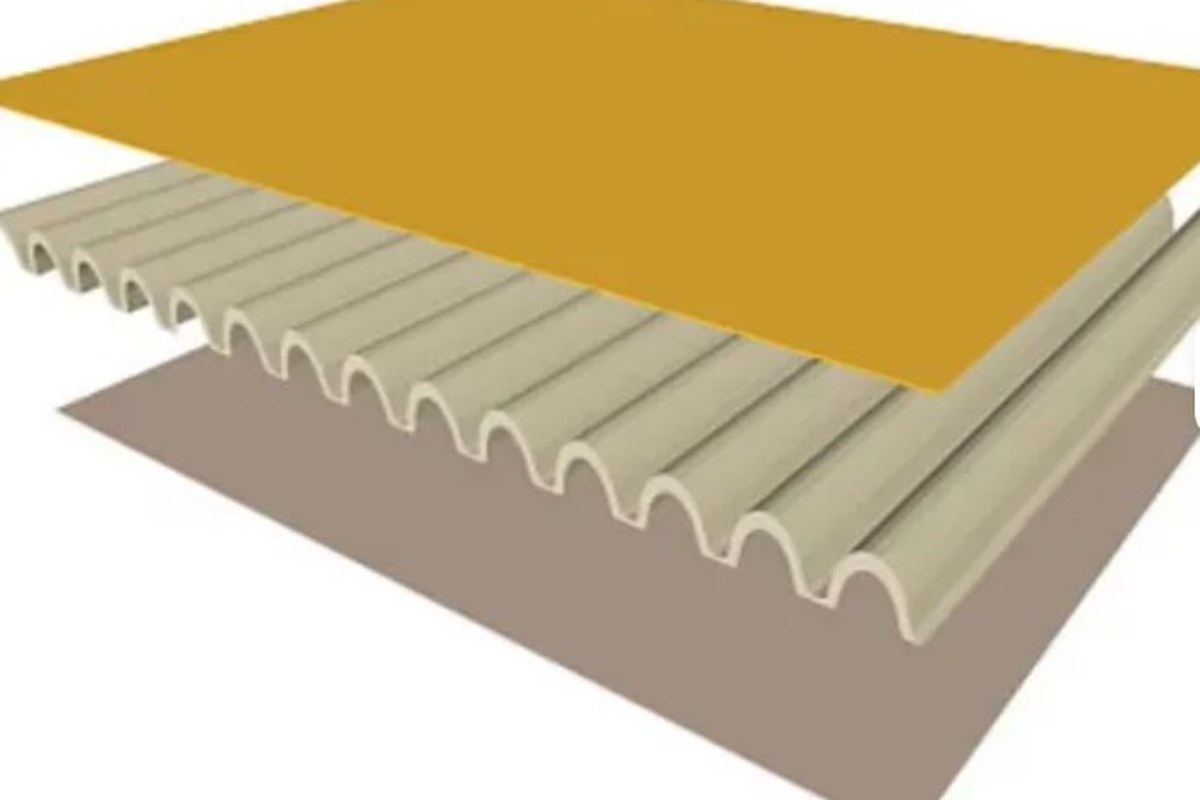
Two FRP panels can come off two production lines built to the same drawing, cure in the same week, leave the same factory — and look five years old and fifteen years old respectively at the end of a single summer. The difference is not the laminate. It is the half-millimetre of resin at the surface, the pigment and additive package inside it, and whether anyone specified what that surface had to do after 2,000 hours of ultraviolet radiation and condensation.
This guide is written for buyers and engineers who have to defend a colour and gloss specification in a purchase order, not for chemists. It explains what ultraviolet actually attacks, which four degradation signals you can actually measure, how gelcoat chemistry and UV additive packages change the outcome, which weathering chamber answers which question, and — the part most specifications get wrong — why accelerated test hours cannot be converted into years of service at a fixed ratio.
1. What Ultraviolet Actually Attacks in a Thermoset Laminate
Sunlight does not damage glass fibre at the wavelengths that reach the ground. Carbon–carbon and carbon–hydrogen bonds in the cured polyester or vinyl ester matrix absorb the 290–400 nm band, and that absorbed energy breaks polymer chains (scission) and simultaneously forms new cross-links. The visible consequences are oxidised species — carbonyl and hydroxyl groups — forming at the surface, measurable by infrared spectroscopy, and a matrix that slowly loses elasticity and gains brittleness at the exposed face.
The single most important engineering fact is that this attack is surface-confined in thermoset FRP. Industry guidance for architectural FRP products is explicit that weathering degradation is typically contained within the surface veil, so it is a cosmetic effect that does not normally affect structural performance — the same conclusion the marine industry reached decades ago, where twenty-year-old hulls remain structurally sound after decades of relentless UV and salt exposure while their gelcoat has faded.
That containment is geometry, not luck. Photo-oxidation requires oxygen and light together, and both are attenuated rapidly: oxygen diffusion into a cured laminate is slow, and the resin absorbs and scatters UV within the outer fraction of a millimetre. In practice the degraded layer sits in the outermost few tenths of a millimetre — the same order of thickness as the gelcoat and surface veil that were applied to protect it. The structural laminate behind that barrier sees essentially no radiation.
This is why an FRP tank shell, pultruded profile or roof panel that has gone chalky is not a structural emergency, and why a laminate that has been ground through its barrier and left unsealed in the open air is a real one. It also explains the design logic of every UV protection strategy described below: they are all attempts to put a stable, opaque, renewable sacrificial layer in front of the load-bearing structure.
Practical consequence for specifications: UV exposure is an appearance and surface-integrity phenomenon in thermoset FRP. Write your weathering requirement around colour, gloss, chalking and surface veil integrity — not around a mechanical property drop that will not materialise while the barrier is intact. Reserve mechanical retention checks for coupons that have been deliberately exposed without a barrier.
2. The Four Signals of UV Degradation — and Which One Matters First
UV degradation does not arrive all at once. It arrives in a sequence, and the sequence determines both what you can measure at 500 hours and what you should put in the acceptance criteria.
Colour shift and yellowing appear first, usually before any measurable surface change. The mechanism is the formation of conjugated chromophores from the aromatic structures in the resin and from residual initiator or inhibitor chemistry. On a pale grey or white FRP surface this reads as yellowing; on a dark surface it reads as fading and loss of depth. Commercial outdoor exposure studies of polyester gelcoats show total colour change rising for roughly three years before plateauing — and in some datasets even partially recovering — while gloss keeps falling throughout.
Chalking comes next. Once the surface resin has been consumed to the point where pigment particles and glass strands are no longer encapsulated, a friable powder layer forms. It wipes off on a hand, it holds dirt differently from the surrounding surface, and it makes the panel look washed-out from a distance while the underlying colour may be acceptable under the chalk layer.
Gloss loss follows chalking and is the most visible signal on gelcoated architectural and marine parts. It is driven by progressive roughening of the surface at the micrometre scale, which scatters light instead of reflecting it specularly. Long-term exposure data show gloss declining steadily and irreversibly while colour change plateaus — the reverse of the usual assumption that colour and gloss move together.
Fibre show-through and microcracking are the end-state signals. When the surface resin is gone, the glass reinforcement becomes visible as a "glass print" or fibre pattern. In daylighting panels this is the specific defect the panel standard is built around, and it is graded rather than judged by eye: a weather-resistant grade requires no glass leakage after the specified weathering dose.
| Signal | Mechanism | Test method | What it tells you |
|---|---|---|---|
| Colour change / yellowing | Chromophore formation in the resin; loss of pigment encapsulation at the surface | ASTM D2244 (CIELAB ΔE), ASTM E313 (yellowness index) | Earliest indicator; driven mostly by the UV absorber package. Cosmetic. |
| Chalking | Surface resin consumption; pigment and fibre left unbound | ASTM D4214 tape/rub method, reported on a 0–10 scale | First sign that the surface layer is genuinely being consumed, not just discoloured. |
| Gloss loss | Micrometre-scale surface roughening; light scattered rather than reflected | ASTM D523, 60° geometry (20° for high-gloss finishes) | Commercial appearance indicator; irreversible without re-coating. |
| Fibre show-through | Barrier fully consumed; reinforcement exposed | Visual per ASTM D2563 defect classification; panel grade test per ASTM D3841 | Genuine surface-integrity failure. Triggers repair, not just a colour complaint. |
| Mechanical retention (control test) | Matrix embrittlement where the barrier is absent or damaged | ASTM D638 tensile, ASTM D790 flexural, ISO 527 | Should be run on uncoated control coupons, not on gelcoated production surfaces. |
3. Gelcoat: The Primary UV Barrier and How It Is Specified
A gelcoat is a pigmented, thixotropic, usually iso or iso-NPG based resin layer sprayed into the mould first so that it becomes the outer surface of the finished part. Industry guidance for architectural FRP describes it as a deep protective layer of roughly 10–20 mil (0.25–0.51 mm), and spray practice in gelcoat application literature typically targets 0.7–0.9 mm total, applied in two passes of about 0.4–0.5 mm and 0.3–0.4 mm to avoid porosity and sagging.
Two parameters in that range do the work: thickness and opacity. Thickness buys time, because the barrier is sacrificial. Opacity decides whether radiation ever reaches the laminate underneath — a translucent gelcoat, or one that is simply too thin over a glass-rich laminate, leaks UV straight into the surface veil and the failure mode changes from colour drift to fibre print.
Resin chemistry then decides how gracefully the barrier ages. The general ranking used in the marine and sanitary-ware industries is consistent and worth understanding before you compare quotations.
| Gelcoat base | Weather / water resistance | Gloss retention | Where it is the right choice |
|---|---|---|---|
| Orthophthalic (ortho) | Basic | Modest | Indoor parts, short-life moulds, cost-driven non-visible components |
| Isophthalic (iso) | Good mechanical strength, weather resistance and chemical resistance | Good | General outdoor FRP where the budget will not stretch to NPG |
| Ortho-NPG | Very good water and weather resistance | Very good | Outdoor products with a moderate appearance specification |
| Iso-NPG | The reference grade for weathering; excellent water resistance, stain resistance and colour retention | Highest of the polyester family | Visible outdoor parts: cooling tower casings, roof and wall panels, marine and sanitary ware |
| Vinyl ester gelcoat | Excellent hardness and chemical resistance; used for tooling and aggressive service | Good, but the harder surface can be less tolerant of impact | Moulds, chemical-service equipment, high-hardness requirements |
Behind the gelcoat, a resin-rich surface layer reinforced with a fine C-glass surfacing veil does the second half of the UV job. The veil thickness (typically tens of grams per square metre) is comparable to the UV penetration depth, which is precisely why industry practice places it there. Where corrosion-barrier laminates are specified under ASME RTP-1, the barrier is commonly built from two layers of C-glass surfacing veil followed by chopped strand mat at a minimum total thickness around 2.5 mm (100 mil) — a corrosion requirement that happens to deliver an excellent UV barrier as a by-product.
4. UV Absorbers and HALS: What the Additive Package Can and Cannot Do
Protection inside the resin is delivered by two additive families whose roles are often confused in purchase orders.
UV absorbers (hydroxyphenylbenzotriazoles, hydroxybenzophenones and the newer triazine classes) work by absorbing ultraviolet radiation and dissipating it as heat before it can cleave polymer chains. In gelcoat formulations they are the additives that protect against colour change and yellowing, because they keep the absorbed energy away from the resin chromophores.
Hindered amine light stabilisers (HALS) work completely differently: they interrupt the radical chain reactions that propagate oxidation, regenerating themselves in the process. In polyester gelcoats, published formulation work found that HALS used alone gives essentially no protection against yellowing, while UV absorbers protect colour — but the two together outperform either alone, and the benefit of the absorber is not linear in concentration.
The practical consequences for a specification are these:
- Ask for the package, not an ingredient. "Contains UV stabiliser" is meaningless. Ask for the specific absorber and HALS types and their loading (a typical development range is around 0.2–0.5 parts per hundred resin for each, optimised by QUV testing rather than assumed).
- Absorber loading protects colour; HALS protects surface durability. If your complaint history is yellowing, the absorber system is the lever. If it is chalking and gloss loss, the HALS and the barrier chemistry are the levers.
- There is a ceiling. Over-loading absorbers costs money, can affect cure and mechanical properties, and can migrate. Beyond a point the formulation becomes uneconomic for a marginal gain.
- Additives do not fix a thin barrier. No additive package rescues a 0.2 mm gelcoat over a glass-rich laminate. Barrier thickness and opacity come first; chemistry optimises what is already there.
Pigment choice is the third lever and the cheapest. An opaque light-coloured surface reflects a large share of incident radiation, runs cooler under the same sun load, and hides yellowing far less well than a dark one — which is why the classic durable specification for outdoor FRP is a light, fully opaque topcoat. Deep colours absorb more radiation, reach higher surface temperatures, and therefore cycle through a larger thermal strain range on every sunny day, which accelerates microcrack initiation around any surface defect.
5. Choosing the Right Weathering Test: A Method Selection Table
Accelerated weathering is a family of instruments, not a single test, and the lamp decides what you are measuring. Fluorescent UV chambers concentrate energy in the ultraviolet band with tight control of irradiance and black-panel temperature; xenon-arc chambers reproduce the full solar spectrum including visible and infrared, which matters for colour and heat ageing.
| Method | Source and spectrum | Typical cycle | Best used for |
|---|---|---|---|
| ASTM G154, Cycle 1 | UVA-340 lamp, 0.89 W/m²/nm at 340 nm | 8 h UV at 60 °C black-panel temperature / 4 h condensation at 50 °C | The default general-purpose cycle for non-metallic materials including FRP; drives chalking and gloss loss |
| ASTM G154, Cycle 4 | UVA-340 lamp | 8 h UV at 50 °C / 4 h condensation at 40 °C | Milder cycle used for plastics and polymers where Cycle 1 is too aggressive |
| ASTM G154, Cycles 5 and 6 | UVB-313 lamp, 0.48 W/m² | 4 h or 8 h UV at 60 °C / 4 h condensation at 50 °C | Fast ranking and quality control screening. Conservative: UVB below 300 nm does not exist in sunlight, so results overstate damage |
| ASTM D4329 / ASTM D4587 | Fluorescent UV | Cycles defined in each standard | D4329 for plastics exposed outdoors; D4587 for coatings and gelcoat-type finishes |
| ISO 4892-3 | UVA-340, 0.76 W/m²/nm at 340 nm | 8 h UV at 60 °C / 4 h condensation at 50 °C | The international equivalent of the ASTM fluorescent UV approach |
| ASTM G155 / ASTM D2565 / ISO 4892-2 | Xenon arc, filtered, about 0.51 W/m² at 340 nm | 102 min light + 18 min light with water spray; black-panel temperature around 65 °C | Full-spectrum simulation for colour and heat ageing; the preferred choice when appearance is contractual |
| ASTM D1435 and outdoor Arizona/Florida exposure | Natural sunlight, 45° south-facing rack | Months to years, with periodic cleaning | The reference against which every accelerated result should ultimately be anchored |
Two selection rules save most of the argument. First, if your customer's specification names a standard, use that standard — chamber choice is not interchangeable, and a UVA-340 result cannot be presented as a xenon-arc result. Second, if you are choosing for yourself, decide whether the question is UV-driven (colour, chalking, gloss) or spectrum-and-heat driven (colour plus heat ageing for architectural and automotive appearance). The first is cheaper and faster; the second correlates better with real appearance acceptance.
6. Reading the Results: Thresholds That Survive a Contract
Test hours without end-point thresholds are decorative. The four numbers that carry commercial weight are colour difference, gloss retention, chalk rating and — only for uncoated controls — mechanical retention.
Colour difference is calculated in CIELAB as the Euclidean distance between the exposed and the reference reading. A commonly quoted perception threshold for the human eye is in the region of ΔE 2.3, which is why so many specifications land on ΔE ≤ 3 as a workable pass mark and why tight-appearance markets (some automotive interior and architectural coating specifications) push the limit to ΔE ≤ 2 or even to around 1.5. Gloss is measured at 60° for semi-gloss surfaces and 20° for high-gloss finishes, and retention is expressed as a percentage of the initial value; a floor of 80% retention is a common general requirement, with high-gloss finishes sometimes accepted at 60%.
| Application | Typical acceptance wording | Why |
|---|---|---|
| Daylighting / roofing panel, visible from ground | Weather-resistant grade per ASTM D3841 (Grade 1), no glass leakage after the specified outdoor or xenon-arc exposure dose; type CC1 where limited flammability is required | Fibre print is the failure mode that ends panel life; the panel standard already defines the grade and dose |
| External architectural or structural profile, visible | ΔE ≤ 3 and 60° gloss retention ≥ 80% after 2,000–3,000 h of the specified cycle, with chalk rating ≥ 8 | Balances appearance expectations against the reality that no gelcoat is colour-stable forever |
| Industrial tank, duct or cooling tower shell, exposed | ΔE ≤ 5, gloss retention ≥ 50%, no fibre show-through, no cracking visible at 3× magnification | The site cares about surface integrity and inspection readability more than showroom appearance |
| Uncoated laminate (deliberate control coupon) | Tensile and flexural retention ≥ 90% of unexposed control after the same exposure | Confirms the barrier argument: if retention drops, the coupon lost its protection |
Screen these numbers against the resin and gelcoat supplier's own QUV or xenon data before they reach a purchase order, and state the lamp type, irradiance, cycle, chamber and number of hours alongside every threshold. A clause that says "UV stable to 3,000 hours" without naming the cycle is not a specification; it is a hope.
7. The Equivalence Trap: Why 2,000 Hours Is Not a Number of Years
The most expensive error in UV specification is treating accelerated hours as convertible into service years at a fixed exchange rate. Published long-term gelcoat studies make the reason obvious: in one dataset the accelerated equivalent of one year of outdoor exposure worked out at roughly 24–48 hours for yellowing but around 200 hours for gloss change in a QUV chamber, and roughly 300 hours for yellowing against about 450 hours for gloss loss under xenon-arc exposure. The two end-points are converting at rates that differ by almost an order of magnitude, in the same test, on the same material.
The underlying causes are physical, not experimental sloppiness:
- Colour and gloss age on different clocks. Chromophore formation saturates — colour change typically peaks and then plateaus or partially recovers — while surface roughening accumulates monotonically.
- Moisture delivery changes the ranking. Continuous condensation in a QUV chamber is far less damaging to chalk formation than the hourly water-spray thermal shock of outdoor exposure, which is why chalk and gloss loss can be delayed in one chamber and accelerated in another.
- Heat is not just UV. Xenon-arc chambers include infrared, so part of the yellowing they produce is thermally driven rather than photolytic — closer to reality for dark surfaces, different from a pure UV chamber.
- Site conditions vary more than chambers do. Latitude, altitude, cloud cover, tilt, mounting height, local pollution and the surface temperature of the part all shift real degradation rates.
How to write a defensible weathering clause: never claim an equivalence to years. Instead (1) name the standard and cycle, (2) specify the exposure duration, (3) set numeric thresholds for ΔE, gloss retention and chalking, and (4) include a reference material with a known outdoor history in the same test run. The reference converts a standalone hour count into a ranking — which is the only thing accelerated weathering reliably delivers.
8. Specifying and Inspecting UV Performance in Practice
A workable specification turns all of the above into five controllable items.
- Barrier definition. Gelcoat type (iso-NPG or better for visible outdoor parts), nominal thickness with a minimum, colour and opacity requirement, and the surface veil behind it. Reject any offer that will not state thickness in millimetres or mils.
- Resin and additive declaration. Resin type plus the UV absorber and HALS types, with loadings. Ask for the supplier's accelerated data on the actual formulation, not the generic resin data sheet.
- Test protocol. Standard, lamp, irradiance, cycle, black-panel temperatures, duration, and end-point thresholds, all written into the order. Where the panel is a building product, use the panel standard's grade classification instead of inventing one.
- Sampling from the production line. Coupons must come from the same run as the delivered goods. A lab panel made by a technician from the same resin proves nothing about a production gelcoat applied at the wrong thickness on a cold morning.
- Delivery documentation and inspection. Record gelcoat thickness measurements, batch numbers, ambient conditions at gelcoat application, and the test report. On site, inspect for pinholing, resin-starved areas, gloss variation between panels of the same shipment, and any spot where the barrier has been sanded through.
Colour consistency across shipments deserves its own line item when the product is visible. Agree a control sample with the customer, keep it in the dark, and compare each production batch to it instrumentally at 60° and in CIELAB rather than by eye under factory lighting. Batch-to-batch ΔE drift is a manufacturing control problem; UV-induced drift is a formulation problem. Confusing the two wastes money in both directions.
9. Repair, Restoration and Accepting Colour Drift
When a surface does degrade, the response should be graded to the defect, and the grading follows the signals in section 2.
| Condition | Diagnosis | Action |
|---|---|---|
| Yellowed or faded, gloss intact, no chalking | Chemical colour shift within an intact barrier | Cosmetic only. Document, monitor annually, no structural action. Do not grind — you would remove the barrier you still have. |
| Chalky film, gloss reduced but no fibre visible | Surface resin partially consumed | Clean and re-coat: a UV-stable topcoat or paint system restores protection at a fraction of re-gelcoating cost. Re-check chalk rating after one year. |
| Gloss lost, light sanding marks or staining retained after cleaning | Barrier nearing end of life | Plan a re-coat. Mechanical polishing alone removes material without restoring UV resistance and is only appropriate where appearance within a specific area matters. |
| Glass fibre visible (fibre print), or cracks at fixings and cut edges | Surface integrity failure | Surface repair: abrade, seal exposed edges with a resin-rich laminate or surface veil, then re-coat. If cracking extends into the structural laminate, treat it as a structural repair and follow the laminate repair procedure. |
Note the asymmetry that makes all of this manageable: the structural laminate behind an intact barrier is protected from UV by geometry, but it is not protected from the consequences of opening the barrier. Every cut edge, drilled hole and sanded patch in an outdoor FRP part is a new UV path into the surface veil, and it will weather faster than the moulded surface around it. Cutting, machining and repair specifications should therefore require sealing of all exposed glass, not just a cosmetic touch-up of the visible face.
Henan HuanGang supplies UV-stabilised FRP panels, profiles, gratings, tanks and equipment with documented gelcoat type, barrier thickness and resin/additive declarations, and can supply weathering test reports on the specific formulation quoted. For visible outdoor FRP work, send us the exposure environment, the appearance expectations and the standard your customer names, and we will confirm the gelcoat system, barrier build-up and gradient of UV stabilisation that matches the service life you are committing to. Related reading: FRP sandwich panel core selection, daylighting panel and corrugated roof sheet selection and pultruded FRP profiles for structural applications.
Need help selecting FRP products?
Our engineers answer technical questions free of charge.
Ask an Engineer on WhatsApp