
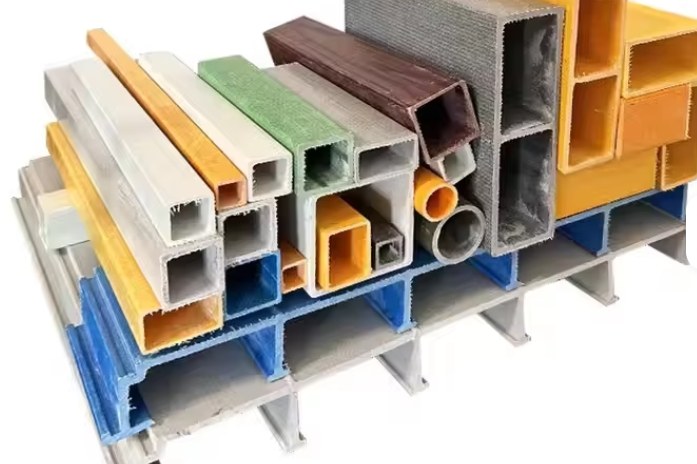
Wastewater treatment plants destroy ordinary structural materials with quiet efficiency. The enemy is not the water — it is hydrogen sulfide gas, which bacteria in the headspace above warm sewage convert to sulfuric acid attacking steel, concrete and coatings alike. That is why the material palette of a modern WWTP has shifted decisively toward FRP: pultruded profiles for structures, molded grating for walkways, handrail systems for edges and custom covers for tanks and channels.
This guide summarises what engineers specify, zone by zone, and the selection checks that keep a plant maintenance-free for decades.
1. The Corrosion Mechanism You Are Designing Against
Biogenic sulfide attack follows a pattern: anaerobic sewage produces dissolved H2S; turbulent drops and warm headspaces release it; aerobic bacteria on damp surfaces above the waterline oxidise it to sulfuric acid (pH locally below 2). The attack zone is therefore the air space — headspaces over channels, tank walls above water line, covers and their supports — not the submerged parts. Specifying for "wastewater" really means specifying for acid gas in the headspace, splash at the interface and washdown chemicals on floors.
2. Where FRP Replaces Steel, Zone by Zone
| Zone | Typical FRP components |
|---|---|
| Clarifier & aeration tank perimeters | Pultruded walkways, handrail systems, grating, launders |
| Channel & basin headspaces | Curved and flat tank covers, baffles, weirs, scum boards |
| Process buildings | Structural frames, platforms, stair towers, cable trays, ladders |
| Underground & wet wells | Pump-station internals, access covers, brace frames |
| Sludge & digester areas | Cover plates, handrails, grating in splash zones |
3. Pultruded Profiles: the Structural Backbone
Pultruded profiles — I-beams, channels, angles, square and rectangular tubes, and custom dies — carry the walkways, platforms and equipment frames. Compared with galvanised steel they cut weight by ~75%, need no repainting cycle, and are non-conductive around the plant's dense electrical infrastructure. The selection logic is the same as any pultruded design: deflection usually governs, so span tables matter more than strength values; we cover the method in our pultruded profiles application guide. Connections use stainless (316) hardware — the one metal still allowed near FRP in this environment.
4. Resin Selection by Exposure Zone
| Exposure | Resin choice | Notes |
|---|---|---|
| General outdoor, mild splash | Isophthalic polyester | Economical, proven in plant atmospheres |
| Headspace over sewage, acid gas | Vinyl ester | Default for covers, baffles, headspace structures |
| Industrial effluent, high chemical load | Vinyl ester (verified grades) | Check against the actual effluent analysis |
5. Covers, Hoods and Odor Control
Covers are where corrosion is harshest, and FRP dominates: curved (arc) covers spanning channels, flat cover plates, and large arched hoods over tanks. Beyond protecting structures, covering the headspace is the first step of any odor-control strategy — the captured foul air then goes to scrubbers or biofilters. Specify sealed edges, hinged or liftable sections for maintenance access, and walkable ratings where covers double as access routes.
6. Walkways, Grating and Handrails
Molded grating with an integrated grit surface serves walkways and platforms; pultruded grating spans longer distances. Handrail systems in pultruded FRP are now the default at clarifier perimeters — non-conductive, no painting, and stable in H2S atmospheres where galvanised rails pinhole within years. Heights and loads should follow the governing code; we walk through them in the FRP handrail systems guide.
7. Quality Checks That Separate Good from Cheap
- Glass content and laminate construction per specification (ask for burn-off or density data)
- Barcol hardness as a cure indicator on delivered profiles
- UV-stabilised veil on all outdoor surfaces
- Covers verified for the actual span and point load (walkable or not)
- Consistent resin system across all components of one structure
8. Installation Notes
FRP structures assemble with hand tools and stainless bolts — no welding permits, no hot-work inside confined headspaces, no coating touch-up. Cut with carbide blades and cap ends. Prefabricate where possible: a cover or platform delivered in lifting-friendly modules installs in hours instead of days, which matters when plant shutdowns are measured in hours. Existing steelwork can often be reused as support, reducing decommissioning scope.
9. Specification Checklist
- Zone map of the plant (headspace / splash / washdown) driving resin choice
- Profiles with span tables and 316 stainless connection hardware
- Grating load class and grit surface for friction
- Covers: span, walkable or not, sealing and access method
- UV protection and colour fastness for outdoor exposure
- QC data: Barcol hardness, glass content, dimensional tolerances
10. Common Mistakes
- Specifying isophthalic resin in H2S headspaces to save 10% on covers.
- Reusing steel connection hardware and reintroducing the corrosion problem.
- Designing walkable covers without point-load checks.
- Buying profiles and grating from different resin systems for one structure.
- Ignoring thermal movement on long covered channels — joint gaps close or open with temperature.
Explore our pultruded square tube profiles, curved sewage tank arc covers, arched tank hoods, integrated pump stations and the full profiles & structural components range; related reads: FRP sheet pile walls and the grating load table guide.
Need help selecting FRP products?
Our engineers answer technical questions free of charge.
Ask an Engineer on WhatsApp