
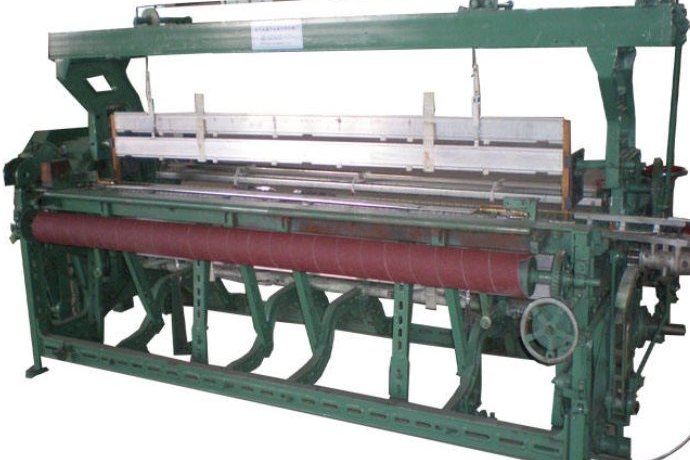
A fibreglass mesh line is usually bought as one package — warper, loom and coating oven — and then run for years on settings that nobody re-derives. The result is a mesh that passes tensile testing on the day it ships and cracks façades eight years later, because the alkali-resistance number, not the virgin tensile number, is what the building actually consumes. This guide works through the whole chain the way a production engineer has to: which glass chemistry you are allowed to use, how yarn count and aperture fix the areal mass before you touch a machine setting, how warping and sizing decide whether the loom can run at all, where the coating pick-up sits, and which tests genuinely decide acceptance. Every number below is either a published material property or arithmetic you can reproduce on a calculator.
1. What a Fibreglass Mesh Line Actually Produces
A construction mesh is a leno- or plain-woven glass fabric, coated after weaving with a polymer that both protects the filaments and stiffens the intersections so the grid does not unravel when it is cut. Four process stages sit in series, and each one has a different failure signature:
- Warping — hundreds of yarn ends are pulled from a creel under individual tension and wound onto a beam. Bad warping shows up as length-wise streaks in aperture size, not as a visible defect.
- Sizing — the warp is impregnated with a film former and coupling agent, then dried. Too little size and the loom stops every few minutes on filament breakage; too much and the mesh goes stiff and refuses to lay flat.
- Weaving — weft is inserted at a fixed pitch, the fabric is beaten up and taken away under controlled tension. This stage fixes aperture size and weft density, which are the two dimensions a customer measures with a ruler on arrival.
- Coating — the greige fabric passes through a polymer bath, is squeezed, and is dried and cured. This stage sets the alkali resistance and the final areal mass.
The commercial output is normally quoted as a class — 75, 110, 145 or 160 g/m² at a 4 × 4, 5 × 5 or 10 × 10 mm aperture — and those classes are not arbitrary. Each one is the arithmetic consequence of a yarn count and a weave density, which is where most specification arguments start.
2. Pick the Glass Before You Pick the Machine
This is the single most consequential decision on the line, and it is made at the yarn purchase order, not at the loom. Portland cement pore solution sits at pH 12.5–13.5. Ordinary E-glass is attacked at that pH and can lose more than half its strength within months, because hydroxyl ions break the Si–O network. Alkali-resistant (AR) glass carries 16–20 % zirconium dioxide in the glass formulation; the zirconia forms a protective hydration layer on the fibre surface that slows the attack to a rate that no longer matters over a building's life.
| Property | E-glass | C-glass | AR-glass (zirconia type) |
|---|---|---|---|
| ZrO₂ content | ~0 % | low | 16–20 % (≥16.7 % per EN 15422 / GB/T 21120) |
| Behaviour in cement pore solution | Degrades — unsuitable | Moderate chemical resistance, not designed for cement | Protective layer forms; retains structural function for design life |
| Filament diameter, typical | 9–17 µm | 9–13 µm | 13–19 µm |
| Strand tensile strength, typical | 2,400–3,100 MPa (roving) | lower than E | ~1,500–1,700 MPa |
| Elastic modulus | ~72–76 GPa | ~70 GPa | ~72 GPa |
| Density | 2,540 kg/m³ | 2,490 kg/m³ | ~2,680 kg/m³ |
| Softening point | ~840 °C | ~840 °C | ~860 °C |
| Where it belongs | FRP laminates, insulation, dry-bonded reinforcement | Chemical service, tank liners, surface veils | EIFS/ETICS base-coat mesh, GRC, cementitious waterproofing |
If the mesh will ever be embedded in a cementitious or polymer-modified mortar, the buyer should ask for the fibre manufacturer's data sheet and confirm the zirconia content themselves. An E-glass mesh and an AR-glass mesh are indistinguishable on delivery — same colour, same feel, same grid — and the difference only appears years later as a façade that loses its crack bridging.
The relevant specifications are worth listing because they are frequently confused. EN 15422 (precast concrete products — specification of glass fibres for reinforcement of mortars and concretes) and GB/T 21120 set the zirconia threshold for AR-glass roving. ASTM C1666 is the equivalent American specification for alkali-resistant glass fibre for GFRC. Yarn designation itself follows ISO 2078:2022 (Textile glass — Yarns — Designation), and woven reinforcement fabric requirements follow ISO 2113:2023.
3. Yarn Arithmetic: tex, Aperture and Areal Mass
Yarn count on a glass line is quoted in tex, which is grams per 1,000 metres. That definition is the whole basis of mesh design. One warp end running one metre contributes T/1,000 grams, where T is the count in tex. Multiply by how many ends cross a metre and you have the glass mass per square metre, before the coating is added.
For a leno weave the warp is arranged in pairs that twist around each other between picks, so one column of apertures carries two warp ends. Weft is inserted once per row. For a square mesh with an aperture pitch p in millimetres:
- Apertures per metre, A = 1000 / p
- Warp ends per metre = 2A (leno) or A (plain)
- Weft picks per metre = A
- Glass mass [g/m²] = (2A·Twarp + A·Tweft) / 1000
- Finished mass [g/m²] = glass mass / (1 − c), where c is the coating fraction of the finished mass
Coating is conventionally quoted as a share of the finished article, typically 10–20 % for an acrylic or styrene-acrylate system. That is why a 15 % coating fraction divides by 0.85 rather than multiplying by 1.15. The table below runs the arithmetic for the common pitches.
| Aperture pitch (mm) | Warps/m (leno) | Picks/m | 68 tex | 100 tex | 136 tex | 200 tex | 272 tex |
|---|---|---|---|---|---|---|---|
| 4.0 | 500 | 250 | 60 | 88 | 120 | 176 | 240 |
| 5.0 | 400 | 200 | 48 | 71 | 96 | 141 | 192 |
| 6.0 | 333 | 167 | 40 | 58 | 79 | 116 | 158 |
| 10.0 | 100 (plain) | 100 | 16 | 23 | 31 | 46 | 63 |
Finished mesh mass in g/m², coating included (15 % for the first three rows, 13 % for the 10 mm row).
Run it backwards and you get the yarn count the purchasing department actually needs to buy:
| Target class (g/m²) | Aperture (mm) | Coating | Required glass (g/m²) | Required yarn (tex) |
|---|---|---|---|---|
| 60 | 10 × 10 | 13 % | 52.2 | 174 |
| 75 | 5 × 5 | 15 % | 63.8 | 106 |
| 110 | 5 × 5 | 15 % | 93.5 | 156 |
| 145 | 5 × 5 | 15 % | 123.2 | 205 |
| 160 | 5 × 5 | 15 % | 136.0 | 227 |
| 160 | 4 × 4 | 15 % | 136.0 | 181 |
Two practical consequences follow. First, a supplier who offers "5 × 5 at 160 g/m² and 4 × 4 at 160 g/m²" is running two different yarn counts, 227 tex and 181 tex — the finer grid needs less yarn per end because it has more ends. Second, if you want to move a 145 class to a 160 class you have three options: heavier yarn, tighter pitch, or more coating. Only the first two add reinforcement. Adding coating raises the number on the datasheet and the mass on the pallet without adding a single newton of tensile capacity, which is a well-known way to lose a durability argument.
4. Warping: Beam Building and Tension Control
Warping converts hundreds of yarn packages into one beam. For a 5 × 5 mm leno mesh woven one metre wide, the beam carries 400 ends. On a 2.4 m loom it carries roughly 960. Every one of those ends has to arrive at the loom at the same tension, because a slack end weaves loose and produces a locally oversized aperture, while an over-tensioned end abrades against the reed and sheds filaments until it breaks.
The control elements are conventional but not optional: an individual tensioner at every creel position, magnetic powder brakes on the beam spindle, automatic stop on yarn breakage, and a photoelectric or infrared guard that halts the drive rather than dragging a broken end through the beam. Commercial warpers in this size range run at roughly 1,000–1,500 m/h of beam length; the tension set-point is normally expressed per end rather than as a total, so it stays valid when the head count changes.
Yarn consumption is worth calculating before the beam is built, because it tells you whether a doff will last a shift. Using the 5 × 5 mm leno, 200 tex construction from the previous section, one metre of woven fabric consumes 400 m of warp yarn and 200 m of weft yarn per square metre of single-width cloth:
| Quantity (per 1,000 m² of 1 m wide mesh) | Value |
|---|---|
| Warp ends per metre of width | 400 |
| Warp yarn length required | 400,000 m = 80.0 kg |
| Weft picks per metre of length | 200 |
| Weft yarn length, +3 % selvedge waste | 206,000 m = 41.2 kg |
| Total glass consumed | 121.2 kg (versus 120.0 kg theoretical — the 1.2 kg is the selvedge allowance) |
That balance check is the fastest way to catch a data-entry error in a costing sheet. If the yarn consumption calculated from beam records does not reconcile with areal mass × area within about 5 %, either the aperture is off or the coating pick-up is being mis-stated.
5. Sizing: Film Former, Coupling Agent and Pick-Up
Sizing is applied to the warp before weaving. On a construction mesh line it is usually a modified starch or PVA film former with a coupling agent and a lubricant; on a line weaving yarns that will later be bonded to an organic resin, the coupling agent is a silane chosen to match that resin. The cement-compatible AR sizing is a different family again — it is tuned for wet-out by a cementitious matrix, not by a polyester or vinyl ester.
Pick-up is measured as loss on ignition (LOI): a weighed yarn or fabric sample is burned at 620–640 °C and the combustible fraction is the size content. ISO 1887 is the reference method for combustible matter content in textile glass. The arithmetic is trivial but the tolerance is not — a 1.0 % LOI means 10 g of size per kilogram of sized yarn, and a line drifting from 1.0 % to 2.0 % has doubled its size consumption for the same output.
| LOI (%) | Size per 100 g of sized yarn (g) | Glass per 100 g of sized yarn (g) |
|---|---|---|
| 0.5 | 0.50 | 99.50 |
| 0.8 | 0.80 | 99.20 |
| 1.0 | 1.00 | 99.00 |
| 1.4 | 1.40 | 98.60 |
| 2.0 | 2.00 | 98.00 |
| 3.0 | 3.00 | 97.00 |
Typical process windows on a glass sizing machine are a size bath around 65 °C, pre-drying near 100 °C and final drying at 120–150 °C, with web speeds in the range of 15 m/min on a single-end machine. For a high-density weaving line producing electronic-grade cloth, published practice puts the optimum size add-on in the 2–6 % range and notes that weaving performance degrades above it — the film gets brittle, sheds, and leaves residue in the reed. For mesh weaving the window is narrower and lower, because the yarns are coarser and the fabric is open.
Size is a process aid, not a product ingredient. If the finished mesh specification includes a combustible-matter limit — and for ETICS base-coat mesh it normally does — the sizing and coating chemistries have to be counted together, because both burn off in the same test.
6. Weaving Setup: Reed, Weft Density and Electronic Let-Off
Three settings decide whether the loom produces saleable mesh:
- Reed and warp spacing set the warp-direction aperture. On a leno weave, the doup mechanism crosses adjacent warp ends once per pick, locking the weft in place; the reed simply holds the column spacing.
- Weft density is set by the pick rate relative to the take-up speed. Since the take-up is normally specified in metres per minute, weft pitch in millimetres is simply take-up speed divided by picks per minute — which is exactly why throughput and specification are the same equation.
- Electronic let-off and take-up hold warp tension constant as the beam diameter shrinks. Without them, aperture size drifts from the first metre of a beam to the last, and the drift is always worst on the widest loom.
Commercial mesh looms in this class run 90–165 picks/min, with high-speed double-rapier machines quoted up to 400–600 picks/min. Weaving width is typically 1,000–2,500 mm, and a 2.4 m machine is often configured to deliver two 1 m rolls plus a selvedge trim. Aperture range spans roughly 2 × 2 mm to 14 × 14 mm, i.e. up to 14 apertures per inch.
7. Coating, Drying and the Oven Profile
Coating is where the mesh becomes alkali-resistant, and it is also where most lines lose consistency. The greige fabric is dipped, then squeezed by rollers or by a tension-extrusion system to remove excess, then dried and cured. Three variables matter:
- Squeeze pressure controls wet pick-up. Too little and the intersections stay wet and block the aperture; too much and the coating does not fully encapsulate the filaments.
- Oven profile controls both cure and coating distribution. Coating ovens for mesh typically run 180–200 °C, and the web path is usually vertical or circular so the wet fabric cannot sag and pool at low points.
- Line speed and dwell together set the cure. At the capacities quoted for mesh coating lines, roughly 1,800–2,500 m/h of single-width web, dwell times are short and the temperature has to be right.
Because the coating is 10–20 % of the finished mass, a coating pick-up change of one percentage point moves the delivered tonnage on a 100,000 m² order by roughly a tonne. That is why the pick-up figure on the certificate should be a measured laboratory value, not a nominal one.
8. Quality Control: Tests, Frequencies and Limits
The tests below cover the chain from incoming yarn to finished roll. The left column is the property a customer will actually challenge you on.
| Property | Method | Typical acceptance |
|---|---|---|
| Yarn linear density | ISO 1889:2009 | Nominal tex ± 5 % |
| Yarn twist | ISO 1890:2009 | Per yarn designation (ISO 2078) |
| Yarn breaking force and elongation | ISO 3341:2000 | Per yarn datasheet; applicable below 2,000 tex at 5 mN/tex pre-tension |
| Size / combustible matter content | ISO 1887 | Process window, e.g. 0.8–1.4 % LOI |
| Greige fabric requirements | ISO 2113:2023 | Per specification |
| Finished mesh tensile and elongation | EN 13496 | ≥ 1,250–1,800 N/50 mm warp, ≥ 1,100–1,600 N/50 mm weft for 145–160 g/m² |
| Areal mass | Gravimetric, 100 × 100 mm coupons | Nominal ± 6 % below 150 g/m², ± 8 % at or above |
| Aperture size | Weave count or travelling microscope | Nominal ± 0.5 mm, and ± 8 % on yarns per unit length |
| Alkali resistance | GB/T 20102-2006 (mesh alkali test); JC/T 841-2007 limits | ≥ 75 % retention for zirconia type, ≥ 50 % for ordinary alkali-resistant type |
| Roll length and width | Measured at rewind | Standard 1 m × 50 m; custom widths on request |
9. Alkali Durability and the Tensile Number That Decides the Sale
Two tensile numbers exist for every mesh and they differ by a factor that matters. The first is the glass contribution: the straight-strand strength of the yarn ends crossing a 50 mm strip. Modern AR-glass strand runs at roughly 1,500 MPa, and at a density of 2,680 kg/m³ that converts to 0.5597 newtons per tex, which is the only conversion factor you need:
- 1 tex = 1 g per 1,000 m = 1 × 10⁻⁶ kg/m
- Cross-section per tex = 1 × 10⁻⁶ / 2,680 = 3.731 × 10⁻¹⁰ m² = 3.731 × 10⁻⁴ mm²
- Force per tex = 1,500 N/mm² × 3.731 × 10⁻⁴ mm² = 0.5597 N
The second number is what a woven strip actually carries. Yarns are crimped around each other, so the strip never reaches the straight-strand sum; a realistic weave efficiency is around 0.80. And on top of that sits alkali conditioning, which is the number the specification is actually written against.
| Construction | Yarn (tex) | Warp ends in 50 mm | Force per end (N) | Glass sum (N) | × 0.80 weave efficiency |
|---|---|---|---|---|---|
| 5 × 5 leno | 136 | 20 | 76.1 | 1,522 | 1,218 |
| 5 × 5 leno | 156 | 20 | 87.3 | 1,746 | 1,397 |
| 5 × 5 leno | 200 | 20 | 111.9 | 2,239 | 1,791 |
| 4 × 4 leno | 181 | 25 | 101.3 | 2,532 | 2,026 |
The × 0.80 column lands inside the 1,250–1,800 N/50 mm band that commercial 145–160 g/m² AR mesh is sold against, which is a useful sanity check on both the model and the quoted datasheet. If a supplier quotes 3,000 N/50 mm for a 160 g/m² mesh, they are quoting the straight-strand sum and the alkali-conditioned value will disappoint the buyer.
Alkali conditioning itself is an accelerated soak. In the ETICS mesh test series the sample is held in a saturated calcium hydroxide solution at elevated temperature for about seven days, washed, dried, and re-tested for tensile strength; the retained fraction is the reported alkali resistance. Measured retention on good AR mesh sits in the 85–95 % range for a 28-day soak, and the EN 15422 long-term accelerated ageing protocol requires at least 50 % retained tensile, which is the threshold that separates structural-grade AR-glass from decorative substitutes. E-glass in the same test does not survive — it loses more than half its strength within months of contact with cement pore solution.
One practical warning: EN 13496 as published in 2013 was withdrawn with effect from 16 April 2025 and replaced by EN 13496:2025, whose scope was redrafted around external thermal insulation composite kits. If your technical file cites the 2013 edition, check whether the notified body now expects the 2025 revision before you ship into the EU.
10. Line Balancing, Throughput and the Defects You Will Actually See
Throughput on a mesh line is one equation, because weft pitch is set by take-up speed over pick rate. Area rate in m²/h is:
rate = picks/min × (weft pitch in m) × width in m × 60 × efficiency
| Picks/min | Weft pitch (mm) | Width (m) | Efficiency | Output (m²/h) |
|---|---|---|---|---|
| 110 | 5.0 | 1.0 | 85 % | 28.1 |
| 110 | 5.0 | 2.4 | 85 % | 67.3 |
| 140 | 5.0 | 2.4 | 85 % | 85.7 |
| 140 | 5.0 | 2.4 | 75 % | 75.6 |
| 140 | 4.0 | 2.4 | 80 % | 64.5 |
| 140 | 10.0 | 2.4 | 85 % | 171.4 |
The same equation explains the balance between stations. At 85.7 m²/h a 2.4 m loom consumes about 34.3 km of warp yarn per hour. A warper building a beam at 1,200 m/h with 400 ends per metre of width supplies 480 km/h of yarn, so the theoretical ratio is more than a dozen looms per warper — but nobody plans on it, because beam doffing, creel changes and warp breaks consume the difference. Plan two to four looms per warper per shift and treat the rest as headroom. A coating line at 2,000 m²/h is never the constraint.
| Defect | Most likely cause | First thing to check |
|---|---|---|
| Length-wise streak of oversized apertures | Slack warp end from the beam | Individual creel tensioner at the position that matches the streak |
| Frequent warp stops | Size add-on too low, or wrong coupling agent | LOI of the sized yarn against the process window |
| Stiff, curly mesh that will not lay flat | Size or coating over-application | Wet pick-up at the squeeze rollers |
| Blocked or bridged apertures | Insufficient squeeze pressure; coating pooling | Squeeze setting and web path through the oven |
| Fraying when the roll is cut | Coating does not fix the intersections | Cure temperature against the resin supplier's profile |
| Passing virgin tensile, failing alkali retention | E-glass or low-zirconia yarn in an AR order | Fibre manufacturer's certificate for ZrO₂ content |
Sourcing a Complete Mesh Production Line
If you are buying the line rather than the mesh, the specification to write is a process window, not a machine list. Fix the glass chemistry and its zirconia evidence first, then the yarn count for each target class using the arithmetic above, then the aperture tolerance you will accept on a delivered roll, then the alkali retention test you will witness. Everything else — warper, loom, oven — is sized around those four decisions.
Related reading on this site: setting up an FRP pipe production line, raw material selection and QC for GFRP rebar pultrusion, mould design, cycle time and temperature control on a grating moulding machine, commissioning a filament winding machine, and how FRP products are made by winding, pultrusion and moulding. The machines themselves are listed under fibreglass mesh weaving loom production lines, precision sizing and warping machines and automatic mesh making machines, with the finished products in the alkali-resistant wall mesh and tear-resistant exterior insulation mesh ranges, all under equipment and complete production sets.
Need help selecting FRP products?
Our engineers answer technical questions free of charge.
Ask an Engineer on WhatsApp