
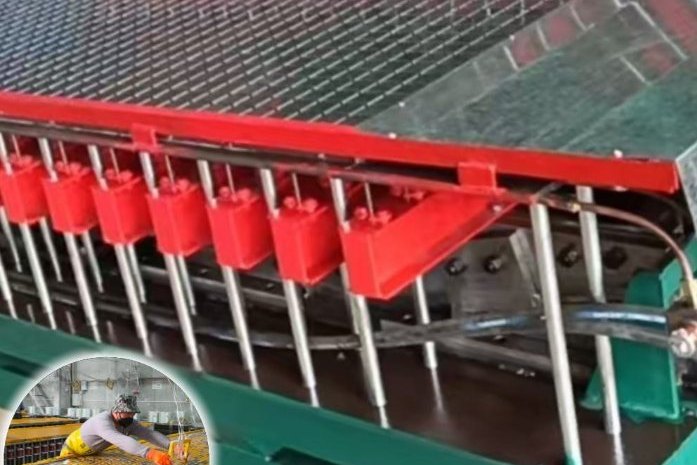
A moulded grating press is not a machine that makes grating. It is a machine that holds a mould closed while a chemical reaction runs to completion inside it, and the difference matters because almost every production problem on a moulded grating line is a temperature or a time problem rather than a force problem. The press supplies clamping force and heat; it does not supply the fibre architecture, the wet-out, or the cure, and none of those can be corrected by pressing harder. This guide covers how the mould bars and their pitch define the product before the press is ever switched on, why the curing cycle splits into two clocks that scale differently with thickness, a worked 1220 by 3660 millimetre line showing what a 38 millimetre panel actually costs in time and energy, and the control settings and checks that separate a line running at nameplate output from one running at half of it with a scrap rate nobody has measured.
1. What the Press Does, and What It Does Not
A hydraulic press for moulded grating does four things and nothing more.
- It closes and clamps. The clamping force has to overcome the internal pressure generated by the resin as it heats and expands, and hold the mould halves at a fixed gap so that the panel thickness is set by the tooling rather than by the pressure.
- It heats both halves to a controlled temperature. Cure temperature, and the uniformity of that temperature across the platen, determine both the cycle time and the consistency of the panel.
- It holds the mould closed for the duration of the cure. Opening early produces a panel that is dimensionally correct and chemically unfinished.
- It opens and ejects. Demoulding is where the surface finish, and much of the scrap, is decided.
What the press does not do is place the glass. The roving or mat is laid into the mould by hand or by a placement device, the resin is poured or injected, and the wet-out happens before the mould closes. A press cannot fix dry glass, uneven resin distribution or a mould that is not full. Those are process failures upstream of the machine, and they show up as a press problem because that is where the operator notices them.
2. The Mould: Bars, Pitch and Coating
The mould is the product. Its bar geometry sets the mesh pitch, the rib thickness, the panel depth and the surface texture, and none of those can be changed without changing the tooling. Typical construction is a hardened steel bar pack with interchangeable inserts, so that a single press can run more than one mesh size.
| Mould element | Typical specification | What it controls |
|---|---|---|
| Bar material and thickness | Hardened carbon steel, about 14 mm | Rib thickness and mesh pitch |
| Bar plating | Chrome, 0.03 to 0.05 mm | Release and mould life |
| Bar end taper | Big end and small end differ by about 2 mm | Draft, so the panel lifts out |
| Roof plate | About 14 mm, polished | Top surface finish and thickness |
| Base plate | About 14 mm, painted | Bottom surface and flatness |
| Heating | Electric cartridge or hot oil, both platens | Cure temperature and uniformity |
| Mould size for a 3660 mm panel | About 3680 by 1280 by 900 mm | Largest panel that can be produced |
Two consequences follow from the tooling being fixed. The first is that the panel size available to a customer is limited by the largest mould the supplier owns, not by what is structurally possible; the common industry panel is 1220 by 3660 mm, with 1000 by 4000 mm available in some European markets. The second is that a mesh size the supplier does not own is a new bar pack, which is why custom meshes carry a tooling cost and a lead time that has nothing to do with the panel itself.
3. Two Clocks: Heat-Up and Hold
The cure cycle is two processes running at once, and they scale differently with thickness, which is why cycle time rises much faster than thickness.
- Heat-up is a diffusion problem. The time to bring the centre of the panel to cure temperature scales with the square of the thickness, because heat has to conduct in through half the section.
- The cure hold is a reaction problem. Once the section is at temperature the resin needs a minimum time to reach an adequate degree of cure, and that time scales roughly linearly with thickness because there is more material to react.
Taking a thermal diffusivity of about 1.3 x 10⁻⁷ square metres per second for a filled polyester laminate, and a hold that is proportional to thickness, the two clocks come out as follows. The curve is the reason a 38 millimetre panel takes more than twice as long as a 25 millimetre one even though it is only half again as thick.
| Panel thickness | Heat-up to centre | Cure hold | Total cure time |
|---|---|---|---|
| 25 mm | 2.0 min | 17.5 min | 19.5 min |
| 30 mm | 2.9 min | 19.6 min | 22.5 min |
| 38 mm | 4.7 min | 23.0 min | 27.6 min |
| 50 mm | 8.1 min | 28.0 min | 36.1 min |
| 63 mm | 12.9 min | 33.5 min | 46.3 min |
Those numbers sit inside the range that equipment suppliers quote for a full cycle, which is about fifteen to forty-five minutes depending on the model and the thickness, with the smaller single-mould machines at the slower end of the range. If a supplier quotes a cycle time shorter than the heat-up term for the thickness involved, the panel is being demoulded before its centre has cured, and the resulting under-cure will not show up in the panel thickness or the appearance. It shows up as poor chemical resistance and a Barcol reading taken on the surface that does not represent the interior.
4. Worked Line: What a 38 Millimetre Panel Costs
Take one press running a 1220 by 3660 millimetre panel, which is 4.465 square metres, with the fixed steps in the cycle being six minutes for lay-up, one minute for closing and clamping, and six minutes for demoulding and trimming. The preheat of the next mould runs in parallel with the cure of the current one, so it does not add to the cycle.
| Panel thickness | Full cycle | Panels per hour per press | Output per press |
|---|---|---|---|
| 25 mm | 32.5 min | 1.84 | 8.2 m2/h |
| 38 mm | 40.6 min | 1.48 | 6.6 m2/h |
| 50 mm | 49.1 min | 1.22 | 5.5 m2/h |
Extending that to a two-press line running fifteen productive hours a day, which is two shifts with allowance for start-up, mould changes and breaks:
| Panel thickness | Panels per hour, two presses | Panels per day | Square metres per day |
|---|---|---|---|
| 25 mm | 3.69 | 55.3 | 247 m2 |
| 38 mm | 2.95 | 44.3 | 198 m2 |
| 50 mm | 2.44 | 36.6 | 164 m2 |
The step from a 25 millimetre panel to a 38 millimetre panel costs twenty per cent of the line's output, which is the commercial reason a supplier will quote a thinner panel than the duty needs if the specification does not pin the thickness down. Specifying the panel depth from the load table rather than accepting what is available is worth real money over a project.
Material for a 38 millimetre panel at 13.0 kilograms per square metre with a 32 per cent glass content:
- Panel mass 58.0 kg
- Glass 18.6 kg, which is 4.16 kg per square metre
- Resin, filler and additives 39.5 kg
- At 3 per cent waste the prepared mix is 59.8 kg, at 6 per cent it is 61.5 kg, at 10 per cent it is 63.9 kg
Energy is the smaller line item but it is not nothing. A platen set of this size draws somewhere between 50 and 150 kilowatts of heating when it is working, with a duty cycle of roughly half over a cure:
| Installed heating | Energy per panel | Energy per square metre | Cost at USD 0.10/kWh |
|---|---|---|---|
| 50 kW | 16.9 kWh | 3.79 kWh/m2 | USD 0.379/m2 |
| 100 kW | 33.9 kWh | 7.59 kWh/m2 | USD 0.759/m2 |
| 150 kW | 50.8 kWh | 11.38 kWh/m2 | USD 1.138/m2 |
Only the cure consumes heat. The lay-up and the trimming are manual, so their cost sits in labour and in how many presses a single operator can attend, not in the power bill. That is why the economics of a moulded grating line are driven by the number of moulds running in parallel rather than by the size of the press.
5. Temperature Control and the Exotherm
The resin cures exothermically: the reaction releases heat, and in a thick section the released heat cannot escape as fast as it is generated. In a 25 millimetre panel the platen temperature dominates and the exotherm is a modest rise. In a 63 millimetre panel the centre can run well above the platen set point, and a runaway exotherm produces a panel that is discoloured, brittle and sometimes cracked before it leaves the mould.
- Both platens must be heated and controlled independently. A single-sided heated press produces a panel with different cure on the two faces, which shows up later as differential shrinkage and warping.
- Uniformity across the platen matters as much as the set point. A ten degree gradient across a 3.7 metre platen cures one end of the panel harder than the other. Hot oil circulation is used for large platens because it evens out the gradient that cartridge heaters produce.
- Control to about one degree. The temperature range used in practice is roughly 80 to 160 degrees, and the tolerance that modern controllers hold is about plus or minus one degree.
- Thick sections need a staged profile, not a single set point. Ramping the platen temperature up rather than starting at the cure temperature lets the exotherm be absorbed instead of being added to.
6. Pressure, Clamping and Closing
Clamping force and hydraulic pressure are different things and are often confused in a specification. The hydraulic pressure, typically quoted between 16 and 25 megapascals, is the oil pressure in the cylinders. The clamping force, typically quoted between 2000 and 5000 kilonewtons depending on the model, is the force the platens apply to the mould, and it is the number that matters structurally.
What the clamping force has to do is hold the mould closed against the resin's thermal expansion and against the pressure generated as the bars are filled. It does not have to compact the laminate, because there is nowhere for excess resin to go except into the flash gap. Two practical consequences:
- Closing speed has to be controlled. A fast close traps air in the bar pack and pushes resin out through the flash gap before the bars are full. Suppliers quote closing and opening cycles of the order of twenty to ninety seconds, and the slower end of that is not a limitation to be designed out.
- Excess clamping force buys nothing. Once the mould is metal-to-metal on the bar ends, further force only loads the tooling. A panel that is under-filled is a lay-up or a resin quantity problem, and adding force will not correct it.
7. Demould, Trim, Grit and Post-Cure
The steps after the cure decide the surface the customer sees and the properties the customer tests.
- Controlled cool-down. Opening a hot mould on a hot panel produces thermal shock and warping. The panel should be cool enough to handle dimensionally stable before it is released.
- Ejection. Ejector pins or an air blast, applied evenly. Tapered bar ends are what make the panel lift cleanly; a panel that has to be levered out has a mould that is wearing.
- Trimming and edge sealing. The flash is trimmed and the cut edges are sealed. An unsealed edge on a grating that will sit in a chemical plant is an exposed glass face from day one.
- Grit. The anti-slip surface is either moulded in, so the grit is embedded in the top layer and cannot wear off, or applied as a coating. Moulded-in grit is the reason moulded grating is preferred over pultruded grating on walkways subject to heavy traffic.
- Post-cure where the duty demands it. A panel for hot or aggressive chemical service may need a post-cure to reach the degree of cure that the chemical resistance data assumes. This is a specification item, not a shop floor option.
8. Quality Checks That Belong on Every Cycle
A moulded grating line that does not test is a line that does not know its scrap rate. The checks below are cheap and each one catches a specific failure.
| Check | Method | Catches | Typical expectation |
|---|---|---|---|
| Barcol hardness | ASTM D2583 | Under-cure | 45 to 55 on a properly cured panel |
| Flexural strength | ASTM D790 | Fibre content, dry glass, voids | 180 to 220 MPa on a 38 mm panel |
| Tensile strength | ASTM D638 | Glass distribution | Varies with resin and glass fraction |
| Flame spread | ASTM E84 | Resin and filler package | Flame spread index at or below 25 with a vinyl ester and filler system |
| Slip resistance | ASTM E303 or EN 13036 | Grit coverage and embedment | Wet value of about 0.60 to 0.80 with a grit surface |
| Panel dimensions | Go and no-go gauges | Mould wear, platen misalignment | Per the published tolerance |
| Visual | Every panel | Dry glass, resin-rich patches, cracks, exotherm discolouration | Compare against a retained reference panel |
The reference panel is the most useful quality tool on the line and the least used. Keeping the first panel from each mould, dated, gives every subsequent panel something to be compared against, and it turns a subjective judgement about colour and texture into a comparison.
9. Resin Viscosity, Wet-Out and the Commonest Defect
The single most common defect in moulded grating is dry or partially wetted glass, and it is a viscosity and timing problem rather than a press problem. A resin blend for this process typically sits between 350 and 600 millipascals per second at the working temperature, and that window is narrow.
- Too viscous and the resin will not penetrate the roving bundle in the time available before the mould closes, so the centre of a bundle stays dry and the panel tests low in flexure while looking perfectly sound from the surface.
- Too thin and the resin drains out of the bar pack before it gels, leaving resin-rich regions at the bottom of the panel and a lower glass fraction there.
- Ambient temperature moves the viscosity. A shop at 15 degrees in winter and 32 degrees in summer will produce different panels from the same formulation unless the resin is temperature-conditioned or the catalyst and accelerator are adjusted. This is the reason a line's scrap rate is seasonal.
Every parameter on the press display is a machine setting. The two variables that actually determine whether a panel is good — resin viscosity at the moment of pour and the time between wet-out and mould close — do not appear on any display. A line that controls only what the PLC can see is controlling the smallest part of the process.
10. FAQ
How long does a mould last? It depends on the plating and on how carefully the bar pack is cleaned between cycles. The chrome layer is the wearing surface, at 0.03 to 0.05 mm, and once it is broken through the underlying steel begins to bond to the resin and the panel starts tearing on release. Replating is cheaper than a new bar pack and is a scheduled maintenance item rather than a repair.
Can one press run several mesh sizes? Yes, if the bar pack is built from interchangeable inserts. That is the reason to ask a supplier what inserts they hold rather than only what panel sizes they quote, because the inserts are what determine whether a custom mesh is a tooling project or a mould change.
Why is my throughput below the figure on the machine nameplate? Almost always because the nameplate figure is a technical maximum and the real cycle includes lay-up, close, demould and trim, none of which the nameplate counts. The worked line above includes them; a nameplate figure usually does not.
Is a bigger press better? Only if the extra platen area is actually used. A press with two moulds running in parallel, each on a shorter cycle, produces more than one large press with a single long cycle, and it fails more gracefully when one mould needs maintenance.
What is the operating temperature range of the finished panel? It is a resin question, not a machine question. An isophthalic panel is generally usable in the range from about minus 50 to about 95 degrees Celsius, while vinyl ester and phenolic systems extend the top end to about 150 degrees. The press settings have no bearing on it.
11. Getting a Moulded Grating Line to Run at Its Rating
At Henan HuanGang we supply FRP moulded grating machines and fibreglass grate production equipment, and the questions we ask before sizing a line are the ones that decide its real output: the panel sizes and depths the customer intends to sell, the mesh pitches needed, how many moulds will run in parallel, and whether the resin formulation is temperature-controlled. A press quoted without that information is a press quoted on platen size alone, and platen size is the least interesting number in the specification. Send us the product mix and the target daily output and we will come back with the press, the mould count, the cycle profile and the finishing equipment as one package.
Related reading: FRP filament winding machine buyer's guide, filament winding machine commissioning, pultrusion machine guide, FRP pipe production line setup, moulded versus pultruded FRP grating, FRP manufacturing processes explained, FRP grating load tables and grating fabrication, installation and field cutting.
Need help selecting FRP products?
Our engineers answer technical questions free of charge.
Ask an Engineer on WhatsApp