
An industrial fire barrier is only as good as its weakest hole. A 2-hour blockwork wall around a switchgear room or a chemical store does its job until someone drills a 120 mm core for a cable tray, feeds four pipes through a sleeve, and fills the gap with expanding foam from the hardware store. In a standard fire test that "seal" is gone in minutes, and the compartment rating it was meant to protect becomes a paper figure. Firestop penetration seals are the discipline of restoring a wall's rating after services pass through it, and the difference between a compliant seal and a liability is almost always a matter of tested systems, correct materials and verified installation. This guide walks through the test standards behind the ratings, the seal types used in industrial buildings, a worked sizing example for an insulating board plug, and the installation and documentation practices inspectors actually check.
1. Why Penetration Seals Decide Compartmentation
Fire compartmentation works by subdividing a building into cells that contain a fire long enough for evacuation and intervention. Every cable tray, pipe, conduit and duct that crosses a rated wall or floor punctures that cell. The physics of the failure is unforgiving: hot gases pressurise the fire side, the "chimney effect" draws smoke and flame through any residual gap at high velocity, and combustible penetrants such as cable insulation or PVC pipe carry fire to the other side directly. Unsealed or poorly sealed penetrations are consistently among the most common findings in fire compartmentation surveys of existing industrial buildings — typically because services were added after handover without anyone re-sealing the hole.
The regulatory principle in most codes is simple: the penetration seal must restore the fire resistance of the element it penetrates. If the wall is rated 120 minutes, the seal is expected to deliver 120 minutes of the same classification. What that means in measurable terms depends on which test regime governs the project — the North American F/T system or the European EI system — and a specifier working on export projects needs to read both.
Seal materials do not carry fire ratings. Systems do. A sealant, a board or a collar is only a component; the rating belongs to the whole tested assembly — wall construction, penetrant type and diameter, annular space, and the firestop materials installed in the tested configuration.
2. The Two Test Regimes: ASTM E814 / UL 1479 and EN 1366-3
North America tests through-penetration firestop systems to ASTM E814 (functionally harmonised with UL 1479; the IBC accepts either). Europe tests service penetration seals to EN 1366-3 and classifies the result to EN 13501-2. Both regimes expose the assembly to a standard time–temperature furnace curve and then verify that the seal survived, but they describe performance with different letters and numbers.
| Parameter | ASTM E814 / UL 1479 | EN 1366-3 / EN 13501-2 |
|---|---|---|
| Specimen scale | Penetration + wall/floor assembly, penetrant extending 12±1 in. (≈300 mm) fire side and 36±1 in. (≈900 mm) unexposed side | Penetration installed in a standard wall or floor specimen in a test frame |
| Furnace curve | ≈538 °C at 5 min; ≈927 °C at 60 min; ≈1,093 °C at 240 min | EN standard curve: ≈945 °C at 60 min; ≈1,153 °C at 240 min |
| Furnace pressure | Positive, at least 0.01 in. w.c. (≈2.5 Pa) above the unexposed side | Prescribed horizontal and vertical locations of the neutral plane |
| Post-fire test | Hose stream test (ASTM E2226) on a duplicate specimen, half-duration exposure first | Not part of EN 1366-3 (national annexes may add impact requirements) |
| Rating vocabulary | F, T (plus optional L, W under UL 1479; FM adds TFM) | E (integrity) and I (insulation), e.g. EI 120 |
| Classification standard | Ratings assigned by the test/lab listing | EN 13501-2 |
The consequence for specifiers is that a "2-hour firestop" means different things in different markets. A listed UL system with an F-120/T-120 rating proves flame blockage and a temperature limit; an EI 120 classification to EN 13501-2 proves integrity and insulation performance throughout the full 120 minutes. For industrial projects in the Middle East and Asia, either regime may be written into the specification — the seal manufacturer's listing and the local authority decide.
3. F, T, L and W Ratings: What Each Letter Actually Proves
The F/T vocabulary is compact but often misread. Each rating answers a different question about the same assembly:
| Rating | Question it answers | Pass criterion (verified values) |
|---|---|---|
| F rating | Does it stop flame and hot gas? | No flame penetration to the unexposed side, no flaming on the unexposed surface, and after the hose stream no opening that projects water — for the stated hours, rounded down to the last completed hour |
| T rating | Does it limit heat transfer through penetrants? | All F criteria, plus no thermocouple on the unexposed side (including on the penetrating item) rises more than 325 °F (181 °C) above its initial temperature |
| L rating | Does it stop smoke? (UL 1479 only, optional) | Air leakage limit at ambient and at elevated temperature; used as a proxy for smoke passage in hospitals, data centres and cleanrooms |
| W rating | Does it hold water? (UL 1479 only, optional) | No water passage under a 3 ft (≈0.9 m) pressure head; relevant for waterproofing as well as fire |
The hose stream is the part most often underestimated. After a fire exposure equal to half the target rating (capped at 60 minutes) on a duplicate specimen, the assembly is struck with a fire hose at a pressure and duration set by the rating: 30 psi (≈210 kPa) nozzle pressure applied for 0.90 s/ft² of opening area for a 90-minute rating, 30 psi for 1.5 s/ft² for 2-hour assemblies, and 45 psi for 3.0 s/ft² for 4-hour assemblies. It simulates the mechanical shock and quench cooling of firefighter intervention, and many materials that survive the furnace alone fail here.
Building codes translate the ratings into requirements. IBC Section 714 requires through-penetration firestop systems tested to ASTM E814 or UL 1479 at a minimum positive pressure differential of 0.01 in. w.c. (2.49 Pa), with an F rating not less than the fire-resistance rating of the wall penetrated. T ratings are required in specific situations — classically for penetrations of floor assemblies, and for wall penetrations where combustible material sits close to the seal on the unexposed side — because a T-rated assembly limits the temperature that cables and other combustibles on the far side will see.
4. The EI Classification in European and Export Projects
EN 13501-2 expresses the performance of a penetration seal as a class such as EI 60 or EI 120. The two letters carry distinct meanings:
- E — integrity: the seal prevents the passage of flames and hot gases to the unexposed side for the classified period. Integrity failures are cracks, gaps and shrinkage.
- I — insulation: the unexposed face of the assembly stays cool enough not to ignite adjacent combustibles — a mean temperature rise of no more than 140 K and no single point rising more than 180 K above initial. Insulation is usually the harder of the two criteria, and it is what "I" adds to a plain "E" class.
An F90 blockwork wall in a German-style national scheme demands an EI 90 penetration seal; under the model line-installation directive (MLAR) cable seals are described in S-classes (S30/S60/S90/S120) and pipe seals in R-classes, with an annual inspection of every seal recommended and often contractually required. Products placed on the EU market are certified through EAD 350454-00-1104 (the successor to ETAG 026), with fire resistance tested to EN 1366-3 and CE marking backed by a Declaration of Performance.
For an exporter of passive fire protection materials the practical takeaway is that test reports and classifications, not marketing sheets, are the deliverable: a purchaser's engineer will ask for the EN 13501-2 classification report or the UL system number before the material is approved, and "tested to the same principle as" is not a substitute for either.
5. Matching the Seal Type to the Service
The penetrating service dictates the mechanism, because different services fail differently in a fire. Steel pipe does not burn but conducts heat; PVC and PE pipes soften and melt away, leaving a hole that must be closed by something else; cable bundles burn along their own insulation; ducts need dampers or enclosures. The usual toolbox:
| Service | Typical tested system | Mechanism |
|---|---|---|
| Steel, copper, cast iron pipe | Firestop sealant or mortar fill in the annulus; for large diameters, mineral wool through the wall depth with sealant collars on both faces | Non-combustible fill blocks the annulus; sealant on both faces closes the metal's heat path to the unexposed side |
| Plastic pipe (PVC/PE/PP) | Intumescent pipe wrap installed inside the wall depth, or intumescent collar fixed on the unexposed (and often both) faces | Wrap or collar expands under heat and closes the bore left by the melting pipe, sustaining pressure to close the hole |
| Cable bundles and trays | Sealant + backfill of mineral wool, or coated fire batts friction-fitted into the opening with sealant on all cut edges; modular transit blocks for repeatability | Endothermic/intumescent materials absorb heat and seal irregular geometries; fills must not burn or shrink |
| Mixed multi-service openings | Coated batt or board cut-out around all services plus sealants, or modular frame systems | One tested configuration covering the full bundle as installed |
| Ventilation ducts | Fire dampers, or tested duct wrapping/board enclosures where dampers are not used | Stops the duct acting as a fire and smoke conduit between compartments |
| Temporary / re-enterable openings | Firestop pillows or insert blocks in a frame, often combined with sealant | Re-occupiable: cables can be added later without rebuilding a mortar seal |
Intumescence deserves one sentence of explanation for those new to the field: an intumescent material is stable at ambient temperature, then swells several times in volume under heat, forming a pressure-bearing char that fills the void left by melting plastics or shrinking cables. Getting the trigger temperature and expansion ratio right is why manufacturers test full assemblies rather than selling loose compounds with claimed hour ratings.
6. Ceramic Fibre and Mineral Wool Boards in Industrial Walls
Boards and batts do the bulk work of industrial penetration seals and blank openings: they are non-combustible, they span large voids, and they provide the insulation function that sealants alone cannot deliver over a large area. Two material families dominate.
Ablative-coated mineral wool batts — typically 50 mm thickness at around 160 kg/m³, coated on both faces with a water-based ablative coating — are tested to EN 1366-3 in flexible partitions (from 75 mm thickness), solid masonry and concrete floors. A single 50 mm coated batt has demonstrated up to 2 hours (EI 120) depending on the configuration, and the 60 mm product up to 4 hours. They are fitted by friction into the void or face-fixed over the opening with a pattress, and all cut edges must be coated with acoustic intumescent sealant so no raw fibre or unsealed path remains. They are not load-bearing; where the seal must carry load, firestop compound systems are the alternative.
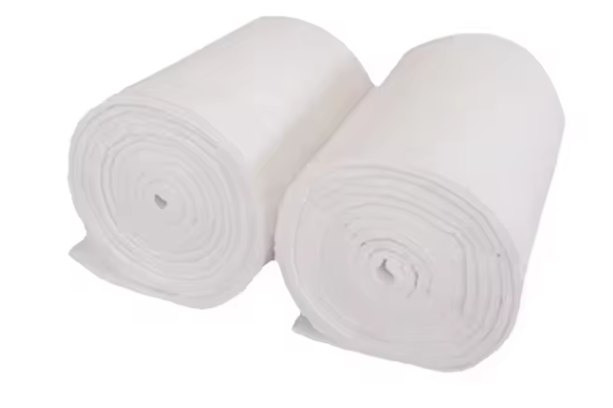
Ceramic fibre (alkali-earth silicate) boards and cotton bring higher temperature capability and chemical inertness: a typical firestop-grade ceramic fibre cotton runs about 130 kg/m³ with a thermal conductivity of ≤0.156 W/m·K at a 500 °C mean temperature, service temperatures at or above 1,200 °C, and a melting point class above 1,760 °C for the alumina-silicate family. Products of this type have 2-hour F and T ratings behind them under ASTM E814-type testing (for example via CNS 14514-referenced listings), and their resistance to thermal shock suits industrial walls around kilns, furnaces and hot process equipment where the penetration also sees a thermal gradient in daily operation. Safing-grade mineral wool used in the same role is non-combustible to ASTM E136 with melting points in excess of 1,093 °C.
| Property | Ablative-coated stone wool batt | Ceramic fibre board / cotton |
|---|---|---|
| Nominal density | 160 kg/m³ | ≈130 kg/m³ (firestop cotton grade) |
| Thermal conductivity | ≈0.10–0.14 W/m·K (ambient-to-mid range) | ≤0.156 W/m·K at 500 °C mean |
| Max continuous service temp. | ≈650–850 °C (binder-limited) | ≥1,200 °C classification; 1,260–1,400 °C grades common |
| Demonstrated rating | 50 mm → up to EI 120; 60 mm → up to EI 240 (EN 1366-3 configurations) | 2 h F + T under E814-type listings |
| Edge treatment | Intumescent sealant on every cut edge | Butt-jointed, no gaps; sealant where the system specifies |
| Best suited to | General walls/floors, multi-service openings, acoustic benefit | High-temperature adjacency, thermal-shock service, furnace walls |
For furnace-adjacent buildings the distinction matters because the board may be asked to function both as a penetration seal and as a thermal barrier in normal operation. Our own product literature for the 1260 °C ceramic fibre insulation blanket and the alumina-silicate fireproof board covers the furnace-side properties; the firestop listing is a separate document and both must exist for a dual-role installation.
7. Worked Example: Sizing an Insulating Board Plug for a 2-Hour Cable-Tray Penetration
A specifier needs a first-order sense of how much board is required before consulting listings. Consider a 400 × 200 mm cable tray passing through a 120-minute-rated concrete wall, closed with a ceramic fibre board plug, target: keep the mean unexposed face within the EN 13501-2 insulation criterion (≤140 K rise, so ≤165 °C mean face at 25 °C ambient — we will target a more conservative 140 °C face). Using the EN standard furnace temperature of 945 °C at 60 minutes and steady-state conduction with combined surface coefficients of 40 W/m²·K hot side and 10 W/m²·K cold side, with k = 0.156 W/m·K for the fibre at high mean temperature:
- Cold-face heat flux at the limit: q = 10 × (140 − 25) = 1,150 W/m²
- Total resistance needed: R = (945 − 25)/1,150 = 0.800 m²·K/W
- Surface films contribute 1/40 + 1/10 = 0.125 m²·K/W, so the board must supply 0.675 m²·K/W
- Thickness d = 0.675 × 0.156 = 0.105 m → ≈105 mm of board
Verification: at 110 mm the model gives a cold face of ≈136 °C — inside the target. At 25 mm the same model gives ≈348 °C, far past any ignition-avoidance criterion, which is exactly why thin "packing" of a large opening fails insulation and why listed systems prescribe thickness per configuration. The same calculation swept over conductivity shows how board grade changes the answer:
| Board conductivity k (W/m·K) | Required thickness (mm) |
|---|---|
| 0.100 (higher-density board) | 68 |
| 0.120 | 81 |
| 0.140 | 95 |
| 0.156 (firestop cotton grade at hot mean) | 105 |
| 0.180 (degraded/wet board) | 122 |
Three honest caveats. First, steady-state is a conservative lens for a transient fire — real furnace exposure builds up more slowly at depth — but it is the right tool for a first cut. Second, the steel tray running through the plug is a thermal short-circuit: conduction along the metal is why T ratings and the EI "I" exist, and no amount of board thickness in the annulus substitutes for the tested treatment of the penetrant itself. Third, this calculation sizes a concept, not a product: the built seal must replicate a listed system for the actual wall, tray and annular space.
8. Annular Space, Sleeves and Code Details That Decide Approval
Most firestop failures in the field are geometry failures, not material failures. The code framework (IBC Section 714, with parallels in EN 1366-3 system approvals) concentrates on the following details:
- Sleeves: where used, they must be securely fastened to the assembly, and the space between the sleeve and the penetrant and between sleeve and assembly must both be protected as tested.
- Coverings travel as tested: pipe or cable insulation/coverings must not pass through the rated assembly unless that exact material was part of the tested system — an insulated pipe is a different system from a bare one.
- Mortar exception: in concrete or masonry walls, steel/ferrous/copper pipes up to 6 in. (152 mm) nominal diameter with an opening area up to 144 in² (0.0929 m²) may be closed with concrete, grout or mortar through the full wall thickness — the one place where ordinary fill is code-recognised, and only for non-combustible penetrants.
- Electrical boxes: annular space between wall membrane and box limited to 1/8 in. (3.2 mm) unless listed otherwise, with separation or putty-pad rules for boxes on opposite faces.
- Small annular gaps: very tight annuli (on the order of 12 mm or less) are frequently sealed with ceramic-fibre-backed systems precisely because the gap is too small for sealant to be toolable — a detail manufacturers' listings address explicitly.
- Special inspection: IBC Chapter 17 requires special inspection of through-penetration and membrane-penetration firestop systems, meaning the installation is verified by someone other than the installer.
On the European side the same idea is enforced through the system approval: every penetration seal carries an approval document (abZ/ETA or national equivalent), and installation must follow the manufacturer's instructions for that approval exactly — otherwise the approval is invalid and the AHJ can reject the work.
9. Installation Quality, Re-Occupancy and Documentation
Because the rating belongs to the system, installation discipline is where compliance is won or lost. The recurring field findings — and their fixes — are predictable:
- Mixing products across manufacturers (a sealant with a different brand's board) voids the listing; every component must come from the tested system.
- Unsealed cut edges on coated batts; sealant on every cut face is part of the tested configuration, not a nicety.
- Cables added later through an existing seal without a re-occupiable design — the single most common defect found in annual inspections. Mortar seals are effectively single-use; soft seals, pillows and modular transit systems are re-occupiable within their approved fill ratios.
- Deviating on annular space or fill depth from the listed detail; a sealant applied at half the tested depth has no rating at all.
- Compressing or over-filling batts, which changes density and therefore both the insulation and the intumescence behaviour.
Documentation closes the loop. Modern building-safety regimes (the UK's Building Safety Act "golden thread" is the template) expect every seal to be numbered on as-built drawings, photographed at completion, and traceable to the system number and manufacturer instructions used. Under the MLAR-style annual inspection, the seal register is the auditor's starting point; a seal that cannot be matched to a system number becomes a finding even if it looks intact. Purchasers specifying industrial buildings should make the firestop register a deliverable in the contract, and it costs nothing to require photographs of every seal before closure by the follow-on trade.
A component does not carry a fire rating. A system does. Changing the pipe diameter, the annular space, the wall construction, or the depth of firestop material invalidates the listing — so the installer's job is replication, not improvisation.
10. A Specification Checklist for Purchasers
When sourcing firestop materials and systems for an industrial project — whether from a distributor or directly from a manufacturer of fibre and board products — the following checklist compresses the points above into a procurement-grade list:
- Rating basis stated for the project market: F/T (ASTM E814 / UL 1479 system listing number) or EI (EN 13501-2 classification report from an EN 1366-3 test), with T or I required wherever combustible services are present.
- Listing/classification matched to the actual wall and floor constructions, penetrant types, diameters and annular spaces — not "similar".
- Board and batt materials specified with density, conductivity at the relevant mean temperature, and continuous-use temperature (e.g. 130 kg/m³ ceramic fibre cotton, k ≤ 0.156 W/m·K at 500 °C mean; 160 kg/m³ coated stone wool batt).
- Edge and joint treatment (intumescent sealant grade and application rate) written into the installation method statement.
- Re-occupancy strategy agreed per opening type before handover.
- Special/third-party inspection scope defined, with photo documentation and a numbered seal register as contract deliverables.
- Annual inspection interval and defect-response responsibility assigned in the O&M documents.
Suppliers who can back a material datasheet with both the furnace-side property data and the system-level test documentation are worth shortlisting; suppliers who quote hour ratings for bare components without a system report are not.
Build a Firestop Package That Survives the Audit
HuanGang manufactures ceramic fibre blankets, boards and alumina-silicate insulation products used in furnace walls and industrial passive fire protection, and supplies firestop-grade fibre materials for penetration sealing systems. If you are putting together a penetration seal package for an industrial building, send us the wall types, services and required rating basis, and our engineers will propose material grades with the property documentation your reviewer needs.
Related reading: Passive Cable Fire Protection: Blankets, Coatings and Putty · Ceramic Fibre Board Density, Binder Type and Shrinkage · Calcium Silicate Board vs Ceramic Fibre · Insulating Firebrick Grade Selection · Product pages: 1260 °C ceramic fibre insulation blanket · Alumina-silicate fireproof board
Need help selecting FRP products?
Our engineers answer technical questions free of charge.
Ask an Engineer on WhatsApp