
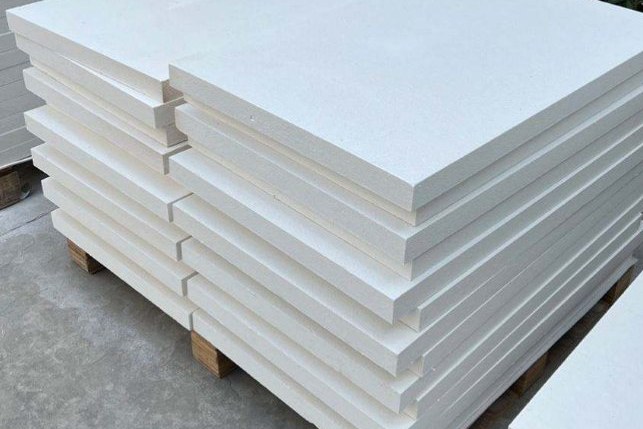
Ceramic fibre board is the simplest refractory product on a purchase order and one of the easiest to buy badly. The datasheet carries a density, a classification temperature and a shrinkage figure, and those three numbers are routinely read as if they were independent performance promises. They are not. The classification temperature is a 24-hour laboratory label, the density is a manufacturing outcome rather than a specification requirement in the relevant ASTM standard, and the shrinkage number only means something when you know the temperature at which it was measured.
This guide separates the three, then puts them back together for the decision that actually matters: which board goes on which square metre of a furnace. Every derived number below - interface temperatures, heat loss, mass, joint gaps - comes from a calculation script so the arithmetic can be checked line by line. The product references are the boards we supply, such as the 1500 °C alumina ceramic fibre board for kilns and the 1260 °C board for stoves and furnaces.
1. What the Datasheet Actually Certifies
The classification temperature is defined in EN 1094-1 by a single criterion: the temperature at which the permanent linear change of the test piece stays within a stated limit after a 24-hour soak. For boards and preformed shapes the limit is 2 %; for blankets, felts, mats and papers it is 4 %. Nothing else is tested to award the label - not strength retention, not thermal conductivity, not resistance to a process gas.
That definition has two consequences that a specification should reflect. First, a board classified at 1260 °C is a board that shrank by no more than 2 % in a 24-hour laboratory soak at 1260 °C. It is not a board that will hold its dimensions for two years at 1260 °C. Second, EN 1094-1 itself notes that the maximum continuous use temperature of an amorphous high-temperature fibre product will typically be 100 °C to 150 °C below its classification temperature. The standard that awards the label is the same standard telling you not to design to it.
Treat the classification temperature as the ceiling of the fibre chemistry, not as the setpoint of the furnace. The design number is the permanent linear change at the temperature the board will actually see, measured over a campaign rather than a day.
There is also a scope trap in the North American framework. ASTM C612 covers mineral fibre block and board from −18 °C to 982 °C, classified Types IA to V by maximum use temperature, with a linear shrinkage limit of 2.0 % per ASTM C356 and surface burning limits of flame spread index 25 and smoke developed index 50 per ASTM E84. Ceramic fibre boards classified at 1260 °C and above sit outside that ceiling. C612 is a useful procurement skeleton - it tells you which properties to demand and which test methods to demand them by - but it cannot certify a 1260 °C board, because the product is above the standard's scope.
| Datasheet figure | Test basis | What it tells you | What it does not tell you |
|---|---|---|---|
| Classification temperature | EN 1094-1 / ISO 10635, 24 h soak | The temperature at which permanent linear change stays within 2 % for board | Continuous service limit; strength retention; gas resistance |
| Density | ASTM C303 (mass / volume) | Mass, heat storage, compressive and bending strength trend | Insulating value on its own; not a performance requirement in ASTM C612 |
| Permanent linear change | ASTM C356 / ISO 10635, 24 h at a stated temperature | How much a panel will shrink at that temperature in one day | Long-term shrinkage; thickness change, which can be several times larger |
| Compressive strength | ASTM C165, 10 % deformation | Bearing capacity under a foot, a scaffold leg or a stacked layer | Strength after the binder has burned out |
| Loss on ignition | Muffle furnace burn-off | Organic binder content, and therefore smoke and odour on first fire | Whether the binder is organic or inorganic in kind |
| Thermal conductivity | ASTM C201 / C518, mean temperature | Heat flow at the stated mean temperature | Behaviour at a different mean temperature, or after shrinkage |
2. Density: What It Buys and What It Costs
Boards are supplied between roughly 280 kg/m³ and 400 kg/m³, with the 1500 °C alumina grades at the top of that band and higher-density tooling boards above it. Density is the single most useful number on the sheet for mechanical decisions, and the least useful for thermal ones.
What density buys. Compressive strength at 10 % deformation rises steeply with density: a 1260 °C board at 280 to 320 kg/m³ typically reports 0.15 to 0.30 MPa, a mid-density grade around 0.3 to 0.5 MPa, and a 700 kg/m³ machining board 1.5 MPa. Modulus of rupture moves in the same direction, from about 0.5 MPa to 0.8 MPa. Resistance to hot gas erosion also improves, because erosion resistance is a function of how much fibre surface the gas stream has to remove per unit area.
What density costs. Two things. The first is heat storage: at 50 mm thickness and 100 m² of lining, 280 kg/m³ board weighs 1,400 kg and stores 1,433 MJ when taken to 1,000 °C, while 400 kg/m³ board weighs 2,000 kg and stores 2,048 MJ. On a continuous furnace that difference is irrelevant. On a kiln car, a shuttle kiln or a batch heat-treatment furnace that cycles daily, it is 615 MJ of extra fuel per cycle per 100 m², and it is the reason kiln-car tops are built from the lightest board that will survive the traffic.
The second cost is thermal conductivity. For the same chemistry, a denser board has more solid conduction paths and a slightly higher k. The effect is modest - a few hundredths of a W/m·K - but it runs in the opposite direction to the strength gain, which is why "heavier is better" is the wrong instinct for a backing layer.
| Property | 280–320 kg/m³ (1260 grade) | 350–400 kg/m³ (1500 grade) | 700 kg/m³ (machining board) |
|---|---|---|---|
| Compressive strength, 10 % (ASTM C165) | 0.15–0.30 MPa | 0.5–1.0 MPa | ≥1.5 MPa |
| Modulus of rupture | 0.3–0.5 MPa | 0.6–0.8 MPa | higher, grade dependent |
| Mass of 50 mm board, per 100 m² | 1,400–1,600 kg | 1,750–2,000 kg | 3,500 kg |
| Heat stored to 1,000 °C, per 100 m² | 1,433–1,638 MJ | 1,791–2,048 MJ | 3,583 MJ |
| Typical use | Backing insulation, kiln cars, door linings | Hot face in high-velocity or high-temperature zones | Burner blocks, sight ports, machined shapes |
The bearing numbers are worth internalising because they decide whether a board survives installation, not just service. A 200 kg technician standing on a 200 mm × 200 mm footprint applies about 49 kPa, which any board carries without complaint. A scaffold leg carrying 5 kN on a 50 mm × 50 mm pad applies 2,000 kPa, which is close to seven times the 300 kPa rating of a standard 1260 board. Boards are not load-bearing surfaces; if the lining will be walked on or used to support staging, put a steel plate or a timber sole plate under the load and size the board for temperature only.
3. Binder Chemistry: Organic, Inorganic and the First Heat-Up
Ceramic fibre board is a vacuum-formed felt of fibre, filler and binder. The binder is what gives a green board its handling strength - the ability to be cut, drilled and carried without delaminating - and it is the part of the product most often left out of a specification.
Organic binders (starch, phenolic, acrylic latex) are the default. They give the best green strength for the lowest cost and burn out between about 200 °C and 300 °C, which is why every board datasheet that lists a loss on ignition of 6 to 10 % is describing an organic-bonded product. The burn-out is visible: smoke, a phenolic or burnt-sugar odour, and a temporary drop in strength as the binder leaves before sintering begins. A 50 mm organic-bonded board at 320 kg/m³ with 8 % loss on ignition carries about 1,280 g of organic material per square metre - 64 kg on a 50 m² lining - which is enough to require ventilation on the first fire, particularly indoors.
Inorganic binders (colloidal silica or alumina) are used where smoke, odour or extractables are unacceptable: food and pharmaceutical furnaces, clean rooms, vacuum furnaces, and any furnace where the load is sensitive to organic contamination. These boards report loss on ignition of 1 % or less and produce almost no fume, at the cost of lower green strength, a more brittle board, and usually a higher price.
The first heat-up is where binder choice becomes a procedure rather than a preference. Heat penetrates a 320 kg/m³ board slowly: with a thermal diffusivity of about 3.0 × 10⁻⁷ m²/s, the penetration depth after one hour is roughly 33 mm, after two hours 46 mm, and a 50 mm board needs about 2.3 hours just to be heated through. A furnace ramped at 200 K/h therefore puts the hot face through the entire binder burn-out range while the back of the board is still cold. The differential shrinkage that follows is a common cause of open joints and cracked panels that get blamed on the board.
- Hold below 300 °C until the visible smoke stops, then continue - typically one to two hours at 250–300 °C for a 50 mm lining.
- Keep the ramp through 200–400 °C at or below 50 K/h on thick linings and on any lining with a steel shell that has its own expansion to accommodate.
- Ventilate the furnace volume during burn-out; do not rely on the process extract to be running.
- Record the burn-out in the commissioning file. If the lining smokes again later, it is not the binder - it is contamination or a process gas.
4. Shrinkage: Read the Test Temperature, Not the Grade Number
Permanent linear change is the number that decides whether a lining stays closed. It is measured on a specimen soaked for 24 hours at a stated temperature, and the stated temperature is the whole point. Published values for the common grades look like this.
| Grade | Al2O3 | Classification temperature | Permanent linear change, 24 h |
|---|---|---|---|
| Standard | 42–46 % | 1260 °C | ≤3 % at 1,000 °C |
| High purity | 47–49 % | 1260 °C | ≤3 % at 1,100 °C |
| High alumina | 52–55 % | 1350–1400 °C | ≤3 % at 1,200 °C |
| Zirconia-bearing | 34–40 % + 15–17 % ZrO2 | 1400–1430 °C | ≤3 % at 1,350 °C |
| Alumina / polycrystalline | 65–72 % and above | 1500–1600 °C | ≤2 % at 1,400 °C; ≤1 % at 1,500 °C |
Read that table as a set of pairs, not as a ranking. The standard board is tested at 1,000 °C, not at its 1260 °C classification temperature; the 1500 grade is tested at 1,400 and 1,500 °C. A buyer comparing "3 %" with "1 %" without comparing the test temperatures is comparing nothing at all.
The arithmetic of shrinkage is more brutal than the percentages suggest, because each panel shrinks away from its neighbours and the gaps accumulate across a wall:
- 1 % on a 1,000 mm panel = 10 mm lost per board.
- 2 % = 20 mm per board; 3 % = 30 mm per board; 4 % = 40 mm per board.
- A 6 m wall built from six 1,000 mm boards at 3 % accumulates 180 mm of gap if the boards are butted tight and free to shrink.
Those gaps do not stay empty. They become paths for hot gas, which is why a lining that "shrank 2 %" can show a 400 °C hot spot on the shell in the second year. The design response is not to demand a lower-shrinkage board alone; it is to build the joints as compression joints - ceramic fibre blanket or rope compressed into the gap, with the board panels laid with a deliberate gap rather than butted - and to accept that the board will shrink by its rated amount over the campaign.
One more caution: the 24-hour test understates field shrinkage. Shrinkage in service is cumulative with time at temperature, and a board that passes 2 % in one day at 1,200 °C may continue to compact over thousands of hours. For a five-year campaign, specify a board whose tested permanent linear change at the actual hot-face temperature is at least one grade better than the bare minimum, and design the joints for the full allowance rather than the tested figure.
5. Chemistry Grades and What Each One Is For
The grade ladder is a chemistry ladder. Alumina raises the softening point of the glassy fibre and slows the viscous flow that shows up as shrinkage. Zirconia does the same more efficiently per percent, which is why a 15–17 % ZrO2 board reaches 1400 °C with less alumina than an alumina-silica board would need. Chromia-bearing grades push shrinkage resistance further but are restricted in some markets on environmental grounds.
The counter-intuitive point is that the higher-temperature board is usually the poorer insulator. Published conductivity for a 1260 board runs about 0.08 W/m·K at a 400 °C mean, 0.11 at 600 °C, 0.15 at 800 °C and 0.19 at 1,000 °C. A 1500 alumina board runs roughly 0.15 at 600 °C, 0.18 at 800 °C and 0.25 at 1,000 °C. The high-alumina board buys temperature capability and shrinkage resistance; it does not buy thermal performance, and on the same thickness it loses more heat.
6. Matching Board to Furnace Zone
Board selection is a zone-by-zone exercise, because the duty changes within a single furnace. The table below is the schedule we use as a starting point for discussion; the thicknesses are typical rather than universal.
| Zone | Dominant duty | Grade | Density | Typical thickness |
|---|---|---|---|---|
| Sidewall hot face, gas velocity above 10 m/s | Erosion by dust-laden gas | 1260 standard or high purity | 350–400 kg/m³ | 25–50 mm over backing |
| Roof hot face | Erosion plus self-weight and thermal cycling | 1260 high purity | 320–400 kg/m³ | 25–40 mm |
| Burner block and flame impingement | Velocity, thermal shock, flame erosion | 1400–1500 high alumina | 400–700 kg/m³ | 50 mm and thicker |
| Furnace door and jamb | Impact, abrasion, thermal cycling | 1260 standard | 320–400 kg/m³ | 25–50 mm |
| Kiln car top | Heat storage, load, abrasion | 1260 standard | 280–320 kg/m³ | 50–75 mm |
| Backing insulation behind hot face | Thermal only | 1260 standard | 280–320 kg/m³ | 50–100 mm |
| Expansion joint filler | Compressibility, not insulation | Blanket or rope, not board | 128–160 kg/m³ | Joint width + 30 % |
| Sight port and thermocouple block | Machining, erosion, sealing | 1500 alumina | 400–700 kg/m³ | As drawn |
The velocity criterion deserves a number. Erosion scales with the dynamic pressure of the gas, which is ½ρv² - so doubling gas velocity quadruples the erosive force on the board surface. A board that performs for years at 5 m/s in a clean flue gas can fail in months at 15 m/s carrying dust. When a customer reports that "the board eroded", the first question is not which grade, it is what the local velocity and dust loading are.
7. Thickness and Layer Split: A Worked Example
Thickness and layer split are two separate decisions, and conflating them is the most common design error. The calculation below is a one-dimensional steady-state solution for a 1,250 °C hot face, 25 °C ambient and a combined outer coefficient of 10 W/m²·K, with each layer's conductivity evaluated at its own mean temperature. The steel shell is treated as isothermal, which is accurate to a few kelvin for a 6 mm shell.
| Build-up | Heat loss | Interface temperature | Shell temperature | Total R |
|---|---|---|---|---|
| 50 mm 1260 + 100 mm 1260 | 995 W/m² | 1,018 °C | 125 °C | 1.131 m²·K/W |
| 50 mm 1500 + 100 mm 1260 | 1,104 W/m² | 1,075 °C | 135 °C | 1.009 m²·K/W |
| 75 mm 1260 + 75 mm 1260 | 995 W/m² | 880 °C | 125 °C | 1.131 m²·K/W |
| 25 mm 1500 + 50 mm 1260 | 2,146 W/m² | 1,080 °C | 240 °C | 0.471 m²·K/W |
Four lessons fall out of that table.
Same thickness, same heat loss, different interface. The first and third build-ups are both 150 mm of the same board. They lose exactly the same 995 W/m² and give the same 125 °C shell, because the total resistance is identical. But the interface temperature differs by 138 K - 1,018 °C against 880 °C - because the split changes how the gradient is distributed. If the backing layer is a lower-temperature product, the split is what protects it, not the total thickness.
The high-temperature face costs heat. Replacing the first 50 mm with a 1500 alumina board raises the loss from 995 to 1,104 W/m², about 11 %, because the alumina board conducts more. Choose the high grade for temperature and shrinkage, and expect to pay for it in fuel.
Thickness is what controls the shell. The fourth build-up is 75 mm total instead of 150 mm. The shell reaches 240 °C, which is above the 60 °C usually specified for accessible surfaces and above the limit of most paints and cable insulation in the area. No change of grade fixes that; only thickness, or a ventilated cladding, does.
The first three build-ups all leave a 125–135 °C shell. That is safe to touch only briefly and is still hot enough to need guarding or a further 50 mm of backing if the furnace sits in an accessible area. A shell temperature target should be set before the thickness is chosen, not discovered afterwards.
8. Installation: Cutting, Joints and Restraint
Board installation is simple in principle and consistently done wrong in practice, because board is stiff and the details that keep it closed are the ones that get skipped.
- Cutting. A serrated blade or a fine-tooth saw cuts board cleanly; a straight knife tears the surface and leaves a ragged edge that will spall. Cut with dust extraction - refractory ceramic fibre is classified by IARC in Group 2B, and the dust is a respiratory irritant regardless of classification.
- Joints. Stagger joints between layers, keep the visible gap to 2 mm or less, and back every joint with compressed blanket so that the gap is filled before the board shrinks.
- Expansion. Do not butt board tight against a steel shell. The board needs a perimeter allowance, and long runs need expansion joints at 3 to 4 m intervals and at every corner. Fill those joints with blanket or rope, never with board - board has no compliance and will either crack or transfer the movement into the panel.
- Fixing. Thin hot-face boards are usually adhered or impaled on ceramic anchors set behind the board, not bolted through the face. Where a mechanical fixing is used, keep it behind the hot face and use a grade that matches the service temperature; a stainless anchor in a 1,200 °C zone will oxidise and disappear.
- Dry-out. Board absorbs moisture from humid air and from wet installation. Bring the lining up slowly through 100–150 °C to drive off water before the main ramp, or the steam will delaminate the board from the inside.
9. What to Put on the Purchase Order
Most board disputes are specification disputes in disguise. The purchase order below is the minimum we would want to see on a project where the board matters.
| Field | Requirement to state | Why |
|---|---|---|
| Classification temperature | Value and the test standard (EN 1094-1 / ISO 10635) | Without the standard the number is marketing |
| Permanent linear change | Limit at a stated temperature, not at the classification temperature | The only number that predicts joint opening |
| Density | Nominal with a tolerance, typically ±10 % | Controls strength, mass and heat storage |
| Compressive strength | ASTM C165 at 10 % deformation | Decides whether the board survives installation loads |
| Loss on ignition | Organic-bonded ≤8 %, inorganic-bonded ≤1 % | Predicts smoke, odour and clean-room suitability |
| Chemistry | Al2O3 and ZrO2 ranges | Grade identity; prevents substitution |
| Dimensions | Length, width, thickness with tolerances; flatness | Thickness tolerance drives both fit and heat loss |
| Moisture and packaging | Sealed, palletised, dry | Board picks up water in transit and spalls on first fire |
| Traceability | Batch number and certificate per lot | Lets a failure be traced to a production run |
Incoming inspection can be short and still useful: weigh a board and divide by its nominal volume to check density, measure thickness at four points, cut a sample and burn it in a muffle furnace to confirm the loss on ignition, and check the certificate against the order. That is half an hour of work that catches the two substitutions that matter - a lighter board sold as a heavier grade, and an organic-bonded board sold as inorganic.
10. Failure Modes and What They Tell You
Board failures are diagnostic. The appearance of the lining usually identifies the mechanism, and the mechanism usually identifies the specification error.
| Symptom | Mechanism | What to change |
|---|---|---|
| Open gaps at joints, hot shell streaks | Shrinkage exceeding the joint allowance | Compressed blanket backing at joints; a grade with lower PLC at the actual temperature |
| Glazed, dark, brittle hot face | Flux attack from alkali, slag or fuel ash | Higher-purity chemistry; a coating; stop the source of flux |
| Surface eroded in a local band | Gas velocity or dust impingement | Higher density; a sacrificial layer; change the flow |
| Cracked panels, spalled corners | Thermal shock or restraint against expansion | Perimeter allowance; slower ramp; smaller panels |
| Delamination parallel to the face | Steam from moisture, or shear at a layer interface | Dry-out schedule; stagger joints; check the layer split |
| Smoke and odour on first fire | Organic binder burn-out between 200 and 300 °C | Not a defect - but confirm the burn-out is in the commissioning procedure |
| Board pulls away from anchors | Anchor oxidation or wrong anchor grade | Anchor alloy matched to temperature; anchors behind the hot face |
The one that is not a failure is the smoke on first fire, and it is worth saying so in the commissioning document, because a maintenance team that has never seen a new lining fired will report it as a defect and lose a day to the investigation.
Related reading on this site: ceramic fibre blanket versus board versus module covers the choice of product form before the grade; ceramic fibre module lining installation deals with the anchored module systems that often sit next to board; high-alumina bricks for cement kiln zones is the dense-product counterpart to this article; insulating firebrick grade selection explains the brick route to the same temperature class; refractory anchor systems covers the metal that holds fibre and castable linings; refractory lining inspection and remaining-life assessment gives the survey method for an ageing lining; and ceramic fibre linings for aluminium furnaces covers the flux-attack case in detail. For the products themselves, see the 1500 °C alumina board, the 1350 °C board for high-temperature furnaces, the aluminium silicate board for furnaces and the 1260 °C board for stoves.
Need help selecting FRP products?
Our engineers answer technical questions free of charge.
Ask an Engineer on WhatsApp