
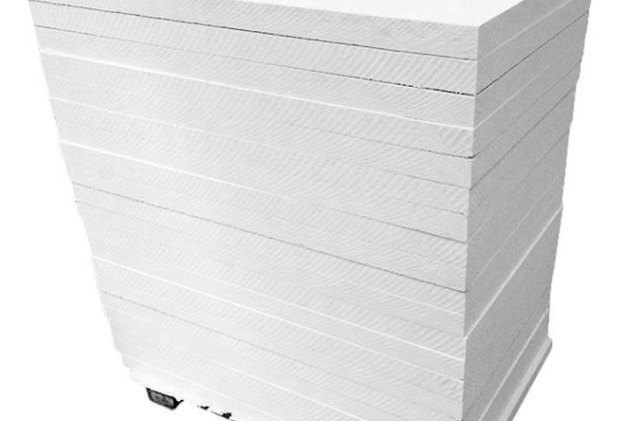
Calcium silicate board and ceramic fibre are quoted into the same application so often that they read like alternatives. They are not. One is a rigid, load-bearing, moisture-tolerant board with a service ceiling near 650 degrees. The other is a family of low-density wools that reaches 1260 degrees and above, cannot carry anything, and — in its standard alumino-silicate form — is classified as a category 1B carcinogen in the European Union. Choosing between them is not a performance comparison; it is a question of which layer in a stack-up each one is allowed to occupy. Get the order wrong and the board sits above its temperature limit, the fibre sits behind a load it cannot take, or the whole wall is built around a material that requires respiratory protection to install and hazardous-waste paperwork to remove. This guide sets out the temperature ceilings, the conductivity cross-over that decides which material is the better insulator at a given mean temperature, a worked 1000 degree wall showing how both layers have to be sized together, and the regulatory position that now drives European specifications more than any thermal argument.
1. Two Materials, Two Different Jobs
The starting point is that neither material is a substitute for the other in the general case, and a specification that names one where the other belongs usually reveals that the service temperature has not been thought through.
- Calcium silicate board is a hydrous calcium silicate made from silica and lime, formed under pressure and steam-cured. It is rigid, machines and saws cleanly, holds its own shape under cladding, carries load at reasonable compressive stress, and tolerates water and moisture without losing its insulating value. It is supplied as block, board and preformed pipe sections.
- Ceramic fibre is an umbrella term for high-temperature insulation wool: alumino-silicate wool, often called refractory ceramic fibre, and the newer alkaline earth silicate wools. It is supplied as blanket, board, paper, rope and vacuum-formed shapes. It is light, flexible, and reaches temperatures that calcium silicate cannot approach, but it has almost no compressive capacity and its performance depends heavily on how it is compressed and supported.
The practical division of labour that follows is that fibre takes the hot face where the temperature demands it, and a rigid board takes the backing where the load, the mechanical abuse or the moisture exposure demands it. A stack-up that puts them the other way round fails on temperature at the hot face and on load in the middle.
2. The Temperature Ceiling Decides the Order
Calcium silicate insulation for block and pipe applications is specified under ASTM C533, which divides it into types by maximum use temperature and density. The distinctions matter more than they look, because they set which layer the board is even permitted to occupy.
| ASTM C533 type | Form | Max use temperature | Max density | Typical duty |
|---|---|---|---|---|
| Type I | Block and pipe | 649 C (1200 F) | 240 kg/m3 | General backing, pipe insulation, fire door cores |
| Type IA | Block | 649 C (1200 F) | 352 kg/m3 | Higher-density backing where load matters |
| Type II | Block | 927 C (1700 F) | 352 kg/m3 | Higher-temperature backing only, still not a hot face at 1000 C |
All three types share the same mechanical floor: minimum flexural strength 344 kPa, minimum compressive strength 688 kPa at five per cent deformation, mass loss on tumbling not more than 20 per cent in the first ten minutes and 40 per cent in the second, and soaking heat linear shrinkage not more than two per cent. Hot surface performance requires the warpage to stay within about 6 mm and no crack to pass through the full thickness.
The wool families sit above that ceiling, and they sit at very different points within it:
| Wool family | Composition | Practical continuous limit | Regulatory status in the EU |
|---|---|---|---|
| ASW / RCF (alumino-silicate) | Al2O3 and SiO2 | 1260 C, higher for high-purity grades | Harmonised classification as carcinogen category 1B, H350i |
| AES (alkaline earth silicate) | SiO2 with CaO and MgO | Typically below about 900 C in current grades | Exempt under Note Q of the CLP Regulation; not classified |
| PCW (polycrystalline mullite wool) | Al2O3 and SiO2, crystalline | Up to 1600 C in specialist grades | Not classified as a carcinogen |
A 1000 degree furnace therefore has exactly one eligible hot-face material in the table above on a purely thermal reading: alumino-silicate wool. Calcium silicate is 351 degrees past its limit even in Type II form, AES is a hundred degrees past a practical limit that suppliers already quote conservatively, and the only unclassified route at that temperature is the crystalline mullite wool, which is a specialist product. If the furnace runs at 850 degrees instead, AES becomes eligible and the whole carcinogen conversation disappears. The design temperature is not a background detail here; it is the decision.
3. Conductivity: Where the Comparison Actually Turns
The received wisdom that fibre is the better insulator is true only at low mean temperatures. Calcium silicate board has a higher density — around 240 kg/m3 against 128 kg/m3 for a standard blanket — and at low temperature that counts against it. As the mean temperature rises, heat transfer across the pores of a low-density blanket becomes dominated by radiation, and the blanket's conductivity climbs steeply. A dense board with small closed pores resists that radiative path much better, so the two curves cross.
| Mean temperature | RCF blanket, 128 kg/m3 | Calcium silicate board, Type I |
|---|---|---|
| 100 C | 0.050 W/m.K | 0.066 W/m.K |
| 300 C | 0.070 W/m.K | 0.093 W/m.K |
| 455 C | 0.107 W/m.K | 0.107 W/m.K |
| 700 C | 0.185 W/m.K | 0.120 W/m.K |
| 900 C | 0.265 W/m.K | 0.120 W/m.K |
- Thickness and performance are not proportional. Adding millimetres to a low-conductivity layer reduces the flux less than the same millimetres added to a high-conductivity layer, so the optimum is never a single material at a single thickness.
- The mean temperature of each layer matters, not the hot-face temperature. A layer's effective conductivity has to be evaluated over the range it actually spans, which is why the interface temperature has to be chosen before either thickness can be calculated.
- A datasheet conductivity is a curve, not a number. Two products quoted at the same "0.06 W/m.K" can differ by a factor of two at the mean temperature your furnace actually runs at, because the quoted figure is at 38 degrees or at ambient.
Below about 455 degrees mean temperature the blanket insulates better per millimetre. Above it the board does, and by a wide margin by the time the mean temperature reaches 700 degrees. This is the physical reason the backing layer in a high-temperature wall is a board rather than more blanket, and it is worth stating explicitly because the alternative explanation — that the board is there only to take the load — is only half the story. Three consequences follow:
4. The Regulatory Divergence
Since the harmonised classification under the European CLP Regulation took effect, the specification of high-temperature insulation in Europe has been driven by hazard labelling at least as much as by thermal performance. Alumino-silicate wool, the standard refractory ceramic fibre that has been in furnace service since the 1950s, carries a harmonised classification as a carcinogen in category 1B with the hazard statement H350i, may cause cancer by inhalation. It was added to the REACH candidate list of substances of very high concern in January 2010, and the classification applied from 19 December 2011. Handling is governed by national technical rules for hazardous substances, disposal is as hazardous waste, and downstream users must be informed under the REACH communication obligations. The IARC monographs retain a Group 2B, possibly carcinogenic, evaluation, which is a lower band than the European classification but does not change the labelling obligation inside the EU.
The alkaline earth silicate wools were developed specifically to break that link. Their composition substitutes soluble calcium and magnesium oxides into the silicate network, so the fibre dissolves in lung fluid far more quickly; the biopersistent fraction is the mechanism that drives the classification, and removing it removes the hazard. AES wools are exempt under Note Q of the CLP Regulation, are not classified as carcinogens, and fall outside the scope of the technical rules that govern alumino-silicate wool. Polycrystalline mullite wool, a crystalline rather than vitreous fibre, likewise carries no carcinogen classification, though its dust is treated as a respirable hazard under separate occupational rules.
The substitution case for AES is not that it performs better than alumino-silicate wool at high temperature. It is that it performs almost as well at temperatures where it is allowed, and that choosing it removes a hazard class, a labelling obligation, a respiratory protection regime and a hazardous-waste disposal route from the project.
Calcium silicate sits outside that entire discussion. It is an inorganic board, not a fibre wool, and carries no comparable classification. Where the service temperature permits it, it is the simpler material to specify, install, inspect and dispose of.
5. A Worked Wall: 1000 Degrees, 300 W/m2
The numbers below are worked from published conductivity curves with a steady-state one-dimensional model. The wall carries 1000 degrees on the hot face, the ambient is 25 degrees, the external surface loses heat at 12 W/m2.K by combined convection and radiation, and the design target is a heat flux of 300 W/m2, which is a reasonably energy-conscious figure for a large furnace.
Taking a single 100 mm layer of each material first shows that neither works alone at that thickness.
| 100 mm single layer | Heat flux | Outer surface temperature | Verdict |
|---|---|---|---|
| Calcium silicate | 951 W/m2 | 104 C | Too hot to touch, and well over the flux target |
| RCF blanket | 1420 W/m2 | 143 C | Worse than the board, and far too hot |
The blanket is worse at this thickness despite its lower conductivity at low temperature, because the mean temperature across the layer is around 570 degrees, well past the cross-over. Now the two layers have to be sized together. The external surface follows from the film, the interface temperature is the design variable that must be held at or below the board's limit of 649 degrees, and the thickness of each layer follows from the enthalpy drop it has to absorb.
| Interface temperature | RCF hot-face thickness | Calcium silicate backing | Total | Comment |
|---|---|---|---|---|
| 450 C | 364 mm | 114 mm | 478 mm | Board well inside its limit, but a lot of fibre |
| 500 C | 345 mm | 132 mm | 477 mm | Lower fibre, more board |
| 550 C | 324 mm | 150 mm | 474 mm | Board still comfortable |
| 600 C | 300 mm | 169 mm | 469 mm | Board at 92 per cent of its limit |
| 649 C | 274 mm | 188 mm | 462 mm | Board exactly at its limit |
| 700 C | 244 mm | 209 mm | 453 mm | Board over its limit; this build is not valid |
Three things fall out of that table. The first is that the total thickness is almost flat across the whole range — 462 to 478 mm — so the choice of interface temperature is very nearly free in material terms. The second is that pushing the interface to 700 degrees saves only nine millimetres of total wall while putting the board 51 degrees over its service limit, which is a bad trade made for no reason. The third is that at the limit the fibre layer does most of the temperature work, carrying 351 degrees of the 950 degree drop, with a mean conductivity of 0.234 W/m.K, while the board carries 599 degrees at a mean conductivity of 0.094 W/m.K. Per millimetre the board is the better insulator over its own range, exactly as the cross-over predicts.
For comparison, achieving the same 300 W/m2 with a single material would need 473 mm of blanket — but a 473 mm blanket self-compresses under its own weight and is impractical to support — or 329 mm of calcium silicate, which is not permitted because the board would be sitting at 1000 degrees on the hot face. A single-material wall is not available at this temperature.
| Consequence | Value |
|---|---|
| Heat flux at the design build | 300 W/m2 |
| Outer surface temperature | 50 C |
| Annual heat loss per square metre | 2,628 kWh |
| Annual energy cost at USD 0.06/kWh | USD 157.68 per m2 |
| Annual energy cost at USD 0.10/kWh | USD 262.80 per m2 |
That last pair of numbers is the reason to size the wall properly rather than copying the last project. Over a ten-year life the difference between a 300 W/m2 wall and a 450 W/m2 wall is several hundred dollars per square metre of furnace surface, which for a large furnace dwarfs the insulation cost.
6. Mechanical Behaviour: Where the Board Is Not Replaceable
Fibre wool has effectively no compressive capacity. It is dimensionally stable in the direction of its fibres but it compresses, and it continues to compress. Anything that has to carry a load — a person walking on a roof, a pipe shoe, a stack of stacked boards, a stud that transmits a wind load, a fire door leaf taking an impact — has to be carried by something else.
- Load bearing: calcium silicate takes the load directly at its published compressive stress; wool does not take load at all and must be supported by a separate structural layer.
- Dimensional stability: the board is self-supporting and holds its shape under cladding; blanket sags and must be impaled or anchored continuously.
- Machining: the board saws, drills and machines to a clean edge and holds a rebate; wool tears and needs a facing or a mechanical retainer at every cut edge.
- Surface for a coating: the board accepts a hard coating or a high-emissivity facing; wool needs a rigidised or encapsulated grade before anything can be applied to it.
- Impact and abrasion: the board resists both; wool abrades and releases fibre wherever it is rubbed.
That is why the board appears in the parts of a furnace that a person touches: the lining of a door, the walkable surface of a roof, the shoe of a support, the core of a fire door. In those positions the temperature is often well within the board's limit and the fibre would be the wrong material even if it were cheaper, because the load is the problem rather than the heat.
7. Water, Moisture and the Morning After a Leak
Both materials are affected by water, but differently, and the difference shows up in what you have to do about it.
Calcium silicate absorbs moisture and, per the standard's own note, can take up to four times its dry weight if it sits in direct contact with water. What it does not do is lose its structure. A wetted board dries out, and once the moisture content returns to its specified level the thermal performance is restored; the failure mode of a wet board is a period of poor performance and, if the wetting is repeated, eventual loss of strength and spalling. High-quality boards are supplied with a water-repellent treatment and do not absorb oil, which is why they are used around steam and condensate systems where a leak is a routine event rather than an incident.
Wool behaves differently. A blanket that has been soaked loses its loft, and once the fibre has matted, the conductivity that depended on the air spaces does not come back. A wet fibre lining is usually a replacement, not a drying job. It also becomes friable, and a friable alumino-silicate lining releases respirable fibre far more readily than a sound one, which is a handling and disposal problem rather than only a thermal one.
8. Passive Fire Protection and Fire Doors
High-density calcium silicate is the core of most certified fire door leaves and of many rated partition systems, and the reason is a combination of properties that no wool has: it is dimensionally stable when heated from one face, it is non-combustible and rated A1, it holds the intumescent seal and the ironmongery fixings, and it takes a hinge and a latch without a reinforcement plate. The board used across a range of fire door designs is drawn from the same ASTM C533 family, at the higher end of the density range.
Fibre products do appear in passive protection, but in the flexible roles: penetration seals, expansion joint fillers, cable tray wraps and curtain systems, and in those roles they are chosen for flexibility and for the absence of a rigid joint that can crack. The split between rigid cores and flexible seals follows the same logic as the furnace stack-up.
9. Removal, Disposal and the Cost Nobody Prices In
An alumino-silicate lining is a hazardous material at the end of its life, and by then it is also devitrified and more friable than it was when it was installed. Removal requires controls that match the installation controls or exceed them, dust suppression, and packaging that will not release fibre in transit. Disposal is as hazardous waste with the accompanying documentation. In several European markets the substitution obligation means that a written assessment of whether a lower-hazard product could have been used is itself a required document, and the assessment has to be done before the order rather than after the failure.
Calcium silicate removal is a demolition job, not a hazardous-materials job. It is dusty, it is heavy, and it goes to a construction waste route. AES wool removes like wool but without the classification, which is why the practical substitution decision usually comes down to the hot-face temperature: below the AES limit, choose AES; above it, either manage alumino-silicate wool formally with a documented assessment, or move to a rigid solution such as a castable or a crystalline wool.
10. Selection Summary
| Requirement | Calcium silicate board | AES wool | ASW / RCF wool |
|---|---|---|---|
| Hot face to about 650 C | Yes, Type I | Yes | Yes |
| Hot face at 900 C | No | At the practical limit | Yes |
| Hot face at 1200 C and above | No | No | Yes |
| Load bearing | Yes | No | No |
| Fire door or rated core | Yes | No | No |
| Machined to shape on site | Yes | Poorly | Poorly |
| Survives a soaking and dries out | Yes | No | No |
| Best insulation per mm above 450 C mean | Yes | No | No |
| Carcinogen classification in the EU | None | None | Carc. 1B, H350i |
| Hazardous waste on removal | No | No | Yes |
Read down the columns and the logic is straightforward. Calcium silicate is the rigid, durable, low-hazard option that stops at about 650 degrees. AES wool is the flexible, low-hazard option that stops at about 900 degrees. Alumino-silicate wool is the only flexible option above that, and it is the only one of the three that brings a hazard class with it.
11. FAQ
Can calcium silicate replace ceramic fibre as a hot face if the furnace is only at 600 degrees? Yes, and it is often the better choice there, because at that temperature the board is both a better insulator per millimetre and a load-bearing surface. What it cannot do is follow a curved or irregular substrate, which is where a blanket still wins.
Is AES wool a direct substitute for alumino-silicate wool? Only up to its temperature limit, and the limit differs by grade. Above the limit the fibre devitrifies, the insulation value falls away and the lining has to be replaced. Specify the actual hot-face temperature and get the supplier's continuous limit in writing rather than working from the classification temperature on the datasheet.
Is IARC Group 2B the same as the European category 1B? No. They are different systems with different evidence bases. The European classification carries the legal labelling, handling and disposal consequences; the IARC evaluation is a hazard identification. Inside the EU the CLP classification is what drives the specification.
Why does the low-density blanket insulate worse at high temperature? Because at high temperature the dominant heat path across the pores is radiation, and a low-density product has more radiating surface and less material in the way. Dense boards with small closed pores suppress that path, which is why the conductivity curves cross.
Does a thicker fibre layer always reduce the heat loss? It reduces the flux, but not in proportion, because the mean temperature across a thick layer falls and the conductivity with it — which actually flattens the curve. The calculation above shows total wall thickness varying by only about three per cent across a 250 degree range of interface temperature, which is why the interface temperature should be set by the material limits rather than by a thickness optimisation.
12. Getting the Stack-Up Right the First Time
At Henan HuanGang we supply aluminium silicate ceramic fibre board for furnaces alongside the rigid board products that sit behind it, and the questions we ask before quoting are the same ones this guide is built around: what is the actual continuous hot-face temperature, is the layer carrying a load, is it exposed to a washdown or a leak, and does the project have a substitution obligation that rules out a classified fibre. Answer those four and the stack-up usually falls out of the temperature ceiling and the cross-over table without any further argument. Send us the furnace condition and the existing lining detail and we will come back with the layers, the thicknesses and the reason each one is where it is.
Related reading: rock wool versus ceramic fibre in furnace service, ceramic fibre blanket, board and module forms compared, ceramic fibre module lining installation, ceramic fibre paper and expansion joint seals, refractory materials selection, refractory anchor systems for castable and fibre linings, castable mixing, curing and dry-out schedules, high alumina bricks in cement kiln zones and passive cable fire protection.
Need help selecting FRP products?
Our engineers answer technical questions free of charge.
Ask an Engineer on WhatsApp