
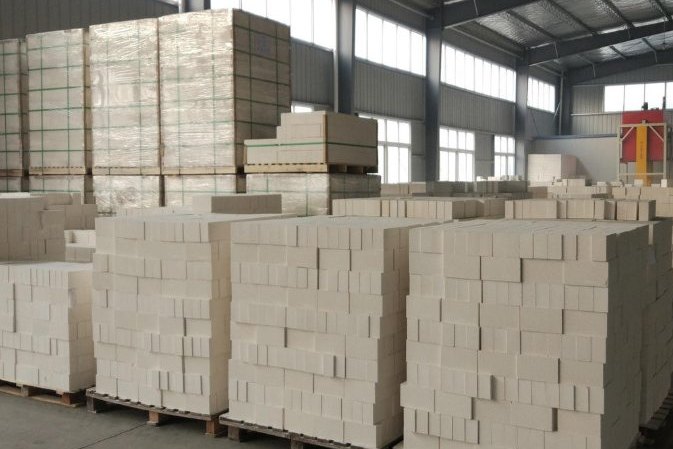
Ask a furnace builder to quote "insulating firebrick" and you will get a price; ask for the grade and the density and the conversation changes completely. Insulating firebrick (IFB) is a lightweight refractory brick made deliberately porous — an organic filler burns out during firing, leaving a controlled pore structure — and that porosity is the product. It is what gives the brick its low thermal conductivity and its low weight, and it is also what limits its strength, its abrasion resistance and its ability to carry load in a hot structure. The whole selection problem is deciding how much porosity you can afford at the hot face and where the rest of the lining should carry the job.
This guide works through the classification systems you will meet in an international tender, what each number on a data sheet actually measures, how to set the hot-face grade and design the backup layers behind it, and the practical constraints — joints, expansion, atmosphere chemistry and dimensional tolerance — that decide whether the lining reaches its calculated performance in service. The worked example at the end uses a 1250 °C duty and shows a two-layer build-up that fails a normal shell-temperature target, then fixes it.
1. What the Grade Number Actually Means
An IFB grade is not a maximum operating temperature. It is the outcome of a reheat test: a specimen is held at temperature for 24 hours, cooled, measured, and reheated; if the permanent linear change is not greater than 2%, the brick qualifies for that class. Every classification system in the world is a variation on that single test plus a ceiling on bulk density.
Two consequences follow, and both cost money when they are ignored:
- Classification temperature is not a continuous service temperature. A brick that survives 24 hours at its classification temperature with 2% shrinkage will still shrink measurably over thousands of hours at that temperature. Metal industry practice for a hot face is to allow a margin above the design temperature, not to run at the rating.
- Two bricks with the same classification can behave completely differently. A grade 26 brick with 47% alumina and a grade 26 brick with 60% alumina both pass the same reheat test, and they do not have the same conductivity, the same iron content or the same hot load behaviour. The grade letter/number is an entry ticket, not a specification.
2. Three Classification Systems, One Principle
Depending on where the furnace is being built, the same brick will be designated three different ways. The ASTM system uses a group number that reads as hundreds of degrees Fahrenheit; the ISO and European systems use a temperature-density designation; the Chinese system uses a material prefix plus a temperature grade.
| System | Designation form | Reference groups | Density ceiling in the designation? |
|---|---|---|---|
| ASTM C155 | Group 16 to 33 — group number ≈ reheating test temperature in hundreds of °F | 16 (1550 °F / 845 °C), 20 (1950 / 1065), 23 (2250 / 1230), 26 (2550 / 1400), 28 (2750 / 1510), 30 (2950 / 1620), 32 (3150 / 1730), 33 (3250 / 1790) | Yes — each group also caps bulk density (group 23 ≤ 769 kg/m³, group 26 ≤ 865, group 28 ≤ 961, group 30 ≤ 1089, group 32 ≤ 1522) |
| ISO 2245 / EN 1094-2 | Classification temperature then density, e.g. 140-0.9 | Groups 75 to 180 in 50 °C steps from 750 °C; maximum density rises from 0.40 to 1.60 g/cm³ | Yes — the second number is the density ceiling (group 140 ≤ 0.9 g/cm³, group 160 ≤ 1.15, group 180 ≤ 1.6) |
| GB/T 35845-2018 | Material prefix plus grade, e.g. MG-26 for mullite insulating brick | MG-23, MG-25, MG-26, MG-27, MG-28, MG-30, MG-32, keyed to reheating test temperatures of 1230, 1350, 1400, 1450, 1510, 1620 and 1730 °C | Yes — minimum density is specified instead (0.55 to 1.35 g/cm³), together with minimum alumina and minimum cold crushing strength |
The Chinese standard is worth reading even if the project is not in China, because it is the most explicit of the three: GB/T 35845-2018 (issued February 2018, effective January 2019) fixes alumina content, iron oxide, bulk density, cold crushing strength, permanent linear change, conductivity at three mean temperatures and refractoriness under load for every grade, and defines the acceptance test set as density, cold crushing strength, permanent linear change and conductivity at a 350 °C mean temperature. Related Chinese standards in the same family cover clay-based insulating brick (GB/T 3994-2013), high-alumina insulating brick (GB/T 3995-2014) and alumina bubble brick (YB/T 4764-2019), while GB/T 16763-2023 provides the national classification of shaped insulating products — the counterpart of ISO 2245 and EN 1094-2.
3. Density, Strength and Conductivity: the Package You Are Choosing
The single most useful table to have in front of you during selection is density against conductivity against strength, because those three move together and you cannot buy all three at once. Published manufacturer data for one commercial IFB family shows the shape of that trade clearly:
| ASTM C155 group | Density (kg/m³) | Cold crushing strength (MPa) | Modulus of rupture (MPa) | k at 260 °C mean (W/m·K) | k at 1093 °C mean (W/m·K) | Al&sub2;O&sub3; (%) | Fe&sub2;O&sub3; (%) |
|---|---|---|---|---|---|---|---|
| 23 | 593 | 0.9 | 0.7 | 0.14 | 0.26 | 39.4 | 0.6 |
| 26 | 769 | 1.9 | 1.4 | 0.23 | 0.37 | 47.0 | 0.6 |
| 28 | 881 | 2.3 | 1.5 | 0.33 | 0.39 | 67.0 | 0.3 |
| 3000 °F grade | 1041 | 3.0 | 1.7 | 0.40 | 0.48 | 69.9 | 0.3 |
| 32 | 1201 | 3.1 | 2.1 | 0.56 | 0.62 | 78.3 | 0.2 |
Read the first and fifth columns together: moving from grade 23 to grade 32 quadruples conductivity at low mean temperature (0.14 to 0.56 W/m·K) and more than triple the density, while gaining only about 3.4× in crushing strength. On a furnace wall, that is a large and permanent energy penalty paid for strength the hot face often does not need — most IFB linings carry the brick in compression and depend on the shell, not the brick, for global stability. Where the higher grade genuinely earns its place is where the hot face must resist erosion by dust-laden gas, where mechanical damage from charging equipment is expected, or where atmosphere chemistry demands the higher alumina and lower iron content.
Note also the iron content column. It is the number that decides whether a brick survives a hydrogen or cracked-gas atmosphere at all, and it is not the number buyers usually check. In reducing atmospheres iron oxide catalyses carbon deposition and accelerates disintegration; premium grades for those duties specify Fe&sub2;O&sub3; below 0.8%, and the data above shows the step from 0.6% in the low grades to 0.2% at the top.
4. Which Test Method Produces Which Number
Every figure on a supplier data sheet should be traceable to a method, because the method defines the specimen, the temperature and the reported basis. The following are the methods you will see quoted for insulating firebrick:
| Property | ASTM method | Chinese equivalent | What the number is based on |
|---|---|---|---|
| Classification / reheat change | C155 (classification), C210 (reheat change of IFB); C113 for dense brick | GB/T 5988 heating permanent linear change; GB/T 35845 grading table | 24 h soak, permanent linear change, ≤ 2% to qualify. |
| Bulk density and dimensions | C134 | GB/T 2998 | Averaged over whole bricks, not a cut specimen — a distinction that matters on cored or shaped bricks. |
| Cold crushing strength and modulus of rupture | C133 | GB/T 5072 | Room-temperature strength; the basis for handling and for compression in the wall. |
| Load testing at high temperature | C16 | GB/T 5989 (refractoriness under load, differential method) | Deformation under a fixed load and soak time; the true indicator of whether a brick carries load hot. |
| Thermal conductivity | C182, used together with C201 | YB/T 4130 (water-flow plate method) | Reported at a mean temperature — a k value without its mean temperature is not usable. |
| Spalling resistance | No single standard; fabricator or client procedure | GB/T 32833 | Cycling test; GB/T 35845 requires the data to be supplied rather than setting a pass/fail limit. |
Two habits save trouble here. First, insist on conductivity curves across the range, not one room-temperature figure: the ratio between 0.14 and 0.56 W/m·K between grades only appears when values are compared at the same mean temperature, and a data sheet that quotes k at 25 °C is not telling you what the brick will do at 800 °C. Second, when a specification says "refractoriness under load ≥ 1300 °C", check that the load in the test matches practice. GB/T 35845 grades quote RUL at a 0.05 MPa load, and RUL values at a different load are not comparable.
5. Setting the Hot-Face Grade: Margin and Reheat Change
The margin rule that IFB manufacturers publish is a useful starting point: for a direct hot face, choose a classification temperature roughly 200–300 °C above the design temperature, and for backup brick choose a class about 100 °C above the calculated interface temperature. The logic is that the classification test permits 2% shrinkage, while a lining that shrinks even 0.5% opens open joints and loses gas tightness; the margin buys dimensional stability rather than a higher melting point.
Worked through on a 1250 °C duty, that rule points to a grade with a classification temperature of 1400 °C or higher, which in the Chinese system is MG-26 and above, and in the ASTM system is group 26 and above. It also rules out the attractive option: grade 23 has the lowest conductivity of the family and would give the lowest heat loss, but its 1260 °C classification sits essentially at the design temperature, with no margin at all for the 2% permissible shrinkage that the classification itself allows. On a furnace that runs continuously at setpoint, that is a lining that will be re-bricked early.
Margin has a measurable energy price. At identical geometry and a 1250 °C hot face, stepping the hot-face brick from the grade 26 column to the grade 28 column raises the calculated heat flux from 1440 to 1517 W/m² — about 5% more heat lost through the wall, indefinitely, in exchange for extra strength. Grade selection is therefore an engineering trade to be argued explicitly, not a safe default of "always buy the higher grade".
6. Designing the Backup: Interface Temperature and Cold Face
Insulating brick alone is almost never enough. The classic two-layer mistake is to build a thick single-material IFB wall and assume the shell will be cool. The calculation below is a one-dimensional steady-state solution of a layered wall with temperature-dependent conductivity, using published conductivity data for a mullite IFB, an alumina ceramic fibre board and a standard 1260-grade fibre board, with a combined convection and radiation coefficient of 12 W/m²·K on the outside of a 6 mm steel shell and 25 °C ambient air.
| Build-up from hot face to shell | Interface temperatures (°C) | Heat flux (W/m²) | Shell temperature (°C) |
|---|---|---|---|
| 230 mm grade 26 IFB, no fibre backup | 1250 → 160 | 1623 | 160 |
| 114 mm grade 26 IFB + 50 mm alumina fibre board | 1250 → 821 → 145 | 1440 | 145 |
| 114 mm grade 26 IFB + 100 mm alumina fibre board | 1250 → 960 → 108 | 995 | 108 |
| 114 mm grade 26 IFB + 50 mm alumina board + 100 mm 1260 board | 1250 → 1016 → 832 → 92 | 809 | 92 |
| 114 mm grade 26 IFB + 50 mm alumina board + 150 mm 1260 board | 1250 → 1062 → 930 → 80 | 656 | 80 |
| 230 mm grade 26 IFB + 100 mm 1260 board | 1250 → 796 → 88 | 752 | 88 |
| 76 mm grade 26 IFB + 50 mm alumina board + 50 mm 1260 board | 1250 → 1018 → 711 → 125 | 1203 | 125 |
Three lessons come out of the numbers. First, the brick is not the insulation in the ordinary sense: 230 mm of grade 26 brick on its own still leaves the shell at 160 °C, which is above any reasonable personnel-protection target and high enough to make thermal growth of the steel a design issue. Second, adding fibre board behind the brick is far more effective per millimetre than adding brick, because the interface temperature drops quickly and the board then operates in the temperature range where its conductivity is lowest. Third, halving the hot-face brick thickness from 114 to 76 mm while keeping the backup unchanged raises the shell temperature by more than 30 K and the flux by about 50% — the brick layer is still doing real work in smoothing the gradient, but it is no longer the controlling resistance.
A shell limit of 80 °C is a common target, chosen for personnel protection rather than for the steel. The table shows that reaching it at a 1250 °C hot face with a grade 26 hot face needs of the order of 260–300 mm of total lining, split between brick and fibre, with the fibre carrying most of the last 100 °C of the gradient. Engineers who specify "230 mm IFB" as a shorthand for a hot furnace wall are specifying a 160 °C shell.
7. Why "Joints Are Where the Heat Leaks" Is Only Half True
IFB datasheets and installation guides often state that brick joints are the main source of heat loss. That statement is true, but not for the reason it is usually presented with. A one-dimensional calculation of conduction through a wall with a fraction of its area filled by mortar shows how small the conduction penalty actually is. Taking brick conductivity at the relevant mean temperature as 0.354 W/m·K, one vertical joint per 230 mm brick length, and an insulating mortar at 0.45 W/m·K:
| Joint thickness | Mortar conductivity (W/m·K) | Jointed area fraction | Increase in wall conduction |
|---|---|---|---|
| 1 mm | 0.45 | 0.43% | 0.09% |
| 2 mm | 0.45 | 0.86% | 0.18% |
| 3 mm | 0.45 | 1.29% | 0.28% |
| 2 mm | 0.90 (dense mortar mis-specified) | 0.86% | 0.53% |
| 5 mm | 0.90 | 2.13% | 1.31% |
Even a badly built 5 mm joint with a dense mortar adds only 1.3% to steady-state conduction, because the joint area fraction is small. The real risk at joints is not conduction but bypass: an unfilled joint or a distorted brick creates an open path for hot gas to travel behind the lining, and a local hot spot on the shell that no one-dimensional calculation predicts. That is why the practical response is dimensional control rather than exotic mortar — brick ground to tight tolerance on the joint faces, joints of 1–2 mm, staggered bond, and no dry stacked joints in a gas-tight application unless the design explicitly relies on a fibre blanket layer behind the brick to stop gas migration.
8. Expansion Allowance, Mortar Grade and Anchoring
Insulating brick expands on heating far less than the steel it protects, but the absolute movement over a large wall is still significant. Using a typical linear expansion for this class of brick of 5.6 × 10⁻⁶ per °C (measured from 20 to 1093 °C) over a 6 m wall heated to 1250 °C:
- Free growth of the brickwork is 5.6 × 10⁻⁶ × 6.0 m × 1225 K = 41 mm.
- Split into 3 m bays, that is about 21 mm per bay, which a 10–15 mm ceramic fibre joint per bay absorbs once compressed — and the joints have to be designed in at construction, not discovered by the bricks lifting in service.
- For contrast, the steel shell behind a similar lining sits near 92 °C in the worked example and grows only about 4.9 mm over the same length. The shell is the cooler member, so it is the brickwork joints, not the shell, that must absorb the differential movement.
Mortar selection follows the same logic as brick selection: use an insulating mortar matched to the brick, not a dense fireclay mortar, and thin joints. In the Chinese standard family the appropriate product is classified as alumina-silicate insulating refractory mortar (YB/T 114), which is a different product from dense high-alumina or clay mortars. Two practical rules apply across all systems: mix mortar in small batches and use it within its pot life, because an insulating mortar that has begun to set will not bond to the next brick; and never allow mortar to fill a joint that is supposed to be an expansion allowance.
Where the brick is anchored rather than stacked (thin veneers, roof sections, burner quarls), the anchor alloy and the anchor-to-brick interface must be designed for the brick's hot-face temperature, and the detail must allow the brick to move relative to the anchor. Anchor systems for castable and fibre linings are covered in a companion article, refractory anchor systems for castable and fibre linings.
9. Zones Where IFB Is the Wrong Answer
IFB is a load-bearing, self-supporting masonry material, which is its advantage over fibre and its limitation. It belongs in furnace walls, roofs and suspended arches where the lining must stand up by itself, where gas velocities and dust loads would erode a fibre surface, and where the lining is expected to be walked on or mechanically cleaned during maintenance. It does not belong in the following duties:
- Dense liquid or slag contact areas — the classification of insulating brick assumes it does not directly contact molten material, and GB/T 35845 states it is for insulation layers or working linings that do not contact high-temperature molten material. Anything facing a metal or slag melt uses a dense brick or a castable working lining in front of the insulation.
- High thermal shock and high mechanical load together — a brick that is both porous and thin spalls when it is also asked to carry a charge impact. Use a denser working face and let IFB sit behind it.
- Tight spherical or highly irregular geometry, where the number of cut shapes and the resulting joint count make a castable or a fibre module cheaper and more reliable.
- Very high gas-velocity surfaces with abrasion, where the brick's low strength becomes the governing failure mode regardless of its temperature rating.
Where the choice is between brick and fibre rather than between brick grades, the decision is broadly: fibre for low mass, lowest conductivity and easiest field cutting; brick where the lining must be self-supporting, erosion-resistant and stable over long campaigns. The comparison across fibre forms is set out in ceramic fibre blanket, board and module selection, and the high-temperature insulation family in general in calcium silicate board versus ceramic fibre.
10. Atmosphere Chemistry: Iron, Alkali and Reducing Gas
Temperature alone does not define service life. The atmosphere chemistry decides whether the brick does the job, and it is the most frequently neglected part of an IFB specification:
- Reducing and hydrogen-rich atmospheres. Iron oxide in the brick catalyses carbon deposition and promotes disintegration. Specify Fe&sub2;O&sub3; below 0.8%, and prefer grades in the 0.2–0.3% range for hydrogen and cracked-gas duty.
- Alkali and alkali-chloride atmospheres. Alkali vapour condenses in the cooler part of the lining and reacts with the silica-rich bond. Higher-alumina grades resist this better; note that the low-grade IFB data in section 3 carries alkali content up to 1.5–2.0% in the brick body itself.
- Fuel switching. Moving from natural gas to a heavy fuel or an alternative fuel changes the sulphur and alkali load arriving at the lining. A grade chosen on temperature will not necessarily still be right after the fuel change.
- Atmospheric condition for the rating itself. Manufacturer rating tables are normal in an oxidising atmosphere. If the furnace runs reducing, ask what the supplier's rating means under that condition rather than assuming the number transfers.
11. Tolerances, Cutting and Incoming Inspection
The last common cause of an under-performing IFB lining is dimensional tolerance, because it is what makes closed joints possible. GB/T 35845-2018 sets the following for mullite insulating brick and is a reasonable benchmark for any international order:
| Item | Permitted deviation |
|---|---|
| Dimensional deviation, dimensions ≤ 250 mm | ± 1.0 mm |
| Dimensional deviation, dimensions 251–400 mm | ± 1.5 mm |
| Twist (101–250 mm / 251–400 mm) | 0.8 mm / 1.0 mm |
| Corner chipping (sum of three edges) | ≤ 35 mm |
| Edge chipping (sum of three edges) | ≤ 55 mm |
| Blowhole diameter | ≤ 5.0 mm |
| Cracks: width ≤ 0.25 mm / 0.26–0.5 mm / > 0.5 mm | No limit / length ≤ 30 mm / not permitted |
| Opposite-edge difference in thickness | ≤ 1.0 mm |
| Batch size and sampling | Batches of up to 30,000 pieces, sampled by the general acceptance rules for shaped refractory products |
For incoming inspection, ask for the size, appearance and section inspection to be done to a defined method, and treat the four acceptance properties named in section 4 (density, cold crushing strength, permanent linear change, conductivity at 350 °C mean) as the mandatory verification set on the certificate of analysis. Blowholes and chipping matter more on insulating brick than on dense brick, because a blowhole is a hole in the insulation value and a chipped corner is an open joint.
12. Specification and Selection Checklist
- Design hot-face temperature, including excursion peaks and their duration, written down before grade selection.
- Grade selected with a stated margin above design temperature, and the margin justified in the specification.
- Classification system and edition named, with the density and strength limits that go with the grade.
- Conductivity requested as a curve over mean temperature, not a single value.
- Alumina and iron oxide limits stated for the actual atmosphere, not copied from a generic data sheet.
- Backup layer calculated so that each layer's interface temperature sits at least 100 °C below its classification temperature.
- Shell temperature target agreed with the mechanical and safety disciplines (80 °C is a common personnel-protection limit).
- Joint thickness, mortar product and expansion joint locations shown on the lining drawing.
- Dimensional tolerances and defect limits referenced to a standard, plus a sampling plan.
- Certificate of analysis to include the four acceptance properties, with test temperatures stated.
How Huangang Supplies Insulating Brick and Backup Linings
Our mullite insulating fire bricks are supplied as a lightweight high-temperature brick for furnace and kiln insulation layers, and we quote them with density, alumina content, strength, permanent linear change and conductivity data so that the values can be checked against the layer calculation rather than taken on trust. We also supply the backup side of the same wall — aluminium silicate ceramic fibre board, the 1500 °C alumina ceramic fibre board used as the intermediate layer in the worked example above, and 1260-grade board for the cold side — so that a lining can be bought as one thermal package with declared interface temperatures instead of three unrelated material purchases.
Send us the furnace or kiln data: hot-face temperature and duty cycle, atmosphere, shell temperature limit, available lining thickness and any mechanical loads at the hot face. We will return a proposed grade, a layer build-up with calculated interface temperatures and shell temperature, and the certificate data that will accompany the shipment. The rest of the fireproof range, including rock wool and sandwich panels, is listed under fireproof and insulation materials.
Related reading: high-alumina bricks for cement kiln zones for dense brick selection in the working lining, refractory materials selection for choosing between brick, fibre and castable, castable mixing, curing and dry-out for the first heat-up of a castable lining, and ceramic fibre paper and expansion joint seals for the joint materials that make the expansion allowance work.
Need help selecting FRP products?
Our engineers answer technical questions free of charge.
Ask an Engineer on WhatsApp