
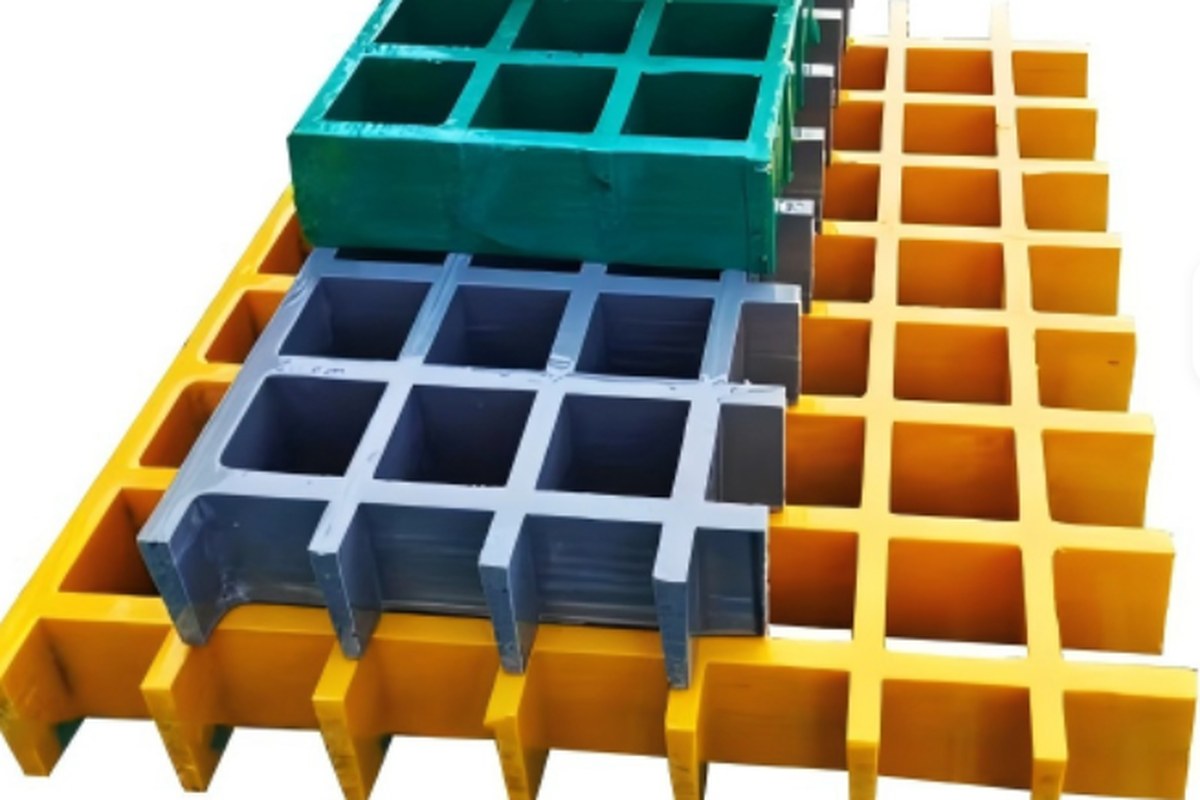
Steel grating tells you when it is in trouble. It rusts, it flakes, the paint lifts, and a maintenance technician walking past can usually see the problem from ten metres away. FRP grating does the opposite. It keeps its colour for years, it does not corrode, and a panel that has lost thirty per cent of its load capacity due to ultraviolet degradation and fiber blooming can look almost exactly like the panel next to it. The failure mode is brittle, the warning signs are subtle, and the part of the assembly that actually fails is very often not the grating at all but the clips, the supports or the handrail fasteners holding it in place.
That is the argument for treating FRP platforms as an inspected asset with a written programme, rather than something that is replaced when someone notices a problem. This guide sets out what to inspect, how often, what to measure, how to grade what you find, and what should trigger repair, load restriction or replacement - with the code numbers and test methods attached, so the programme can be defended in an audit.
1. Why FRP Walkways Fail Differently from Steel
Corrosion is replaced in FRP by a different set of ageing mechanisms, and knowing them is what turns a visual walkover into a useful inspection. The material is a composite of glass reinforcement and a thermoset resin matrix; degradation almost always starts in the resin, because that is the part exposed to the environment, and only becomes structural once the resin has been lost or the reinforcement has been exposed.
- Ultraviolet degradation. Solar radiation attacks the resin surface, which chalks, loses gloss and gradually erodes. Once the surface resin is gone, the glass strands at the surface "bloom" - they become visible as a white, fibrous, fuzzy texture. Blooming is the single most reliable early indicator that the protective surface has been consumed.
- Wicking and glass exposure. Exposed or cut glass acts as a capillary. Water travels along the fibers into the laminate, and freeze-thaw cycling or chemical attack can then work from the inside out. Any cut edge, drilled hole or damaged surface that is left unsealed is a future delamination site.
- Chemical attack on the resin. The same chemistry that makes FRP the right choice in a chemical plant is what limits it: strong oxidisers, hot caustics and some solvents attack polyester resins. The visible sign is often a change in surface texture - dullness, softening, or a "bleeding" appearance along the bar edges - rather than an obvious hole.
- Thermal cycling and elevated temperature. Mechanical properties fall as the service temperature approaches the glass transition temperature of the resin. Grating exposed to radiant heat from steam lines, flue ducts or hot process equipment ages much faster than the ambient temperature around it suggests, and the local temperature at the panel - not the room temperature - is the number that matters.
- Impact and point loading. FRP does not yield. A dropped flange, a forklift tyre or a trolley wheel loading a single bar produces local cracking rather than a dent, and a crack through a load-bearing bar removes the capacity of the whole panel along that line.
- Connection-level failure. Hold-down clips, bolts, and the supports themselves are where most real failures occur: clips loosen, fasteners corrode, panels shift, gaps open at edges, and supports deflect or corrode beneath a perfectly sound grating panel.
- Creep under sustained load. A permanently stored pallet or a pipe rack bearing on a panel is a sustained load case that a load table built around foot traffic does not describe. Sustained local loading produces progressive deflection that will not recover when the load is removed.
The practical consequence is that an FRP inspection has to look at three layers at once: the panel surface and resin, the load path through the bars and clips, and the supporting structure. An inspection that only looks at the walking surface will pass a platform whose handrail bolts are corroded through.
2. What the Codes Require You to Maintain
None of the relevant standards tell you how often to inspect an FRP platform. They tell you what condition it has to be in, which means the inspection interval itself is an engineering judgement that you have to document. That judgement needs to be anchored to a set of criteria, and these are the ones that apply in most projects.
| Requirement | Reference | What it means for an FRP platform |
|---|---|---|
| Walking-working surfaces must be maintained in a safe condition, free of hazards, and must support the maximum intended load | OSHA 29 CFR 1910.22(a) and (b) | The surface, and therefore its inspection, is a compliance obligation, not optional maintenance |
| Fall protection required at unprotected edges 4 ft (1.2 m) or more above a lower level | OSHA 1910.28(b)(1) | Sets where guardrail systems are required at all; also governs openings, hatches and ladder wells |
| Guardrail top rail 42 in ±3 in above the walking surface (39-45 in working range) | OSHA 1910.29(b)(1) | Height is measured from the walking surface - a panel settled or replaced at a different level changes the number |
| Top rail to withstand 200 lbf applied in any outward or downward direction, without deflecting below 39 in; midrail 150 lbf; toeboard not less than 3.5 in and 50 lbf | OSHA 1910.29(b)(3), (b)(4), (b)(5), (b)(9) | Design criteria, not field test requirements - but they define what a "failed" handrail is |
| No opening in a guardrail system large enough to pass a 19 in sphere; posts spaced not more than 8 ft on centre in common practice | OSHA 1910.29(b)(2) | Missing midrails and missing toe boards are the most frequently cited defects found on FRP platforms |
| Fixed walkways, stairs and platforms for machinery access | EN ISO 14122-2 and -3 | The international route: the height and load criteria come from the edition being applied, so they must be read, not copied from OSHA |
| Grating load tables published in a recognised format, with the deflection criterion stated | NAAMM MBG 531 practice; ASTM D790 flexural data | Used to confirm that the installed panel depth and span still match the load case |
| Surface burning characteristics for internal and occupied areas | ASTM E84 / UL 723, Class 1 or Class A criterion: flame spread ≤25, smoke developed ≤450 | Where a platform needs a fire class, the certificate must cover the specific panel depth and construction installed |
The obligation that most plants overlook is the paper trail. If a surface has to be safe, and an incident investigation follows a fall or a panel collapse, the first question asked is what the inspection programme was, when it last ran, what it found and what was done about it. A programme that exists only as a verbal practice does not answer that question.
3. Inspection Intervals by Service Class
Interval selection should follow exposure severity and consequence, and it should be written into the maintenance management system as a scheduled task rather than left to memory. The following intervals are a workable starting point for industrial platforms; they assume a baseline inspection at handover and adjustment after the first two annual cycles, when the actual rate of degradation becomes visible.
| Service class | Environment | Visual walkover | Detailed assessment | Notes |
|---|---|---|---|---|
| Benign indoor | Dry, temperature-controlled, occasional foot traffic only | Annually | Every 3 years | Best case for FRP; watch for impact damage and unauthorised modifications |
| General industrial | Outdoor weather exposure, mixed traffic, some chemical splash | Quarterly | Annually | UV degradation is the dominant mechanism; Barcol readings compared to baseline |
| Aggressive chemical | Continuous acid, alkali, chlorine or solvent exposure; regular washdown | Monthly | Every 6 months | Resin attack and chemical staining; grip loss on wet surfaces; check supports and fasteners too |
| High-temperature adjacency | Near steam lines, flue ducts, radiant equipment | Monthly | Every 6 months | Measure the local surface temperature, not the ambient; derating above about 65 °C should be confirmed with the supplier |
| Low-use access platforms | Used once or twice a quarter - tank tops, roof plant platforms, catwalks | Quarterly (include on the round) | Annually | These are consistently the worst-maintained platforms in any plant, precisely because nobody walks them |
| Post-event | After a chemical spill, fire, impact, overload or ground movement | Immediate | Damaged area, targeted | Same-week assessment; consider closing the area until graded |
Two practices make the interval schedule work. First, record a baseline at handover: panel identifiers, resin type, production batch where traceable, installed span and support spacing, and a set of Barcol hardness readings taken on representative panels. Without a baseline, a field reading of 34 has no meaning - it may be a healthy reading for that panel, or a collapse from 45. Second, keep a photographic record from a fixed position on each platform. Standardised photographs taken from the same place each time make slow changes visible in a way that walk-around photos do not.
4. The Defect Families and Their Signatures
The value of grouping defects into families is that each family has a characteristic signature, a characteristic cause, and a characteristic response. An inspector who knows the families can walk a platform in fifteen minutes and know what to measure next.
| Family | What you see | Usual cause | What it predicts if ignored |
|---|---|---|---|
| Surface degradation | Chalking, loss of gloss, colour fading, visible white glass fibers ("blooming"), a fuzzy or "hairy" texture | Ultraviolet exposure consuming the resin surface; no or exhausted UV protection | Progressive loss of resin and section; wicking into the laminate; reduced grip and appearance of loose fibers |
| Chemical attack | Dulling, softening, blistering, staining along bar edges; fiber prominence in patches; smells or residues after washdown | Chemistry outside the design envelope of the resin system, or concentration and temperature higher than assumed | Localised resin removal and loss of load capacity; eventual bar failure at the attacked zone |
| Grip loss | Bare or polished grit surface, smooth areas along walking lines and at stair edges, grit collected in corners | Wear, chemical removal of the binder, freezing and abrasion from truck wheels | Slip incidents; note that the visual surface can look intact while the friction value is already unacceptable |
| Bar cracking | Transverse cracks in load bars, cracks radiating from clip holes or cut edges, "clicking" underfoot | Overload, impact, over-torqued fasteners, thermal shock, unresolved creep deflection | Sudden brittle failure of the bar line, without warning deflection beforehand |
| Delamination and voids | Dull sound when tapped, lifting edges, visible separation between resin-rich surface and structural layers, moisture weeping from a cut edge | Under-cure, resin-starved or dry reinforcement, water ingress through unsealed cuts | Loss of composite action; the panel behaves as unconnected layers rather than a section |
| Fixings and clips | Missing or loose hold-down clips, rusted or sheared fasteners, elongated holes, panels able to move or lift, gaps at edges and at supports | Incorrect fastener type or torque, vibration, thermal movement, installation damage | Panel movement and prying at clips; edge uplift; progressive damage to clip holes that cannot be repaired |
| Support structure | Corroded or deflected support beams, missing bolts, loose anchorages, out-of-level supports, new loads added without review | Corrosion of the steel beneath the GRP, or field modifications made without engineering review | The grating may be sound while the platform is not - this is the defect family that causes collapses |
| Guardrail and handrail | Loose or missing bolts, degraded pultruded rails with exposed fibers, missing midrail or toe board, failed gate springs, guardrail height out of the 39-45 in range | UV ageing of the rail, vibration loosening fasteners, incomplete installation, later panel replacement changing the surface level | Loss of fall protection and the most likely source of a regulatory citation on an FRP platform |
5. Field Testing: What You Can Measure in Half a Day
An FRP platform assessment does not need a laboratory. It needs a small set of instruments and a consistent procedure, and the results need to be recorded against the same positions each time so trends can be seen.
Barcol hardness as the core measurement
Barcol impressor testing per ASTM D2583 is the most practical field measurement available for FRP condition. It is a hand-held indentation test: a spring-loaded steel indenter is pressed against the surface and the resistance to penetration is read on a 0-100 scale, with the harder scale impressions used for cured laminates and a softer scale available for more flexible materials. The instrument needs a minimum material thickness of about 3 mm to give a meaningful reading, and it is effectively non-destructive - the indentation is small enough not to matter structurally.
The absolute number matters less than the comparison. Properly cured polyester and vinyl ester laminates commonly read in the range of about 30 to 50, and grating specifications frequently quote a minimum around 40, but the useful criterion in service is the ratio to the original condition and the trend:
- Above 80 % of the installation baseline - treat as acceptable; continue the routine interval.
- Below roughly 80 % of baseline, or a clear downward trend across two inspections - investigate: check for under-cure of replaced panels, chemical attack, or surface resin loss; increase inspection frequency in that area.
- Very low readings combined with visible blooming, softening or bar cracking - grade the panel for repair or replacement rather than monitoring; hardness loss of that order is usually accompanied by loss of mechanical properties.
Take at least ten readings per panel or per 10 m² zone, distributed across bars rather than concentrated in one spot, and record both the average and the lowest value. Read on a smooth bar side or a cut edge rather than on the grit surface of a gritted panel, or the grit will control the result.
| Check | Method or instrument | Criterion to record against | Frequency |
|---|---|---|---|
| Cure state and surface degradation | Barcol impressor, ASTM D2583 | Compare with installation baseline; flag below 80 % or a falling trend | Every detailed assessment |
| Delamination and voids | Tap test with a small hammer or coin; ultrasonic follow-up if the result is ambiguous | A dull rather than sharp ring indicates a suspected delamination; any dull area on a load bar is graded for action | Every detailed assessment, and after any impact event |
| Slip resistance | Portable pendulum or tribometer, ASTM E303 practice; wet conditions | Compare with the project criterion; a wet dynamic coefficient of about 0.42 is a widely used floor-safety threshold | Annually, and after grit loss is identified |
| Deflection under load | Straightedge and dial gauge, or a long straightedge under a known load | Against the load table criterion for the span, commonly L/100 to L/200; about 6 mm is the conventional walkway comfort limit | Annually, or when visible sag is suspected |
| Fixings | Calibrated torque wrench and visual check of every clip | Manufacturer's torque value - over-torque crushes FRP; no missing clips | Annually, and after any panel replacement |
| Local temperature | Infrared thermometer at the panel during normal operation | Confirm the supplier's derating position above about 65 °C at the actual local temperature | During hot-operation surveys |
| Visual defect classification | Photographic record against a defect standard; ASTM D2563 provides a visual defect classification framework for laminate parts | Same defects recorded at the same locations across inspections | Every inspection |
Barcol hardness is a cure and degradation indicator, not a load rating. A panel that passes a hardness check can still fail on span, clip condition or support defects - which is why the measurement is one line in the report, not the report.
6. Load Verification: Does the Platform Still Match Its Assumed Duty?
Condition assessment and load verification are two halves of the same question, and the second half is often skipped. Grating is selected against a load table that states a panel depth, a span and a deflection criterion; in service, platforms gain loads that were never in the original case.
| Panel depth (typical) | Indicative distributed rating | Typical maximum recommended span | Where it is used |
|---|---|---|---|
| 25 mm | About 1.5-2.5 kN/m² | About 600 mm | Light foot traffic, trench and drain covers, screens |
| 38 mm | About 2.5-5.0 kN/m² | About 900 mm | General industrial walkways and access platforms |
| 50 mm | About 5.0-7.5 kN/m² | About 1,200 mm | Longer spans, higher loads, maintenance access over equipment |
Values like these are manufacturer-specific and must be taken from the load table for the panel actually installed, together with the deflection criterion and any temperature or resin basis. A load table without a stated deflection criterion, span or safety factor is a marketing document rather than an engineering one, which is a useful thing to know when a replacement panel is being purchased against an old table.
The four things to verify in the field are: the actual support spacing (measured, not assumed from a drawing); the panel depth as installed; the concentrated load case (a trolley wheel, a drum, a stored item) as well as foot traffic; and whether the platform has acquired new permanent loads - pipework, additional tanks, stored spares, new equipment. Any of these can move the platform outside its original design case, and the remedy is engineering review rather than a stronger-looking panel.
7. Defect Grading and Repair Triggers
A defect grading system is what converts an inspection into action. The scale below is deliberately simple - five grades, each with a defined response and a defined time window - because a system that requires an engineer to interpret every entry will not be used consistently by the people doing the inspections.
| Grade | Description | Typical triggers | Required action |
|---|---|---|---|
| 0 - Acceptable | No defect, or cosmetic only | Light chalking; uniform colour; grit intact; all clips present | Continue the routine interval |
| 1 - Monitor | Early degradation, no loss of function | Surface blooming starting; localised grit thinning; slight colour change; minor surface scuffs | Record with photographs; re-check at the next scheduled interval; schedule re-coating in the next maintenance window |
| 2 - Repair | Local degradation or hardware defect with no immediate structural risk | Widespread blooming with material loss; grit gone over more than about 30 % of a walking route; one or more missing clips; minor edge damage; loose handrail bolt | Repair within 90 days: re-coat or re-grit, replace clips and fasteners, seal cut edges |
| 3 - Restrict and repair | Structural capacity or protection is compromised at a specific location, but the area is usable with control | Bar cracks not through the full section; suspected delamination on a bar; deflection beyond the load table criterion; Barcol below 80 % of baseline over a defined zone; handrail deflection or height outside criteria | Restrict load or access in that area; engineer review within 30 days; repair or replace the affected panels; re-inspect before returning to service |
| 4 - Isolate immediately | Loss of structural or fall-protection function | Crack through a load-bearing bar; any delamination on a primary load bar; shattered or missing panel section; missing midrail or guardrail section; fallen or detached handrail; support beam visibly deflected or detached | Barricade and remove from service until repaired or replaced; document the trigger and the closure; review the rest of the platform for the same condition |
Two rules make this scale work in practice. First, grade and act at the same visit wherever possible: a Grade 2 missing clip is a five-minute fix, and deferring it converts a cheap repair into a Grade 3 evaluation. Second, a Grade 3 or 4 finding is a prompt to look at the neighbouring panels and the whole platform, because degradation in FRP is rarely localised to one panel unless the cause was a single event. Widespread blooming on one platform usually means the resin's UV protection has been consumed across the whole installation, and the age of the rest of the site's platforms should be checked on the same basis.
8. Repair Methods and What They Are Actually Good For
FRP can be repaired, but the range of legitimate repairs is narrower than for steel, and the most common mistakes are repairs that create a new defect.
| Method | Applies to | Acceptance check | Limits |
|---|---|---|---|
| Cleaning and re-coating with a UV-stable urethane or resin coating | Chalking, fading, early blooming, resin surface loss | Surface prepared and roughened, coating continuous, dry film thickness recorded | Restores UV protection only; it does not restore any section that has already been lost |
| Re-gritting or applying anti-slip strips or plates | Grit loss, polished walking lines, stair treads | Adhesion verified, no lifted edges, no trip step above the panel surface | Choose an adhesive compatible with the service chemistry; check the fire class if the area requires one |
| Localised laminate overlay (hand lay-up with compatible resin and glass) | Mechanical damage to profiles, handrail sections, non-critical areas of a panel | Surface abraded and cleaned, correct resin, cure verified with a hardness check | Not a primary load path repair; not acceptable on cracked load bars in a walkway panel |
| Panel replacement | Cracks through load bars, delamination, under-cured panels, shattered sections | Same depth, mesh, resin and surface type; correct clips and torque; edges sealed | Match the original specification - mixing panel types in one platform creates uneven deflection and load paths |
| Clip and fastener replacement | Missing, loose or corroded fixings; elongated holes | Correct corrosion-resistant or FRP-compatible fastener with a load-spreading washer; torque to the manufacturer's value | Clip holes cannot be re-drilled indefinitely; once holes are oversized, the panel needs replacement |
| Sealing cut edges and drilled holes | Every field cut, every drilled hole, every damaged surface | Resin applied to fully wet out exposed fibers | Not optional. Unsealed cuts are the most common self-inflicted defect on FRP installations |
| Handrail re-bolting, midrail and toe board restoration, gate spring replacement | Guardrail and handrail defects | Height back within 39-45 in, bolts torqued, no 19 in sphere opening, toe board gap within tolerance | If the rail itself has UV-degraded with exposed fibers, replacing the section is usually more reliable than coating it |
The repairs that should never be accepted: filling a crack with putty or sealant; welding or applying heat to reshape a panel; bolting through a cracked bar to "tie it together"; painting over delamination so it is no longer visible; and replacing a single panel with a different depth or mesh while leaving its neighbours unchanged. Each of these either hides a defect or moves the load into a part of the structure that was not designed for it.
9. Documentation, Spares and Shutdown Planning
The difference between an inspection programme and a pile of inspection reports is a register that links findings to dated actions. At minimum, the register should carry the platform identifier, panel identifiers and batch information where available, the defect grade, the date of the finding, the assigned action, the completion date, and the person who closed it. Photographs belong in the register, not in a separate folder nobody opens.
Three practical arrangements reduce both cost and downtime:
- Keep spares from the original supply. Holding roughly 3 to 5 % of the panel population in the same depth, mesh, resin and colour, plus a stock of hold-down clips and the correct fasteners, means repair work can be planned rather than improvised. FRP panels from a different batch or a different resin colour in the same platform look like a repair, permanently, and create an uneven surface where stiffness differs.
- Record the baseline at installation. Barcol readings, resin system, panel depth, span and clip type, taken at handover and included in the asset register, are what make every later measurement interpretable. This is a single half-day of work at commissioning that saves an unquantifiable amount of guesswork in year ten.
- Bundle repairs into planned shutdowns. Re-coating, re-gritting and panel replacement are all easier, safer and cheaper when the area is already isolated for other work. Annual inspection findings should feed the next turnaround scope directly, and Grade 3 findings should be reviewed before the platform is handed back to unrestricted use.
10. When to Replace the Platform Rather Than Repair It
At some point on every FRP platform, cumulative repair stops being economical and the right answer is systematic replacement. The decision criteria that matter most are these:
- Thirty per cent or more of the panel population at Grade 3 or 4. At that point the platform is being maintained panel by panel, and a coordinated replacement is usually cheaper and far more predictable than continuing to patch it.
- Barcol hardness below 80 % of baseline across the whole installation, with visible fiber blooming throughout. The degradation is a property of the material population, not of individual panels, and repair cannot restore it.
- The resin system is wrong for the service. Where a platform has been attacked by a chemistry outside its design envelope - or where the process has changed since installation - replacing panels with the same resin simply restarts the failure.
- The load case has increased. New equipment, heavier trolleys, stored materials, or a change of occupancy can move the platform beyond the load table for the installed depth; the answer is a deeper panel and possibly a closer support spacing, which is a design change rather than a repair.
- The guarding no longer complies. A guardrail system whose top rail has degraded, whose height has drifted out of the 39-45 in range, or which is missing midrails on open sides is a code problem that a like-for-like panel replacement will not fix.
- Replacement is an opportunity, not just a cost. Where a platform is being renewed, it is worth reviewing panel depth against current load tables, choosing a closed-top or covered grating where small dropped items are a hazard, upgrading the grit specification for wet or oily areas, and confirming that the fire class of the replacement matches what the area requires.
HuanGang supplies the grating and profile side of these programmes: molded FRP grating for industrial walkway floors, Class 1 fire-resistant anti-slip grating with custom cutting, and pultruded GRP handrail and stair railing profiles, plus matched hold-down clips and fasteners so that repairs use components designed for the panels. For the design background, the grating load table guide explains how uniform and concentrated load cases are read, the stair tread slip resistance guide covers friction testing and grit surfaces, the handrail systems guide sets out the code heights and loads in detail, and the fabrication and installation guide covers the cutting, edge sealing and clip fixing details that field repairs should follow.
Need help selecting FRP products?
Our engineers answer technical questions free of charge.
Ask an Engineer on WhatsApp