
Mining and mineral processing attack materials from two directions at once: acidic, reagent-laden water corrodes, and slurries of ground ore abrade. Carbon steel lines thin from the outside and inside simultaneously; rubber-lined steel works but is heavy and labour-intensive to maintain. FRP occupies the middle ground — immune to corrosion, manageable against abrasion with the right design, and light enough to install in remote plants without heavy lifting capacity.
1. The Corrosion-Abrasion Double Attack
Process water in concentrators is frequently acidic (pH 2–5) after flotation reagents and oxidation products, and it carries abrasive fines. Steel must choose a lining (rubber, polyurethane, coatings) whose failure exposes bare metal; FRP's structure is corrosion-proof through thickness, so the design question shifts to managing wear: velocity limits, resin-rich liners at wear points, and replaceable wear sections where slurry does the worst damage.
2. Where FRP Works Across the Plant
| Area | FRP components | Notes |
|---|---|---|
| Reagent & acid storage | Filament-wound tanks (sulfuric, HCl, flotation reagents) | Vinyl ester for strong acids |
| Process water & transfer piping | Filament-wound pressure pipe, fittings, flanges | Size DN80–DN3000; pressure classes per line |
| Thickener & basin covers | Curved/flat cover plates | Odor control + safety |
| Walkways, platforms, handrails | Molded grating, pultruded profiles | Corrosion-proof, non-conductive |
| Launder & chute linings | FRP sheet / custom lay-up | Replaceable wear elements |
3. Piping: Corrosion-Proof by Design, Abrasion by Management
Filament-wound FRP pipe handles the acidic process and return-water circuits that destroy steel: no corrosion allowance to consume, smooth bore (Hazen-Williams C ≈ 150) that lowers pumping power, and large diameters at modest weight — a real advantage at remote sites where every crane hour is expensive. For abrasive slurry duty, respect three levers: keep velocities in the supplier's recommended band (excess velocity abrades any material), specify resin-rich liners and heavier wall at direction changes, and design elbows and tees as replaceable spools. Sizing and pressure-class fundamentals are in our GRP pipe specification guide.
4. Tanks: Reagents, Acids and Process Liquors
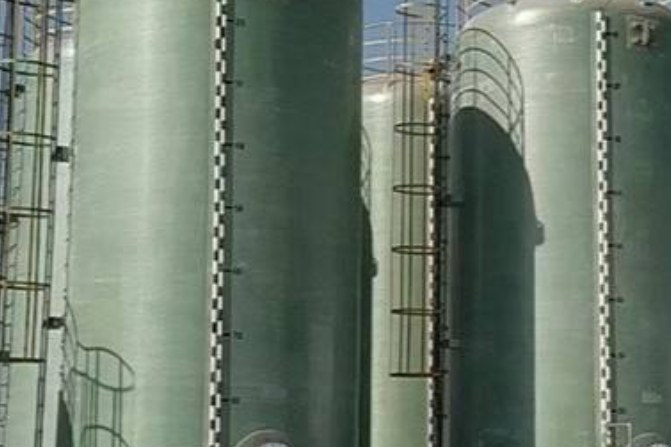
Filament-wound FRP tanks store the acids and reagents that define a concentrator — sulfuric, hydrochloric, flocculants, flotation collectors — with vinyl ester liners matched to each chemistry. Mixing and neutralisation duties suit filament-wound chemical mixing tanks; agitated services need baffle and nozzle reinforcement designed in, not retrofitted. Ground-level tank farms pair naturally with bunding and the safety logic in our chemical tank safety guide.
5. Structures: the Maintenance-Free Envelope
Around the process, FRP gratings, handrails and pultruded structures remove the painting cycle that dominates maintenance budgets in corrosive plants: walkways over thickeners and launders, platforms at filter presses, handrails along reagent areas — all non-conductive, all unaffected by the same acidic air that peels coatings off steel. Structural span selection follows our grating load table guide.
6. Chemical Resistance Quick Reference
| Exposure | FRP suitability | Resin |
|---|---|---|
| Dilute sulfuric / hydrochloric (process pH 2–5) | Excellent | Vinyl ester |
| Flocculants, collectors, frothers | Excellent | Isophthalic+ |
| Oxidising agents (high ferric, chlorides) | Check grade | Verified vinyl ester |
| Slurry abrasion | Manage via velocity & liners | Any, with wear design |
7. Installation in Remote Locations
Remote sites reward FRP's logistics: pipe and tank sections ship nested and join with adhesive bell-spigot or flanged joints using hand tools and small mixing kits — no welding machines, no hot-work permits, minimal specialist labour. Support spacing per the pipe supplier's tables, thrust blocks at direction changes for unrestrained joints, and winter installation notes for adhesive-cure temperatures complete the picture.
8. Specification Checklist
- Water chemistry per circuit (pH, reagents, oxidants) driving resin choice
- Piping: pressure class, stiffness class, liner design for abrasive lines
- Velocity bands and wear-section strategy for slurry service
- Tanks: chemistry-matched liner, agitated-service reinforcement
- Structures: grating spans, handrail code compliance
- Joining system and site installation kit included in supply
9. Common Mistakes
- Treating FRP like rubber-lined steel in slurry — abrasion is managed, not ignored.
- Isophthalic resin on strong-acid duty to save a little.
- No thrust restraint on adhesive joints at direction changes.
- Agitator loads on tanks without designed baffles/nozzles.
- Ignoring winter adhesive cure limits during remote installation.
See our FRP pressure pipes, filament-wound process pipes, acid & reagent tanks, walkway grating and the full pipes & fittings / storage tanks ranges; related: pipe diameter & wall thickness guide.
Need help selecting FRP products?
Our engineers answer technical questions free of charge.
Ask an Engineer on WhatsApp