
Gunning is the repair method everyone reaches for at 2 a.m. when a kiln shell shows a hot spot and the next scheduled shutdown is five weeks away. It is also the repair method that fails most often, not because the material is wrong but because the decision to gun was made before anyone checked whether the damage pattern suits it, and because nobody measured the two variables that dominate the result: water at the nozzle and rebound.
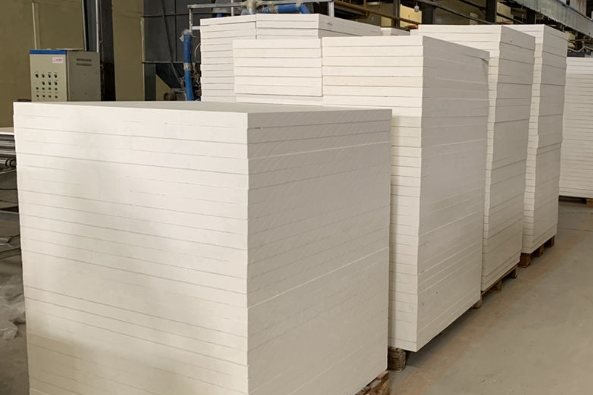
This guide treats refractory gunning and wet shotcrete as an engineering process rather than a trade skill. It covers the damage patterns that gunning can and cannot fix, the difference between dry and wet application, how to read a gunning mix data sheet, why a cast laboratory specimen cannot qualify a sprayed lining, nozzle water and rebound economics with worked numbers, surface and anchor preparation, adhesion testing, and the heat-up stage where most patches die. Product references point to the materials involved: ceramic fibre board for backup insulation, 90% alumina bricks and fireclay bricks for the zones where spraying is the wrong answer, and ceramic fibre blanket for the layers behind the working face.
1. When Gunning Is the Right Repair, and When It Is Not
Gunning bonds to the substrate chemically and by impact compaction. It does not restore a mechanical interlock, it does not carry compressive arch action, and it cannot replace a lining that has lost its anchor system. Those three limits define the decision.
| Damage pattern | Gunning appropriate? | Method | Reason |
|---|---|---|---|
| Localised hot spot over a shell defect, surrounding brick sound | Yes | Dry gunning, hot | Small area, substrate still at temperature, no time to cool |
| Erosion band in a transition or preheat zone | Yes | Wet shotcrete | Larger area, density and thickness consistency matter |
| Exposed or partially consumed anchor tips, lining otherwise intact | Yes | Either | Recovers cover over the anchors before they burn away |
| General thinning over more than about a third of the surface | No | Reline | Spraying over widespread loss hides the cause and adds load to a weakened structure |
| Arch, crown or dome segments | No | Brick or cast | These zones work in compression; a sprayed layer cannot reproduce that geometry |
| Lining detached from the shell (hollow under hammer or foil test) | No | Cut out and replace | Spraying over a detached plate adds weight to something already falling |
| Hairline thermal-shock crack network | No | Map, monitor, inject if through-thickness | Spray bridges the crack and conceals propagation |
Gunning is a surface repair. The moment the damage is structural, thickness-driven or geometry-driven, spraying converts a scheduled reline into an unscheduled failure with a shorter warning.
The second decision is whether the furnace can be cooled. Wet shotcrete needs access, a mixer and pump staging, and a substrate cool enough for personnel to work against. Dry gunning needs a nozzleman, a hose and air, and can be applied to a surface that is still glowing. That single constraint decides the process in most emergency repairs, and it is the reason a plant should hold both a dry gunning grade and a wet shotcrete grade rather than standardising on one.
2. Dry Versus Wet: The Process Sets the Properties
In dry gunning, dry mix travels through the hose and water is added at the nozzle by a water ring. The nozzleman controls the water by feel and by the look of the plume, which means the water content varies within roughly plus or minus 1.5 to 2.5 percentage points. In wet shotcrete, the mix is pre-mixed to a designed water content and pumped; water precision is much better, typically within 0.2 percentage points, and an accelerator is dosed at the nozzle.
| Parameter | Dry gunning | Wet shotcrete | Engineering consequence |
|---|---|---|---|
| Rebound, vertical wall | 15-25% | 5-9% | Dry process wastes up to three times more material |
| Rebound, overhead | 25-38% | 8-14% | Overhead dry gunning is a cost and safety problem, not just a waste problem |
| Water content precision | Variable, operator dependent | Set in the mixer | Wet process reaches design density; dry process can leave unhydrated pockets |
| In-situ bulk density vs vibro-cast | 88-92% | 96-99% | Porosity difference drives slag and alkali penetration |
| Cold crushing strength, dried at 110 C | 35-55 MPa | 65-85 MPa | Wet process allows earlier form stripping and earlier heat-up |
| Apparent porosity after 1000 C | 18-22% | 14-16% | Two to six points of porosity is a large change in penetration resistance |
| Dust at the workface | High, full respiratory protection | Minimal | Confined-space work is often only possible with the wet process |
| Application rate per nozzle | 1.5-3.0 t/h | 4.0-9.0 t/h | Shutdown duration, not material cost, may decide the method |
| Equipment footprint | 10-15 m2 | 40-60 m2 | Wet plant needs mixer, pump and staging space |
These are compiled industry ranges, not guaranteed values. They are useful for choosing a method and useless for accepting a lining. Acceptance has to come from a panel sprayed with the actual mix, by the actual nozzleman, at the actual water setting, tested as described in section 4.
3. Reading the Gunning Mix Data Sheet
A gunning mix is a castable that has been reformulated for pneumatic placement: finer aggregate to reduce rebound, a plasticiser or clay to stop it slumping on a vertical face, and usually a set accelerator. That reformulation has consequences, and the data sheet is where you find out whether the supplier has been honest about them.
The first number to check is the cement class. ASTM C401 classifies alumina and alumina-silicate castables by the lime contributed by cement, and the boundaries are not marketing categories:
| Class (ASTM C401) | CaO from cement | Typical behaviour |
|---|---|---|
| Conventional castable | 2.5% or more | Higher water demand, higher porosity, lower refractoriness, cheapest |
| Low cement castable (LCC) | above 1.0% up to 2.5% | Better density and hot strength, needs careful water control |
| Ultra-low cement castable (ULCC) | above 0.2% up to 1.0% | Dense, strong, sensitive to mixing and cure |
| No-cement castable (NCC) | 0.2% or less | Highest hot performance, most demanding placement |
The second is the permanent linear change class. C401 also sorts dense castables by the temperature at which the 5-hour permanent linear change stays at or below 1.5%:
| PLC class | A | B | C | D | E | F | G |
|---|---|---|---|---|---|---|---|
| Test temperature, C | 1095 | 1260 | 1370 | 1480 | 1595 | 1705 | 1760 |
If a gunning grade is offered without a CaO class or a PLC class, it is being sold on price alone and the buyer has no way to compare it with the castable it is meant to repair. Two further numbers matter: the maximum aggregate size, which sets the minimum layer thickness and the hose diameter, and the recommended service temperature, which is a material limit and not a licence to spray into a zone that is 200 K hotter than the surrounding lining.
There is a real penalty built into gunning grades. Dry-process mixes are typically based on castables modified with finer aggregate and clay to improve sticking, and the clay adds silica; in high-alumina systems that addition can reduce hot modulus of rupture and increase shrinkage above roughly 1480 C. Sodium silicate accelerators, widely used in both dry and wet processes, add alkali, which further reduces hot strength and refractoriness in low-cement high-alumina mixes. This is why a gunned patch in a steel ladle or a cement burning zone is a campaign extender, not a permanent reline.
4. Why a Cast Specimen Cannot Qualify a Gunned Lining
Most refractory data sheets are built on cast specimens. ASTM C862, the practice for preparing refractory concrete specimens by casting, states in its scope that it does not apply to monolithic castables intended primarily for gunning applications. The standard is telling you something important: a cast sample is not a sprayed sample, and there is no standardised route that turns one into the other.
The practical consequence for a buyer is that a gunning mix supplied with cast-only data is unqualified for its intended use. What is needed instead:
- A sprayed panel, at least 500 x 500 mm on a steel plate with the production anchor pattern, applied by the nozzleman who will do the work.
- Cure and dry-out matched to the site procedure, then firing to the anticipated service temperature per ASTM C865.
- Cores or cut cubes from the panel for bulk density, cold crushing strength and modulus of rupture per ASTM C133.
- Abrasion loss per ASTM C704/C704M where the zone sees particle-laden gas or dust.
- The panel retained as a reference sample, labelled with mix batch, water setting, nozzleman and date.
Expect the sprayed density to be below the cast reference. A dry-gunned sample at 90% of cast density is normal and is not a defect; judging it against the cast number is how good gunning gets rejected and bad gunning gets accepted.
5. Water at the Nozzle: The Variable Nobody Measures
Dry gunning grades are usually designed for 7-12% water by weight added at the nozzle. That range is narrow in practice: below about 7% the mix dusts, rebounds and laminates; above about 12% it slumps, skins over and leaves a porous layer that will spall on first heat-up. Because the water is added by a ring fed from a small pump, the actual flow is rarely recorded, and a partially blocked water ring can halve the flow without anyone noticing until the wall is covered in rebound.
| Nozzle output | 7% water | 9% water | 12% water | Time for 5.2 t placed (20% rebound) |
|---|---|---|---|---|
| 1.5 t/h | 1.75 L/min | 2.25 L/min | 3.00 L/min | 4.3 h |
| 2.5 t/h | 2.92 L/min | 3.75 L/min | 5.00 L/min | 2.6 h |
Those flow rates are small enough that they can be checked with a bucket and a stopwatch: disconnect the water ring, run for 60 seconds into a 10-litre container, measure, and repeat at the start of every shift and after any nozzle change. A 0.5 L/min drift on a 2.5 t/h machine is roughly two percentage points of water, which is the difference between a dense layer and a porous one.
Water also has to go somewhere. A 100 mm layer holding 9% water contains about 23 kg of water per square metre, and every kilogram becomes 1.67 cubic metres of steam at 100 C. Heat that water faster than it can escape and the pore pressure does the rest; section 9 gives the numbers.
6. Nozzle Technique and Rebound Economics
The nozzle should be held perpendicular to the surface within about 15-20 degrees and at a distance of roughly 0.6-1.2 m. Supplier literature quotes narrower windows - some say 0.5-1.0 m, others 0.8-1.2 m - and the difference reflects air pressure, hose length and mix grading rather than a disagreement about physics: too close and the impact destroys what has just been placed, too far and the stream separates, the coarse aggregate arrives faster than the fines and the layer becomes a graded, weak deposit.
Rebound is what does not stick. It is not a fixed property of the mix; it depends on angle, distance, water, substrate and layer thickness. A realistic take-off for a 20 m2 patch at 100 mm on a 2600 kg/m3 mix is 2.0 m3, or 5.2 t in place. Purchased tonnage follows directly from the rebound rate:
| Rebound | Mix to purchase | Material not placed | Material cost at USD 620/t | Cost per placed tonne |
|---|---|---|---|---|
| 8% (wet shotcrete, vertical) | 5.65 t | 0.45 t | USD 3,504 | USD 674 |
| 12% | 5.91 t | 0.71 t | USD 3,664 | USD 705 |
| 20% (dry, vertical) | 6.50 t | 1.30 t | USD 4,030 | USD 775 |
| 30% (dry, overhead) | 7.43 t | 2.23 t | USD 4,606 | USD 886 |
The cost of rebound is not only the material. Rebound that lands on the floor picks up debris and partly hydrates, so it cannot go back into the same layer; it becomes industrial waste with a disposal cost, and the 30% case above generates 2.2 t of it for a job that only needed 5.2 t. On overhead work the economic argument for wet shotcrete usually wins once the placed volume passes roughly 12-15 t, even after the higher mobilisation cost.
Layering matters as much as aim. Apply 20-30 mm per pass on vertical and overhead surfaces, let the layer take its initial set, then build the next pass; spraying 100 mm in one pass produces a soft, heavy layer that sags, traps rebound behind it and delaminates from the substrate.
7. Surface Preparation, Anchors and the Layer Behind
Nothing determines adhesion more than what the mix is sprayed onto. The substrate must be sound, roughened and free of slag, glaze, alkali condensate and loose material; edges of the repair should be cut square and keyed so the patch is not a feathered wedge that lifts at the first thermal cycle. Hammer the whole area first: any hollow note means the old lining is coming off and spraying over it will simply hold it in place until it falls.
Anchors carry the patch and conduct heat away from it. They also define the minimum cover: the tips must finish at least 20-25 mm inside the gunned layer, or they oxidise and the patch loses its reinforcement within a campaign. Anchor density is a design decision, but the material consequence is easy to see:
| Anchor grid | Anchors over 20 m2 | Steel mass at 0.15 kg each | Typical use |
|---|---|---|---|
| 100 x 100 mm | 2,000 | 300 kg | Severe thermal cycling, thin layers, overhead |
| 150 x 150 mm | 889 | 133 kg | General furnace walls and transition zones |
| 200 x 200 mm | 500 | 75 kg | Low-stress zones, insulating linings |
The layer behind the working face deserves more attention than it usually gets. Where a gunned hot face sits over ceramic fibre board or blanket, wet shotcrete will wet the insulation. Water in a fibre lining raises thermal conductivity, and on the first heat-up it turns the backup into a steam reservoir behind a freshly sprayed, still-permeable face. If the design relies on fibre board for its cold-face temperature, specify a water-repellent board, keep the spray water out, or use the dry process. The 1350 C ceramic fibre board and the standard 1260 C blanket are both available for that backup role, but neither is designed to be saturated.
Expansion joints should follow the lining design rather than the patch outline. A gunned panel 1.0-1.5 m square with a compressible joint at the perimeter behaves very differently from one continuous 6 m band that has nowhere to expand.
8. Adhesion: What to Test and What to Accept
Adhesion is the property most often quoted and least often measured. Two tests are available, and they answer different questions.
| Test | Standard | Specimen | What it tells you | Pitfall |
|---|---|---|---|---|
| Cold bonding strength | ASTM C198 | Two half-bricks joined with mortar, oven dried at 105-110 C, loaded in 3- or 4-point bending | Bond strength of a joint at room temperature, with the failure mode reported | Designed for air-setting mortars, not for sprayed monolithics; treat as a workmanship proxy |
| Pull-off bond strength | ASTM C1583 or EN 1542 | 50 mm core drilled through the patch, pulled with a calibrated disc | Actual tensile bond at the interface, on site, on the real substrate | Core must cut through the interface; a core that stops in the patch measures the patch, not the bond |
The acceptance criterion that survives contact with a furnace is not a single number. It is a combination: a minimum pull-off stress agreed in the inspection and test plan, plus a failure-mode requirement that the break occurs in the substrate or in the body of the patch, not as a clean separation at the interface. A patch that pulls off at 1.0 MPa with the whole interface exposed is worse than one that pulls off at 0.6 MPa with substrate attached, because the first will detach as a sheet on the next thermal cycle.
Record the location, the layer thickness at the core, the substrate condition and the failure mode for every test. Three or four cores per patch, taken at the thinnest point, the thickest point and one edge, is a defensible sampling plan for a repair of a few square metres.
9. Curing, Venting and the First Heat-Up
Most gunned patches that fail do so before the furnace reaches operating temperature. The mechanism is steam, and the numbers are not subtle. A 20 m2 patch at 100 mm carrying 9% water holds about 468 kg of water, which becomes roughly 783 m3 of steam at 100 C, or 39 m3 per square metre of surface. Saturated steam pressure rises steeply with temperature:
| Temperature | 100 C | 120 C | 150 C | 200 C | 250 C | 300 C |
|---|---|---|---|---|---|---|
| Saturated steam pressure, bar abs | 1.01 | 1.99 | 4.76 | 15.55 | 39.76 | 85.88 |
A pore sealed by a skin of dense gunned material reaches several bar well before the surrounding lining is at 150 C. Nothing in the mix design resists that; the water has to be given a path out and time to use it. Vent holes through the full thickness help, but the arithmetic is sobering. At a 4-hour dry-out the steam rate for that patch is about 54 L/s, which at 1 m/s of escape velocity corresponds to 544 cm2 of open area - roughly 1,900 holes of 6 mm diameter. Spreading the same release over 16 hours cuts the requirement to 136 cm2, still about 480 such holes. A few weep holes therefore relieve local pressure; they do not remove the water. The water leaves through the porosity of the whole sprayed surface, which is why thin lifts, slow heating and an unpainted face do more for a patch than any amount of drilling.
The heat-up procedure should therefore include a hold at 120-150 C long enough to release free water, a second hold at about 300 C for chemically bound water, and rates in the 20-30 K/h range below 300 C, with the total time scaled to thickness at roughly one hour per 25 mm. Sealed, painted or densely glazed surfaces should be avoided on a fresh gunned layer; they turn a permeable lining into a pressure vessel.
Where explosive spalling risk is high - thick sections, low-permeability mixes, fast heat-up - the standard mitigation is a polymer fibre addition that melts and leaves a channel network, plus a slower schedule. Both are design decisions to be made with the supplier before the mix is ordered, not adjustments to make at the burner.
10. Hot Gunning, Shutdown Practice and the Records That Matter
Hot gunning is dry-process work by definition. Wet shotcrete needs a cooled vessel and personnel access, so a repair at 800-1,200 C is done with a dry mix, often a phosphate-bonded grade that sinters against the hot face rather than relying on hydraulic set. The technique is different: shorter passes, minimal water, and acceptance that the patch is a campaign extender whose thickness will be measured again at the next shutdown.
What separates a controlled repair from an expensive experiment is the record. An inspection and test plan for gunning should capture, at minimum:
- Mix identification, batch and expiry, with the CaO and PLC class from the data sheet.
- Sprayed panel test results: density, cold crushing strength, modulus of rupture, abrasion loss where relevant.
- Nozzleman name and qualification, water flow measured at the start of each shift.
- Substrate preparation: method, extent, anchor type and grid, anchor tip cover.
- Layer thickness per pass, total thickness and the measurement method (core, needle, or depth gauge).
- Rebound rate and the quantity of material purchased against the quantity placed.
- Pull-off results with failure modes, and the location of every core.
- Heat-up curve, with actual thermocouple data and holds, signed by the person who ran it.
Two documents prevent most disputes: a purchase order that names the CaO class, PLC class, maximum service temperature and required panel test data; and a heat-up record that shows the holds actually happened. Everything else is detail.
Get Gunning Materials and Backup Insulation That Match the Specification
Henan HuanGang supplies the refractory and insulation side of these repairs: dense and insulating firebricks for the zones where spraying is the wrong answer, ceramic fibre board and blanket for backup layers that must not be saturated, and the anchor and accessory items that keep a patch attached. Send the damage description, the zone, the operating temperature and the substrate build-up, and we will quote the material set with the data sheet values that the gunning contractor needs to match.
Related reading on this site: refractory castable mixing, curing and dry-out for the water ratio and heat-up schedule behind a cast lining, refractory anchor systems for alloy choice, spacing and expansion joints, refractory lining inspection and remaining-life assessment for deciding whether a patch is worth doing at all, insulating firebrick grade selection for the backup layers, and ceramic fibre board density and binder selection for what the board behind the hot face is actually doing. Product pages: 1350 C ceramic fibre board, 1260 C ceramic fibre blanket, 90% alumina refractory bricks, fireclay bricks for kilns and mullite insulating firebricks.
Need help selecting FRP products?
Our engineers answer technical questions free of charge.
Ask an Engineer on WhatsApp