
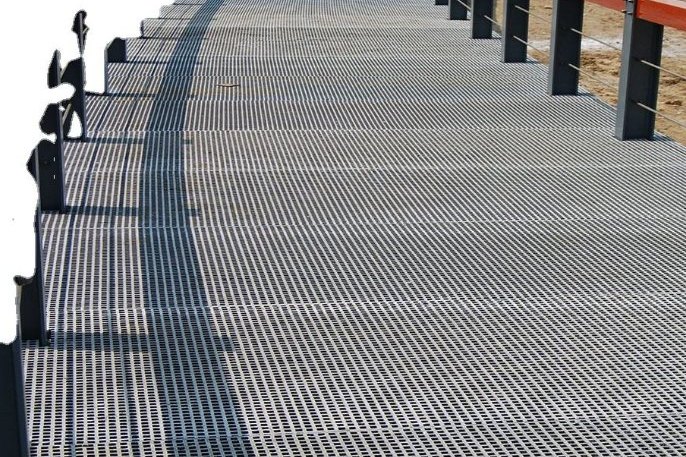
In a metro station or a tunnel walkway, an FRP grating panel is not a piece of access hardware that happens to be made of plastic. It is a combustible component of the escape route, and in an enclosed transit environment its smoke output and its toxic gas yield matter more than whether it burns. That is why European projects quote EN 45545-2 requirement sets rather than "fire retardant", and why North American projects quote NFPA 130 with ASTM E662 smoke limits. This guide explains how the hazard levels are derived, which requirement set applies to a grating panel, the full limit values for smoke density and toxicity at HL1, HL2 and HL3, how the 0.2 m² threshold decides whether your product goes through a four-test set or a three-test set, why general-purpose polyester fails where phenolic passes, and what documentation to demand before a panel is approved.
1. Why Smoke, Not Flame Spread, Is the Design Driver Underground
An above-ground platform with open ends can be evacuated the moment a fire is detected. A platform 30 metres below ground, or a tunnel section with no side evacuation, cannot. Passengers have to travel through the same air the fire is feeding, and the two things that kill in that situation are loss of visibility and inhalation of combustion products.
That single fact reorganises the entire fire specification. A material that resists ignition but produces dense, acidic smoke is a worse choice underground than a material that ignites slightly sooner but produces very little smoke and almost no toxic gas. Modern rail fire standards are built around that trade-off, which is why the headline numbers in EN 45545-2 are smoke optical density and a toxicity index rather than a flame spread class.
It also explains why a supplier's proud claim of "Class 1 fire rated" is not an answer. Class 1 or Class A ratings under ASTM E84 or a national building code address surface flame spread and, at most, a smoke developed index measured in a completely different scenario. They do not produce a MARHE, a Ds(max) or a CIT, and those are the numbers the rail authority is going to ask for.
2. The Two Regimes You Will Be Held To
Rail projects worldwide have converged on two frameworks. Which one governs comes from the client, not from the material.
| Framework | Scope | Structure |
|---|---|---|
| EN 45545 series | European; also widely adopted on projects outside Europe | Seven parts, from general rules to flammable liquid systems, with the material requirements sitting in Part 2 |
| NFPA 130 | United States and projects following North American practice | A single standard covering stations, trainways, vehicles and maintenance areas, with material tests named directly |
The seven parts of EN 45545 are worth knowing because enquiries often quote the wrong one. Part 1 sets the general rules and the vehicle classification; Part 2 sets the reaction-to-fire requirements for materials and components, which is the part that applies to a grating panel; Part 3 covers fire resistance of fire protection closures; Part 4 covers structural design of vehicles; Part 5 covers electrical equipment including trolleybuses, track-guided buses and maglev; Part 6 covers fire detection and firefighting equipment; Part 7 covers systems for flammable liquids and gases.
The current edition of the material requirements is EN 45545-2:2020 with amendment A1:2023. The 2013 edition that many older datasheets still reference contained 26 requirement sets; the 2020 edition expanded the set to 28. If a supplier's certificate cites a withdrawn edition, that is a re-test, not a paperwork problem.
3. Hazard Levels: How HL1, HL2 and HL3 Are Assigned
EN 45545-1:2013 classifies vehicles on two axes and derives a hazard level from the combination. The operation category describes the route and how easily people can get off the train; the design category describes the vehicle itself.
| Operation category | Condition |
|---|---|
| OC1 | Overground operation, minimum delay in stopping, immediate side evacuation to a place of safety |
| OC2 | Underground, tunnel or elevated structures, with stations or emergency stations reachable in a short running time and fast side evacuation available |
| OC3 | Underground, tunnel or elevated, with side evacuation available only after a longer running time |
| OC4 | Underground, tunnel or elevated, with no side evacuation available |
| Design category | N — standard | A — automatic, no emergency staff | D — double deck | S — sleeping / couchette |
|---|---|---|---|---|
| OC1 | HL1 | HL1 | HL1 | HL2 |
| OC2 | HL2 | HL2 | HL2 | HL2 |
| OC3 | HL2 | HL2 | HL2 | HL3 |
| OC4 | HL3 | HL3 | HL3 | HL3 |
The practical reading for a supplier of station and tunnel components is blunt. The moment a project involves a tunnel or an elevated structure with a long evacuation route, you are in HL2 territory, and OC4 puts you at HL3. A generic "fire retardant FRP" certificate to HL1 will not be accepted, and HL1 is not a fallback — the hazard level is set by the route, and the route is not negotiable.
Ask one question before quoting: which hazard level is written in the specification? Everything else — resin system, additive package, product family, test programme — follows from that one word.
4. Finding Your Product on the Requirement Matrix
EN 45545-2 assigns each product to a requirement set, an "R-set", according to where it is installed and what it does. A grating panel used as a walkway or a platform edge is a surface; the same material used as a small clip or a cleat is a small component. The R-set determines the test programme, and the tests are not interchangeable.
| R-set | Typical products | Tests required |
|---|---|---|
| R1 | Interior surfaces with an exposed area above 0.2 m² — wall and ceiling panels, interior doors, insulation, ducting, floors and floor coverings where not otherwise listed | ISO 5658-2 lateral flame spread; ISO 5660-1 cone calorimeter; EN ISO 5659-2 smoke chamber; EN 17084 toxicity. Add EN ISO 11925-2 if flaming droplets are observed. |
| R7 | Interior and exterior surfaces of gangways, exterior walls and floors, external design features, bogie structures, and non-listed exterior products with an exposed area above 0.2 m² | Same four tests as R1; a material compliant with R7 is also accepted for R8 external roof structures |
| R10 / R28 | Interior structures and coverings, insulation materials, floor composites and coverings | EN ISO 9239-1 radiant panel for flooring; EN ISO 5659-2; EN 17084 toxicity |
| R22 | Small interior components and non-listed interior products with an exposed area of 0.2 m² or less — clips, brackets, cleats, seals, small pipework and hoses | EN ISO 4589-2 oxygen index; EN ISO 5659-2 smoke chamber; EN 17084 Method 1 or Method 2 toxicity |
| R23 | The exterior equivalent of R22 | As R22 |
Note what changes. The large-surface sets R1 and R7 require a heat release measurement to ISO 5660-1 and a lateral flame spread measurement to ISO 5658-2, neither of which appears in R22 or R23. The small-component sets instead require an oxygen index, which the surface sets do not. A test report for the wrong R-set proves nothing about the product you are buying.
5. The 0.2 m² Threshold Decides Your Test Programme
The boundary between the surface sets and the small-component sets is a single number: 0.2 m² of exposed area. Almost every real grating product sits on the large side of it.
| Product | Exposed area | Likely R-set family |
|---|---|---|
| Standard moulded grating panel, 1220 × 3660 mm | 4.47 m² | Surface set — full four-test programme |
| Smaller panel, 1220 × 2440 mm | 2.98 m² | Surface set |
| Trench cover or duct cover strip, 1000 × 300 mm | 0.30 m² | Surface set |
| Narrow edge strip, 900 × 200 mm | 0.18 m² | Small-component set |
| Fixing clip or cleat, 100 × 100 mm | 0.01 m² | Small-component set |
Two consequences follow. First, a grating supplier cannot qualify a panel on a small-coupon oxygen index test and call it done — the panel needs the four-test surface programme. Second, a system approach can bring small parts inside the small-component route, but grouping rules in the standard set conditions on total combustible mass and separation distance; you cannot split one large panel into four small ones to change its R-set.
6. The Three Metrics That Actually Decide Approval
Whichever requirement set applies, the same three physical quantities carry most of the risk, and the same pattern repeats: HL2 tightens them, HL3 tightens them again.
- Heat release — MARHE. The maximum average rate of heat emission measured in the cone calorimeter to ISO 5660-1, in kW/m². It predicts whether the component will drive a compartment towards flashover. It is the metric most closely tied to fire growth.
- Smoke optical density — Ds(max). Measured in the smoke chamber to EN ISO 5659-2, dimensionless. It predicts how long people can still see the exit signs.
- Toxicity — CIT. A conventional toxicity index built from the concentrations of the main lethal gases — carbon monoxide, hydrogen cyanide, hydrogen chloride, hydrogen fluoride, sulphur dioxide and others — measured to EN 17084, which has replaced the older French NF X 70-100 method.
For the large-surface sets, the limit values most often quoted are:
| Hazard level | Critical flux, ISO 5658-2 | MARHE, ISO 5660-1 | Ds(4), EN ISO 5659-2 | VOF(4) | CIT / CITG |
|---|---|---|---|---|---|
| HL1 | ≥ 20 kW/m² | No requirement | ≤ 600 | ≤ 1200 | ≤ 1.2 |
| HL2 | ≥ 20 kW/m² | ≤ 90 kW/m² | ≤ 300 | ≤ 600 | ≤ 0.9 |
| HL3 | ≥ 20 kW/m² | ≤ 60 kW/m² | ≤ 150 | ≤ 300 | ≤ 0.75 |
Note the shape of the requirement rather than the individual digits: the flame spread threshold is broadly constant, and the smoke and heat release requirements get twice as tight between HL2 and HL3. A formulation that scrapes past HL2 will not come close to HL3. Always confirm the current limit table against the edition of the standard in your contract, since the tables have been revised between editions.
7. R22 and R23 Limits in Full
For small components, the requirements are set out in the standard's Table 5 and are frequently misquoted because R22 and R23 are not symmetric. R22 applies inside the vehicle envelope and R23 outside, and the interior requirements are the stricter of the two at every hazard level.
| Requirement set | Parameter | HL1 | HL2 | HL3 |
|---|---|---|---|---|
| R22 — interior, EN ISO 4589-2 | Oxygen index, minimum | 28 % | 28 % | 32 % |
| R22 — interior, EN ISO 5659-2 | Ds max, maximum | 600 | 300 | 150 |
| R22 — interior, EN 17084 | CIT, maximum | 1.2 | 0.9 | 0.75 |
| R23 — exterior, EN ISO 4589-2 | Oxygen index, minimum | 28 % | 28 % | 32 % |
| R23 — exterior, EN ISO 5659-2 | Ds max, maximum | No requirement | 600 | 300 |
| R23 — exterior, EN 17084 | CIT, maximum | No requirement | 1.8 | 1.5 |
The HL3 oxygen index requirement of 32 % is the single most useful screening number in the whole standard, because it is cheap to test and hard to fake. A general-purpose polyester laminate has an oxygen index close to that of ordinary air, which is precisely why it burns in an ordinary atmosphere; reaching 32 % requires either a genuinely fire-retardant resin chemistry or a heavy additive loading, and there is no way to pass it by testing a thicker sample.
8. Why Phenolic Passes Where Polyester Fails
The resin system, not the glass content, decides the fire result. Glass fibre is inert in a fire; the matrix is what burns, what smokes and what produces the toxic gases.
| Resin system | Fire behaviour | Smoke and toxicity | Practical role |
|---|---|---|---|
| General-purpose orthophthalic polyester | Burns readily; oxygen index close to ambient | High smoke output, high CIT | Not acceptable for enclosed transit. Fine for outdoor industrial walkways. |
| Polyester with heavy ATH loading | Improved ignition resistance; ATH decomposes endothermically and releases water vapour | Better than plain polyester; toxicity depends on the whole formulation | Historically the standard answer, still used. High loadings raise viscosity, slow the process and reduce mechanical performance. |
| Brominated fire-retardant systems | Good oxygen index performance | Corrosive and toxic combustion products; a high oxygen index can still fail the smoke density and toxicity limits | Being displaced on rail work for exactly this reason. |
| Phenolic | Forms a stable char, low flame spread, inherently fire resistant | Low smoke, low toxicity, without needing heavy fillers | The default choice for enclosed transit, tunnels and stations. Modern low-viscosity and hybrid phenolics process faster than older grades. |
| Halogen-free modified acrylic and phosphorus-based systems | Balanced heat release and processability | Low smoke, low toxicity | Increasingly specified where phenolic colour or surface finish is a constraint. |
The counter-intuitive point, and the one that costs suppliers money, is that a high oxygen index is not sufficient. Brominated systems can deliver an oxygen index that passes on paper while the same formulation produces the corrosive, toxic smoke that fails Ds and CIT. Smoke density and toxicity are measured separately for a reason. If your formulation was developed against an oxygen index target alone, it has not been qualified.
A second practical constraint: phenolics are darker and more difficult to pigment than polyesters. Where a station specification calls for a yellow or safety orange walkway for visibility, that requirement has to be resolved with the resin supplier at formulation stage, not specified into the order and discovered at moulding.
9. NFPA 130: The North American Route
Where EN 45545-2 governs in Europe, NFPA 130 covers fixed guideway transit and passenger rail systems in the United States, including stations, trainways, vehicles, and vehicle maintenance and storage areas. It names its test methods directly rather than through requirement sets, and it applies different tests to different classes of component.
| Component class | Test method | Typical limit |
|---|---|---|
| Structural components, panels, partitions, exterior shells | ASTM E162 surface flammability | Flame spread index commonly limited to 25, with 35 accepted for some product classes |
| Same components, smoke | ASTM E662 specific optical density | Ds(1.5) ≤ 100 and Ds(4.0) ≤ 200, in flaming mode |
| Walking surfaces and floor coverings | ASTM E648 critical radiant flux | Minimum 0.5 W/cm², which is 5 kW/m² — stricter than the 0.45 W/cm² Class I threshold in the building codes |
| Small components | ASTM E1354 heat and visible smoke release | Project-specific limits |
| Elastomeric gaskets and seals | ASTM C1166 flame propagation | Project-specific limits |
| Toxicity | BSS 7239 | Concentrations of eight gases: CO, CO2, HF, NO2, HCl, HCN, SO2 and HBr |
Two details matter commercially. First, the ASTM E648 requirement applies to walking surfaces, so a grating used as a station platform or a walkway between tracks may be caught by the critical radiant flux limit as well as the surface flammability limit — and 0.5 W/cm² is a higher bar than most suppliers expect from a building-code habit. Second, NFPA 130 is revised on a three-year cycle; at the time of writing the current edition is the 2026 edition. Confirm which edition your contract references, because material clauses have been reworded between recent editions.
A product qualified to EN 45545-2 is not automatically qualified to NFPA 130, and vice versa. The test methods, the sample sizes and the acceptance thresholds all differ. If a project may be procured against either framework, qualify against both from the start rather than paying for a second test programme later.
10. Slip Resistance, Stray Current and the Non-Fire Reasons FRP Wins in Metros
The fire case is the gate, but it is not usually why FRP was chosen. In metro applications four other arguments carry weight.
- Stray current. DC electrified railways return traction current through the running rails, and a conductive steel walkway can provide an unintended parallel path or an arc point. FRP's dielectric behaviour removes that path and the shock risk with it.
- Chloride and de-icing salt exposure. Platform canopies, escalator pits and tunnel drainage all see chlorides; a steel grating needs coating maintenance that is difficult to perform in a live station at night. An FRP panel has no coating to renew.
- Weight and installation access. Panels that can be lifted by one or two people matter where the only access is a station escalator or a tunnel walkway. Handling labour and access closures are a real cost line in transit work.
- Integral colour and slip resistance. Pigment through the full thickness and a moulded grit surface keep both the visibility and the anti-slip performance when the surface is scratched, which a painted steel panel cannot do. Slip resistance is normally declared against a ramp test class rather than a single coefficient; specify the class your project requires and require the test report.
11. The Documentation Package to Ask For
A rail fire approval lives or dies on paperwork, so make the evidence list part of the enquiry rather than a post-award surprise.
- Test report to the correct requirement set, naming the edition of the standard including amendments.
- The hazard level the report demonstrates, and the report's own conclusion statement to that effect.
- The resin system, additive system and product family the report covers, with the tested thickness range.
- For surface products, results for all four tests — lateral flame spread, cone calorimeter, smoke chamber and toxicity — not a summary.
- For walking surfaces, the ASTM E648 critical radiant flux result if NFPA 130 applies.
- Batch traceability from the tested formulation to the delivered product, including glass content and Barcol hardness records.
- Slip resistance test report to the ramp method required by the project.
- Load and deflection evidence for the panel at the specified span and support condition, since a fire-approved panel still has to carry people.
12. Specification Checklist for Transit Grating
- State the framework and edition — EN 45545-2:2020+A1:2023, or NFPA 130 with the edition year — and do not mix clauses between them.
- State the hazard level explicitly, and the operation and design category it came from.
- State the requirement set for each product on the BOM, including clips, cleats and edge strips, which may sit in R22 or R23.
- Require phenolic or halogen-free fire-retardant resin for any enclosed or tunnel application, and rule out general-purpose polyester by name.
- Require smoke density and toxicity results as separate line items, not as an oxygen index result presented as overall compliance.
- State slip resistance as a ramp class with the test method.
- State the design load, span and support arrangement, and the deflection limit.
- State colour and UV requirement, and confirm with the supplier that the pigment survives the fire-retardant formulation.
- Require fixing hardware to the same fire requirement as the panel, since a compliant panel on non-compliant cleats is not a compliant walkway.
Getting the Resin Right Is a Formulation Decision, Not an Order Line
Approving FRP grating for a metro or tunnel project is not a matter of finding a fire certificate and attaching it to a purchase order. The hazard level is fixed by the route, the requirement set is fixed by the installation position, and the limit values get twice as demanding between HL2 and HL3. Meeting them is a formulation and process decision — phenolic chemistry and a controlled additive package, qualified by an accredited laboratory against the right requirement set, with the colour, the slip class and the structural performance all surviving the change. If you are working on a transit enquiry, tell us the hazard level, the requirement set and the panel size, and we will come back with the resin system, test evidence and panel build-up that match.
Related reading: our anti-slip fire-resistant FRP grating and moulded FRP walkway grating ranges, FRP grating fire resistance and flame spread classes for the ASTM E84 and EN 13501-1 side of the question, moulded versus pultruded FRP grating, reading FRP grating load tables, FRP stair tread slip resistance and FRP grating and handrail in electrical substations for the dielectric argument in a different setting.
Need help selecting FRP products?
Our engineers answer technical questions free of charge.
Ask an Engineer on WhatsApp