
UAN — urea ammonium nitrate solution — is the most widely traded liquid nitrogen fertiliser in the world, and it is also one of the most frequently mis-specified storage problems in agriculture and at fertiliser terminals. The mistake is almost always the same: because the product is delivered as a clear liquid that looks like water and is not classified as a hazardous substance under CLP, it is treated as water. It is not. At 32 % nitrogen the solution has a specific gravity of 1.330, so a full tank carries a third more load than water; it salts out into crystals at around 0 °C, so a cold night can block a transfer pump; and its aggressiveness to metal depends on a corrosion inhibitor and on the ammonia excess that the producer maintains, both of which can change without anyone noticing.
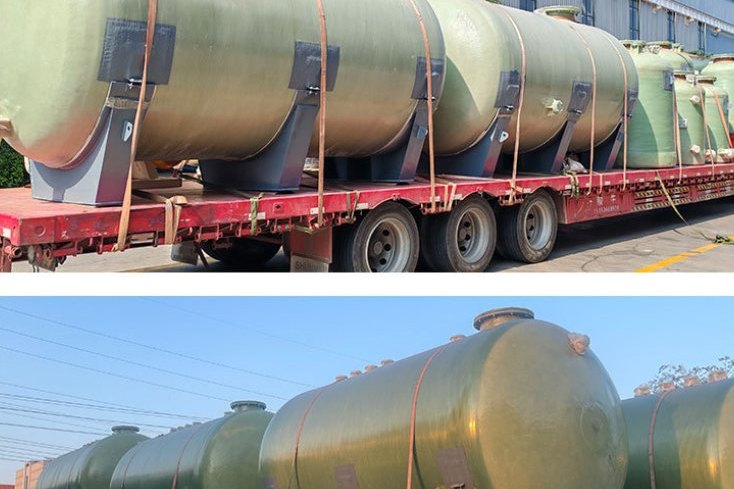
FRP is a genuinely strong answer to those three problems — there is no inhibitor to manage, no pH-related corrosion allowance to consume, and no chloride stress-corrosion risk in a laminate. But an FRP tank for UAN differs from a water tank in ways that must be designed in from the start rather than discovered in service: the shell has to be rated for the real product density, the resin system has a service-temperature ceiling that varies hugely between isophthalic polyester and vinyl ester, and the withdrawal detailing has to keep the product moving so that sludge does not build a pitting cell in the tank floor. This guide covers the material, mechanical, thermal, containment and operating decisions that determine whether a UAN tank lasts twenty years or five.
1. What UAN Actually Is, and Why a Water Tank Is Not the Answer
UAN is a mixture of aqueous ammonium nitrate and aqueous urea, normally with a small corrosion inhibitor addition. Three grades dominate trade: 28 %, 30 % and 32 % nitrogen. The physical data below is the basis of every other decision in this article.
| Property | UAN-28 | UAN-30 | UAN-32 |
|---|---|---|---|
| Total nitrogen (% by mass) | 28 | 30 | 32 |
| Ammonium nitrate content (% by mass) | about 37–40 | about 40–44 | about 42–47 |
| Urea content (% by mass) | about 31–34 | about 31–34 | about 34–37 |
| Salting-out (crystallisation) temperature | about −18 °C | about −9 to −10 °C | about 0 to −2 °C |
| Specific gravity at 25 °C | 1.281 | 1.304 | 1.330 |
| Density (lb/US gal at 60 °F) | 10.67 | 10.86 | 11.07 |
| pH of the solution | 6.8–7.5 as supplied, maintained by the ammonia excess | ||
| Boiling point | about 107 °C; heating above about 60 °C can hydrolyse the product | ||
The consequences follow directly from the table. A 100 m³ tank holds 128 t of UAN-28 but 133 t of UAN-32 — a 4 % difference that is easy to miss when a tank is ordered for "fertiliser" and then filled with the highest-analysis grade available. Because it is not classified as hazardous under CLP, storage tends to be governed by water-protection and agricultural rules rather than by dangerous-goods rules, which is precisely why the design review has to be internal discipline rather than a regulatory prompt. And since the salting-out temperature rises with concentration, a terminal that switches from 28 % to 32 % has quietly moved its crystallisation margin from −18 °C to 0 °C.
2. The Three Failure Modes That Decide Tank Life
- Crystallisation and salt-out. When the solution cools past its salting-out temperature, urea and ammonium nitrate crystals form. The immediate effects are pump cavitation, blocked transfer lines, blocked nozzles and uneven nitrogen concentration across the tank — the crystals are not homogeneous with the mother liquor. In a severe case the tank heel becomes a solid mass that has to be dissolved out. This is a temperature-control problem, not a corrosion problem, and it is the reason UAN storage is designed around a minimum wall and outlet temperature rather than a maximum.
- Corrosion driven by pH and ammonia excursions. In carbon steel tanks, UAN corrosion is managed with an inhibitor and by keeping the product's ammonia excess within specification. Stagnant product loses its excess ammonia, becomes acidic, and corrosion accelerates; diluting puddles and heels are the classic locations. Field monitoring in UAN storage has recorded mild-steel general corrosion near 0.1 mpy (about 0.0025 mm/year) at pH 6.5–6.8 but 2.8 mpy (about 0.071 mm/year) after a pH excursion to roughly 7.5, and 1.5 mpy at pH 9.0. In other words, a badly-run day can cost as much wall thickness as several normal years, and severe upsets have damaged tanks within days.
- Containment failure. Because UAN is a nitrogen-rich, highly mobile liquid that can reach groundwater, the consequences of a leak are environmental and regulatory rather than explosive. A single-wall tank with no bund, or a bund with a permanently open drain valve, converts a small tank leak into a groundwater incident.
Reframe the specification accordingly: UAN storage is not a chemical-resistance problem first, it is a temperature-control, solids-management and containment problem. Resin selection solves one of the three; the other two are geometry and procedure.
3. Material Selection: Carbon Steel, Stainless Steel or FRP
| Material | Suitability for UAN | What has to be managed |
|---|---|---|
| Carbon steel, uncoated | Common in large terminals, and the product suppliers' own data sheets state that properly inhibited UAN is not corrosive to carbon steel | Inhibitor type and dose, and the excess-ammonia specification, both of which are properties of the delivered product rather than of your tank. Corrosion-monitoring coupons and a five-yearly clean-out are standard practice; blending product from two producers that use different inhibitors can leave the blend below the effective dose of either. |
| Carbon steel with internal lining | Widely used for horizontal UAN tanks, typically a specialist internal coating over blast-cleaned steel | Coating integrity: holidays, mechanical damage at the manway and any repaired weld are the failure points, and a repair requires an internal re-coat. |
| Austenitic stainless steel (304L, 316L) | Used where a clean, uncoated internal surface is wanted | Chloride. Where the product or the make-up water carries chloride, austenitic grades are exposed to pitting and chloride stress-corrosion cracking; a molybdenum-bearing grade helps but is not immunity, and the capital cost is far higher than FRP. |
| FRP with vinyl ester corrosion barrier | The mainstream composite solution for UAN and mixed liquid fertilisers | Specific-gravity rating, resin service-temperature ceiling and the detail of the corrosion barrier and floor construction. |
| FRP with isophthalic polyester barrier | Acceptable for dilute ammonium-nitrate solutions at low temperature | Temperature ceiling drops sharply — see section 4 — and the resin supplier's published data will not cover saturated ammonium nitrate at all. |
| Polyethylene (rotomoulded) | Fine for small farm-scale tanks | Structural stiffness, specific-gravity rating, UV degradation and the fact that wall thickness, not resin chemistry, limits the size. |
The argument for FRP is not that it beats steel on any single property. It is that FRP moves the compliance burden off the product and onto the equipment. Once a laminated corrosion barrier is selected and validated for the grade, there is no inhibitor to monitor, no pH window to police, no lining to repair and no chloride to exclude.
4. FRP Resin System Selection and the Temperature Ceiling
Resin selection for a fertiliser solution is decided by a published maximum recommended service temperature for the specific chemical, and the spread between resin families is larger than most buyers expect. The figures below are the resin suppliers' own recommended service temperatures for continuous immersion; they are provided as a comparison between families, not as a licence to operate at the top of the band.
| Medium | Vinyl ester | Isophthalic polyester | Comment |
|---|---|---|---|
| Ammonium nitrate, 50 % | about 77 °C | about 49 °C | The classic pair: vinyl ester doubles the usable temperature band |
| Ammonium nitrate, saturated | about 77 °C | not rated | No published rating for isophthalic — a common trap when a tank is ordered for "AN solution" without a concentration |
| Ammonium hydroxide, 5 % | about 60 °C | not rated | Relevant to the ammonia-rich headspace and to ammonia make-up lines |
| Ammonium sulphate | about 77 °C | about 49 °C | Mixed fertiliser blends |
| Ammonium chloride | about 77 °C | about 49 °C | Chloride-bearing blends |
| Distilled water (reference) | about 71 °C | about 49 °C | Shows how much of the "chemical resistance" of isophthalic is in fact just the water rating |
- Vinyl ester is the default for UAN. It buys roughly a 25–28 °C higher ceiling than isophthalic on the nitrate chemistries, which is the difference between a tank that survives a hot summer day with dark-coloured product and one that does not.
- State the concentration and the maximum temperature in the requisition, not the product name. "Liquid fertiliser, 32 % N" and "ammonium nitrate 50 %" are different exposure cases with different data.
- Urea itself is not listed in most resin supplier tables as a separate medium. Where a blend contains a large urea fraction, or a micronutrient package, the honest route is a laboratory immersion test to ASTM C581 at the service temperature, and the retained flexural strength and Barcol hardness after exposure should be stated by the manufacturer.
- The corrosion barrier, not the structural laminate, is the tank. A resin-rich inner barrier with a specified glass content, backing layers and total thickness is what sees the chemistry; the chopped-strand and wound layers behind it carry the load and should never be exposed by a scratch that reaches through.
5. Designing the Shell for a 1.330 Specific Gravity
Fertiliser is heavier than water and this is where a "water tank" quotation becomes an unsafe tank. Take a vertical cylindrical FRP tank of 100 m³ at 5 m diameter, so the product height is 5.09 m.
| Contents | Specific gravity | Pressure at the tank floor | Hoop stress in a 12 mm shell | Hoop strain (E = 15,000 MPa) |
|---|---|---|---|---|
| Water (for comparison) | 1.000 | 50.0 kPa | 10.41 MPa | 0.069 % |
| UAN-28 | 1.281 | 64.0 kPa | 13.3 MPa | 0.089 % |
| UAN-32 | 1.330 | 66.5 kPa | 13.84 MPa | 0.092 % |
Three practical conclusions come out of this arithmetic.
- The shell stress scales exactly with specific gravity. Design for 1.0 and fill with UAN-32 and every hoop stress in the shell is 33 % higher than the case that was analysed. FRP tanks are normally issued with a design factor of about 10:1 on the relevant strength basis and a stated maximum specific gravity — for agricultural tanks this is typically quoted up to about 1.4 — and the maximum SG figure, not the volume, is the line to check on the quotation.
- The utilisation against a strain limit is comfortable, which is why the details govern. At 13.84 MPa and a hoop modulus around 15,000 MPa the strain is about 0.09 %, well inside the 0.2 % design strain traditionally used for GRP laminates. What then limits the tank is not the shell membrane but the nozzles, the base knuckle, the restraint against wind and seismic, and the quality of the corrosion barrier.
- A water hydrotest does not prove the design condition unless the pressure is raised. Water is 1/1.330 = 0.752 times as dense as UAN-32, so filling the tank to the design level with water applies only about 75 % of the service hoop stress. To reach the design stress, the test must be run at 1.33 times the design pressure; hydrotesting at 1.5 times design pressure — the upper end of the 1.33–1.5 range normally used for GRP piping and vessels — gives 150 % of the service stress and is genuinely conservative, while a test at 1.0 times design pressure is not a proof test at all for a heavy product.
6. Temperature Control: Staying Above Salt-Out and Below Hydrolysis
For UAN the design window is bounded on both sides, and both bounds are physical rather than conservatively chosen.
- Lower bound: the salting-out temperature. Design the tank, the outlet nozzle, the suction line and every exposed transfer line to stay above 0 °C for UAN-32, above about −9 °C for UAN-30 and above about −18 °C for UAN-28, with a working margin. Insulation, heat tracing on exposed pipework and a suction taken from the warmest part of the tank are the standard measures; the product inside a thin-walled outlet spigot on the north face of a tank is the first thing to freeze, not the tank body.
- Upper bound: about 47 °C in service and 60 °C absolute. Published UAN corrosion-management guidance recommends keeping tank contents within roughly 10–47 °C, because higher temperature accelerates both hydrolysis and corrosion; and the product safety data notes that heating above about 60 °C may cause hydrolysis. A dark-coloured tank in full sun will exceed ambient air temperature on the shell and at the top of the liquid, so a light gelcoat or a reflective coating is a functional specification item, not decoration.
- Do not fill to the top in winter. Leaving headspace allows warm product to be added to dissolve crystals that have started to form, and gives room for circulation. Conversely the vent must be sized for the fill rate in both directions — see section 9 — because a tank that is filled at high rate and then cools can pull a vacuum.
- Verify with instruments, not with the weather forecast. Tank contents, the outlet and the exposed transfer line can all sit at different temperatures; a single site thermometer does not tell you the temperature in the suction spigot at 4 a.m.
7. Recirculation, Sludge and the Pitting Cell in the Tank Floor
The single most useful operational refinement in UAN storage is to keep the product moving. The mechanism is well documented in fertiliser-industry corrosion management: sediment and corrosion sludge settle on the tank floor, oxygen and ammonia gradients develop under the deposit, and the result is under-deposit pitting that can perforate a floor while the rest of the tank looks perfect.
- Fit a recirculation connection across the tank diameter, with angled outlet spigots — around 45° is the usual arrangement — so that the returning liquid sweeps the floor rather than stirring one spot. This is the specific measure credited with drastically reducing floor pitting in UAN service.
- Never leave heels or puddles. Stagnant UAN loses its excess ammonia and turns acidic; small dilute puddles left on a metal floor or in a drained tank are the worst case. Drain completely, and rinse rather than leaving a film to dry.
- Clean out on a schedule, not on failure. Draining and cleaning large UAN storage tanks at least every five years removes the sludge that creates under-deposit corrosion, and is the routine that makes the difference between a tank reaching twenty years and one that does not.
- Monitor the product, not only the tank. Sample pH and excess ammonia on each delivery — ask for the excess ammonia figure on the certificate of analysis — and keep corrosion coupons at mid-height and near the floor, with one set read quarterly for trend and one retained for annual comparison.
- In an FRP tank the same discipline prevents a different failure: settled solids abrade and load the floor and the corrosion barrier, and a crystal mass at the base can load a nozzle or a suction when the product is finally pumped out. Circulation and clean-out protect a laminate just as much as they protect steel.
| Normal-situation general corrosion rate | mm per year | Wall thickness consumed in 20 years |
|---|---|---|
| About 0.1 mpy at pH 6.5–6.8 | 0.0025 | 0.05 mm |
| About 1.5 mpy at pH 9.0 | 0.038 | 0.76 mm |
| About 2.8 mpy after an excursion to pH 7.5 | 0.071 | 1.42 mm |
Read that table as an argument for monitoring rather than as a corrosion allowance. Even the excursion rate is a slow general loss; the reason UAN tanks fail is that pitting under a deposit concentrates the same electrochemical driving force into a small area, and the failure is a hole rather than a uniform thinning.
8. Nozzles, Fittings, Pumps and Pipework Materials
UAN is selective about metals, and the prohibited list is short but absolute.
- Avoid zinc, copper and copper alloys. Brass, bronze and galvanised components in contact with UAN corrode, and the product supplier's guidance is explicit that zinc and copper alloys must not be used. This rules out a surprising number of standard fittings, level switches and pump components.
- Cast iron, malleable iron and ductile iron are far more susceptible to corrosion than carbon steel or aluminium in UAN service, so iron-bodied valves, plugs and fittings on the tank should not be assumed to be "just steel".
- FRP, stainless steel, carbon steel and polyethylene are the practical materials for nozzles, spigots, sight tubes, vents and dip pipes. On an FRP tank, specify FRP or stainless flanges with the correct bolt grade, and use a published bolt torque for the gasket material rather than "tight".
- Gaskets and seals should be selected from the product supplier's compatibility list. EPDM and PTFE are the usual starting candidates for nitrate solutions; verify rather than assume, and inspect annually because gaskets are where leaks begin.
- Withdraw product from near the top of the liquid, not from the floor. An internal siphon or a top-mounted suction keeps settled solids and any water that has entered the tank out of the delivery stream. Typical agricultural FRP tank practice is a threaded coupling fitted with an internal siphon plus a separate vent connection.
- Pumps: a centrifugal pump with a flooded suction is normal; keep the suction line short, slope it back to the tank, and insulate or trace it if the terminal operates near the salting-out temperature. Never leave the suction line full of cold product over a frosty night.
9. Venting: Fill Rate, Vacuum and Ammonia Vapour
Fertiliser tanks are damaged by their vents more often than by their contents, and the mechanism is straightforward.
- Size the vent from the maximum fill and withdrawal rate, in both directions. A vent sized for the vapour generated in storage is not a vent sized for the liquid displacement during a fast tanker unloading.
- Provide vacuum protection. Product pumped out faster than air can enter, or a tank whose contents cool and contract, will pull a vacuum. FRP shells are difficult to design for vacuum service, so a vacuum breaker or a properly sized free-breathing vent is a required item.
- Never rely on a loose manway as a vent. It will either be bolted down during the next maintenance campaign or it will leak, and neither outcome is a design.
- Expect ammonia vapour and odour. The headspace is ammonia-rich, and the vent location should keep that release away from occupied areas and from air intakes. On larger terminals, a scrubber or an absorption arrangement may be required by the site permit rather than by the tank.
- Keep water out. A vent that admits rain raises the level and dilutes the product, which moves the composition toward a lower-analysis grade and, in the case of a fertiliser blend, may invalidate the declared analysis. Rainwater ingress over a season is a real, if unglamorous, source of product loss.
10. Secondary Containment, Bunding and the Rules That Bite
UAN storage is regulated mostly as a water-pollution risk, and the containment design follows the same principle as for any bulk liquid: assume the tank will eventually leak.
- Bund capacity. The standard provision is 110 % of the largest tank's volume, or 10 % of total stored volume plus the largest tank, whichever is greater — confirm the local rule, and add allowance for rainfall and firewater.
- Bund materials. Concrete is attacked by fertiliser solutions and by the acidic washes used in maintenance, so an FRP bund pan or a chemically resistant lining to the bund is normal. An FRP bund also avoids the joints and cracks that undermine a concrete bund over time.
- Drainage. The bund floor should slope to a sump with a normally closed valve, so that rainwater can be removed under control and a spill cannot escape. A bund drain left open is the single most common finding in a containment audit.
- Leak detection between the primary tank and the secondary containment turns a slow weep into an alarm, and is cheap compared with remediation.
| Regulatory point | Threshold or requirement | Why it matters for a UAN installation |
|---|---|---|
| Seveso III (EU 2012/18) ammonium nitrate entries | Aqueous ammonium nitrate solutions above 80 % ammonium nitrate by mass fall under the 350 t / 2,500 t entry; fertiliser-grade and compound fertilisers have their own entries at 1,250 t / 5,000 t and 5,000 t / 10,000 t | UAN at 42–47 % ammonium nitrate is well below the aqueous-solution entry, so a normal UAN terminal is not a named Seveso substance stock — but a plant that also stores solid high-nitrogen fertiliser or handles concentrated AN solution can be in scope, and the site assessment must cover the whole inventory. |
| Regulation (EU) 2019/1148 on explosives precursors | Ammonium nitrate must not be made available to the general public above a limit of 16 % by mass of nitrogen in relation to ammonium nitrate, which is equivalent to about 45.7 % ammonium nitrate; no licensing is permitted above that limit, and suspicious transactions and thefts must be reported within 24 hours | This one catches UAN-32. Nitrogen from ammonium nitrate in UAN-32 ranges from about 14.7 % to 16.5 % depending on the grade, so grades at the top of the range sit at or above the threshold while UAN-28 typically sits below it. The obligation falls on the seller, and it means buyer identification, declared end use and records — not a tank design change, but a distribution decision. |
| Regulation (EU) 2019/1009, PFC 1(C)(I)(a)(i-ii)(A) | Solid ammonium nitrate fertiliser of high nitrogen content (28 % or more nitrogen from ammonium nitrate) has to pass detonation resistance testing — five thermal cycles then two detonation tests, with crush of the supporting lead cylinders below 5 % — plus limits on oil retention (4 %), combustible carbon, pH ≥ 4.5, copper ≤ 10 mg/kg and chlorine ≤ 200 mg/kg | The detonation and oil-retention regime applies to solid, packaged product, not to a liquid UAN solution. The value of the rule for a liquid-storage project is evidential: it shows what the sensitivity concern is actually attached to, and why keeping a UAN tank free of oil, debris and contamination matters. |
| Nitrates Directive (91/676/EEC) action programmes | Closed spreading periods defined nationally | Determines how many days of production or delivery a dealer or farm must be able to hold, which is the real driver of tank size — and therefore of bund size, load on the foundation and the specific-gravity case. |
11. Safety: What Must Never Meet UAN
- Chlorine and hypochlorite. UAN reacts to form nitrogen trichloride, which is explosive. A hypochlorite or chlorine line must never share a tank, a bund, a drain or a hose station with UAN, and this is one of the few genuine detonation risks in a fertiliser terminal.
- Nitric acid at low pH. UAN plus nitric acid can form urea nitrate, which is unstable and potentially explosive under some conditions. Acid cleaning of a UAN tank is therefore prohibited; clean with water and a neutral detergent, and check pH before returning the tank to service.
- Incompatible fertilisers and contaminants. Soil, crop residues, oil, other fertiliser grades and unapproved liquids all cause precipitation or chemical reaction, degrade the declared analysis, and in the case of oil raise a contamination issue in the headspace. Keep dedicated hoses and dedicated tanks per grade.
- Hot work and ignition sources. UAN is not flammable, but a drained tank that has held nitrate solution is not a place to grind or weld. Purge, water-wash and test the atmosphere before any hot work, and treat empty tanks as hazardous until proven otherwise.
- Washdown and spillage. Dilute spills are slippery and mobile; provide clean-up procedures and prevent washdown water from reaching surface drains. Personal protection is basic — gloves, eye protection, no eating or drinking in the handling area — because the product is not classified as hazardous, which is exactly why familiarity is the risk.
12. Inspection and Maintenance Schedule
| Interval | Task | Acceptance criterion |
|---|---|---|
| Every delivery | Check certificate of analysis for nitrogen analysis, specific gravity, pH and excess ammonia; sight the tank for level, discolouration and weeping | Product within the grade specification; no visible change on the shell, at nozzle flanges or at the base knuckle |
| Monthly | Inspect tank shell, base, nozzles, bolts if fitted, and bund; verify the bund drain valve is closed; test the level indication and the vent for obstruction | No cracking, blistering, bulging or staining; vent clear; drain closed |
| Quarterly | Read the short-interval corrosion coupons if a metal tank; verify insulation and heat tracing before the cold season; check the gaskets and the pump suction line | Corrosion rate within the site's alarm threshold; traced line holds its set temperature |
| Annually | Full external inspection, wall-thickness survey on metal tanks, Barcol hardness readings on FRP, checks on earthing and bonding where fitted, and gasket replacement where hardened | No loss of barrier integrity; Barcol readings consistent with the original laminate |
| Every 5 years | Drain, clean and internally inspect; remove settled sludge; examine the corrosion barrier and tank floor; re-validate the vent and the containment | Barrier intact with no exposed reinforcement; bund volume still 110 % of the largest tank |
Ordering an FRP Tank for UAN and Liquid Fertiliser
To get a comparable quotation, send the grade and nitrogen analysis, the maximum and minimum operating temperature, the minimum expected product temperature in winter, the specific gravity, the volume and the required containment, and state whether the tank will be indoors, outdoors in sun, or insulated and heated. The tank itself is drawn from the horizontal FRP storage tank range or the vertical range of vertical FRP storage tanks for chemical service, with larger process volumes from the filament-wound FRP storage tank series and chemical-grade shells such as the filament-wound chemical storage tank; all of them sit under storage tanks and containers.
For the surrounding decisions, the most useful companion articles are chemical storage tank safety, containment, venting and bunding, resin choice and venting for oxidising chemicals, nozzle and manway design with bolt torque values, mounting loads for agitators and mixers, tank insulation and heat tracing and vinyl ester versus isophthalic resin selection. Tell us the grade, the volume and the coldest night your site sees, and we will specify the resin, the specific-gravity rating and the containment to match.
Need help selecting FRP products?
Our engineers answer technical questions free of charge.
Ask an Engineer on WhatsApp