
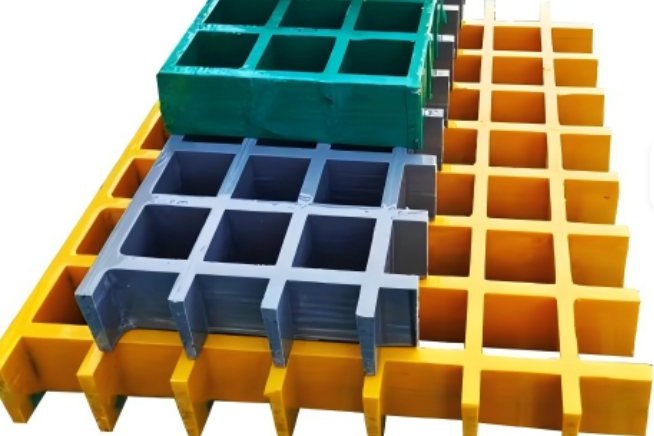
Walkways around a public pool, splash decks at a water park and the channels that collect overflow water are among the most punishing pedestrian surfaces in the building industry. The traffic is barefoot, the surface is wet from opening to closing, the water carries active disinfectant chemistry, and the structure sits outdoors under UV load for most of the year. Hot-dip galvanised steel rusts within a few seasons, uncoated carbon steel is a maintenance liability, and timber rots or splinters. This is why moulded FRP grating and pultruded FRP profiles have become the default answer for pool surrounds, overflow channels, slide-tower platforms and water-park walkways. This guide works through the four engineering questions a specifier actually faces: what the pool water does to the resin, what slip class the surface must achieve, which loads the grating must carry, and how UV and heat change the specification.
1. Where FRP Grating Sits in a Modern Pool Facility
A public pool or water park concentrates several distinct applications, and each one has its own governing requirements:
- Deck-level overflow channel grating. The continuous slot along the pool rim collects surface water. The grating here is walked on constantly, is essentially always wet, and must not trap fingers or toes — European practice under EN 13451-1 limits accessible openings to 8 mm or less.
- Pool surround walkways. The wide circulation decks where bathers move, queue and sit. Here structural grating (or grating laid over a drainage layer) carries crowd loads and must meet barefoot slip classes.
- Slide-tower stairs, platforms and queue lanes. Wet steel stairs are a known accident source; FRP grating treads and pultruded handrail profiles replace them, and the same profiles support the slide flumes themselves.
- Splash pads and interactive play zones. Shallow water, children running, and high foot-impact duty — the most slip-critical area in the park.
- Plant rooms and chemical dosing areas. Chlorine dosing stations and balance-tank rooms combine wet floors with concentrated chemical vapour, a duty closer to a water-treatment plant than to a pool deck.
The materials decision is shared by all five zones: a matrix that tolerates oxidising, mildly acidic water; a surface geometry that grips wet bare feet; and a UV-stable finish that does not chalk or bloom fibres into the water.
2. The Water Chemistry FRP Actually Sees
Pool water is not aggressive in the industrial-chemical sense, but it is chemically active every hour of the operating year. German practice under DIN 19643 gives the clearest reference envelope, and most European operators work within the same bands:
| Parameter (DIN 19643 practice) | Typical requirement | Relevance to FRP |
|---|---|---|
| Free chlorine | 0.3–0.6 mg/L (pools); 0.7–1.0 mg/L (spas/warm water) | Continuous oxidising exposure of the walking surface film |
| pH | 6.5–7.6 | Sets the HOCl/OCl⁻ split (Section 3) |
| Combined (bound) chlorine | ≤ 0.2 mg/L | Chloramines — the smell; mildly aggressive vapour near waterline |
| ORP (redox potential) | ≥ 750 mV | Confirms a continuously oxidising environment |
| Peak/shock dose | 2 g Cl₂/m³ (indoor); 10 g Cl₂/m³ (outdoor) | Intermittent excursions to oxidant levels 20–100× the routine value |
| Common salt | Present in brine/electrolysis pools (typically >1200 mg/L Cl⁻ for inline systems) | Added chloride load on steel fixings; negligible for FRP matrix |
Two numbers matter most for material selection. First, the routine free-chlorine level of 0.3–0.6 mg/L sounds tiny, but the wetted surface film on a walkway concentrates dissolved species as water evaporates between splash events. Second, shock dosing is a design case, not an anomaly: a 500 m³ indoor pool receives 1 kg of Cl₂ in a single 2 g/m³ shock treatment, and an outdoor pool of the same volume receives 5 kg per 10 g/m³ treatment — the specification must tolerate those excursions, not just the average.
3. How Hypochlorous Acid Attacks Polyester — and What Stops It
Chlorine disinfection works by converting dosed chlorine into hypochlorous acid (HOCl), and HOCl is the species that attacks organic polymers. Its behaviour is governed by acid dissociation: with pKa = 7.53 at 25 °C, the fraction of free chlorine present as HOCl depends directly on pool pH:
| pH | Fraction as HOCl | Fraction as OCl⁻ |
|---|---|---|
| 6.5 | 8.5% | 91.5% |
| 7.0 | 22.8% | 77.2% |
| 7.2 | 31.9% | 68.1% |
| 7.4 | 42.6% | 57.4% |
| 7.6 | 54.0% | 46.0% |
Running the same pool at the top of the DIN band (7.6) instead of the bottom (7.2) puts about 1.7× more of the disinfectant in the aggressive HOCl form — and the walking surface sees the difference, because grating sits in the splash film where evaporation concentrates chemistry. HOCl attacks unsaturated polyester in three stages: surface oxidation and chalking, then hydrolysis of the ester linkages (the polymer's weak point), then capillary attack along the fibre–matrix interface. Once water reaches glass bundles the classic failure sequence follows: blistering, then fibre bloom — visible fibres at the surface — and finally section loss.
The blistering stage is worth quantifying because it explains why resin choice and surface veil dominate pool-laminate life. Water migrates through the gelcoat (which acts as a semi-permeable membrane) into voids and resin-starved pockets, where dissolved glycols, acids and salts build up. Osmotic pressure then does the mechanical work:
| Solute concentration in trapped void | Osmotic pressure (van 't Hoff, 30 °C, i ≈ 2) |
|---|---|
| 0.1 mol/L | ≈ 5 bar |
| 0.3 mol/L | ≈ 15 bar |
| 0.5 mol/L | ≈ 25 bar |
Even a modest solute concentration generates pressures in the 5–25 bar range — roughly a 50–250 m water head pushing on a gelcoat layer a fraction of a millimetre thick. That is why blisters form at the gelcoat/laminate interface long before the bulk laminate loses strength.
The defence is layered: a resin-rich surface with a synthetic (C-glass or polyester) veil keeps glass bundles away from the wetted face, and the resin behind the veil must itself resist oxidation and hydrolysis. Exposed glass is where pool-laminate failure starts.
On resin families, the industry ranking for chlorinated water is consistent: orthophthalic polyester is unsuitable; isophthalic polyester is acceptable for cold, dilute splash but discolours and blisters over time; bisphenol-A epoxy vinyl ester is the standard base for pool walkways and dosing areas; phenolic novolac vinyl ester is reserved for hot or concentrated oxidising duty. Accelerated immersion data support the gap between the two workhorse resins: in a 70 °C seawater-ageing study, chloride penetrated a 2 mm orthophthalic polyester laminate in 90 days (corresponding to roughly 30 years in natural seawater) versus 210 days for a 2 mm vinyl ester laminate (roughly 70 years) — about a 2.3× service-life advantage at equal thickness. Our overview of vinyl ester versus isophthalic and orthophthalic polyester covers the wider chemistry selection logic.
4. Barefoot Slip: the DIN 51097 Classes
Shod-slip ratings (the R9–R13 classes under DIN 51130, tested with oil) do not transfer to pool decks, which are used barefoot. The relevant ramp test is DIN 51097: a test person walks on the sample inclined in steps, wetted with water plus a neutral wetting agent, and the class is set by the angle at which safe walking fails:
| Class (DIN 51097) | Minimum angle | Typical pool application |
|---|---|---|
| A | ≥ 12° | Dry-adjacent areas: changing rooms, locker zones |
| B | ≥ 18° | Pool surround walkways, shower areas, splash-adjacent decks |
| C | ≥ 24° | Pool interiors, inclined entries, submerged steps, high-traffic wet zones |
Public facilities should treat Class B as the minimum for surround walkways and specify Class C wherever water is continuous — pool rims, inclined entries, toddler splash zones. FRP grating achieves its class through geometry rather than coating: the meniscus-breaking top-face pattern, open mesh edges and (for demanding areas) an embedded grit surface. Because the grip is moulded into the panel rather than painted on, it does not wear off the way applied anti-slip coatings do; wear is covered further in Section 9. Note that DIN 51097 has been partly superseded by EN 16165:2021 (the harmonised European slip-resistance test catalogue), and EN 13451-1's 2024 amendment now references EN 16165 for pool equipment — but the A/B/C angular classification remains the specification language the pool industry actually uses. For shod industrial areas the complementary system is described in our stair tread slip-resistance guide.
5. EN 13451-1: the Public-Pool Equipment Standard
For equipment installed in public pools — classified under EN 15288-1/-2 — the general safety standard is EN 13451-1. Three of its requirements shape grating selection directly:
- Finger and toe entrapment. Openings accessible to users must fall in the permitted bands (≤ 8 mm, 25–110 mm, or ≥ 230 mm); test bodies verify that fingers cannot wedge in. Overflow channel gratings therefore use fine-slot or micro-mesh geometry, not the 38 mm structural mesh used elsewhere.
- Barefoot slip angles by location. The standard requires: horizontal walking surfaces 800–1350 mm below water level — 12° to 18°; horizontal surfaces 0–800 mm below water — 18° to 24°; inclined surfaces and steps — 24° or higher. The deeper the surface sits in the water, the higher the required grip.
- Test method update. The 2020 edition plus Amendment A1:2024 removed the old barefoot ramp test from the standard body and references EN 16165:2021 test methods instead — buyers should ask suppliers for current certificate references, not legacy test names.
A structural grating panel with a 38 × 38 mm mesh is an excellent walkway deck but is not finger-safe as a channel cover over water; specifying the wrong geometry is the single most common compliance mistake we see in pool tender documents.
6. Loads: the EN 13451-1 User Model
EN 13451-1 gives an explicit load model for user crowds, built on a reference user of about 69.5 kg with a dynamic factor that decays as the crowd grows (individual impacts average out):
| Users n | Total mass (kg) | Dynamic coefficient | Vertical load (N) | Per user (N) | Horizontal = 10% (N) |
|---|---|---|---|---|---|
| 1 | 69.5 | 2.00 | 1,391 | 1,391 | 139 |
| 5 | 304 | 1.16 | 3,648 | 729 | 364 |
| 15 | 868 | 1.07 | 9,259 | 617 | 925 |
| 30 | 1,700 | 1.03 | 17,567 | 585 | 1,756 |
Two practical readings of the table. A single jumper generates 1,391 N — the point-load case that governs panel thickness and mesh bridging, since one heel lands on one bar intersection. And a 15-user group on a 5 m² deck section works out to about 1.85 kPa distributed — comfortably within the range of a standard 38 mm moulded grating on its usual support spacing, but a reminder that long spans between supports need checking rather than assuming. The 10% horizontal component matters for fixings and for gratings laid on curves, where lateral crowd load works against retaining clips rather than gravity. Partial factors follow the EN 1990 limit-state format (permanent actions 1.35 unfavourable), so the table values are characteristic loads, not design capacities — the substructure, not the grating, usually governs.
7. UV, Heat and Barefoot Comfort on Outdoor Decks
Outdoor pool decks combine two surface problems: UV degradation of the polymer surface, and solar heating of the surface bathers actually touch. On the first, unprotected polyester surfaces chalk and lose gloss within a few seasons; the fix is a UV-stabilised gelcoat or topcoat layer, validated by the accelerated weathering methods described in our UV weathering and colour stability guide. Chalking is not only cosmetic: gelcoat erosion eventually exposes glass fibres — fibre bloom — which is both a laceration hazard and a sign the corrosion barrier has been consumed.
On the second, surface temperature under sun is a straight energy-balance result (ΔT = α·S/h, with solar irradiance S ≈ 1000 W/m² and a combined convective/radiative coefficient h ≈ 10 W/m²K):
| Surface colour | Solar absorptance α | Surface rise above air |
|---|---|---|
| White gelcoat | 0.30 | ≈ +30 K |
| Light grey | 0.50 | ≈ +50 K |
| Mid grey | 0.70 | ≈ +70 K |
| Black | 0.90 | ≈ +90 K |
Bare-skin contact pain begins around 43–45 °C. On a 35 °C afternoon, a dark grey deck reaches roughly 95 °C — hot enough to injure, and dark pools decks are regularly closed for exactly this reason. Light pigmentation is therefore a functional requirement for outdoor decks, not a styling choice; the open mesh also helps by letting feet avoid continuous contact and by convective cooling from below.
8. Water-Park Attractions: EN 1069 and the Slide Environment
Water slides over 2 m high fall under EN 1069-1:2017, and the environment they create around themselves drives walkway specification. The standard's load assumptions give a feel for the duty: user line loads of 1.5 kN/m (Type 3 slides) with water loads of 0.2 kN/m, acceleration limits of 4 g (below 0.1 s) and 2.6 g (0.1 s or longer), and access platforms at least 500 mm deep with steps of 140–240 mm rise and ≥ 240 mm going. The splash-down and run-out zones next to slides see standing water plus continuous foot churn, which is precisely the Class C barefoot condition. Slide flumes themselves are FRP — isophthalic-NPG gelcoats formulated for UV and chlorinated water are standard practice among European slide manufacturers — and the surrounding platforms, stair treads and queue barriers in FRP avoid the galvanic and chloride problems that steel structures develop in the same splash field. Support hardware should be A4 (316) stainless or isolated FRP-to-steel connections.
9. Fixing, Cutting and Installation Practice
Pool installations fail in the details more often than in the panel. Four practices matter:
- Retaining clips on every edge. Pool decks get jumped on; a grating panel that can lift is a hazard regardless of its rated load. Use the manufacturer's clip pattern (typically M-clips on panel centres and C-clips at panel edges and corners), in 316 stainless.
- Expansion allowance. FRP's thermal expansion (longitudinal roughly 2–3 × 10⁻⁶/K for pultruded profiles, higher transverse) plus a 40–50 K outdoor swing gives a few millimetres of movement over a long channel run — the reason pool-channel systems build 5 mm lateral clearance into the channel detail. Long runs need movement joints, not a continuous grating ribbon.
- Sealing every cut edge. Field-cut panels expose fresh glass; reseal with the panel's own resin system or a compatible topcoat. The full workshop and field practice is covered in our grating fabrication and field-cutting guide.
- Curved layouts. One quiet advantage of moulded grating and purpose-made channel tiles is that they follow pool curves — radius layouts that would require fabricated steel segments.
Choosing between moulded and pultruded product for the different zones is its own decision — the trade-offs are set out in our moulded versus pultruded grating comparison. Moulded panels dominate walkways and channel covers; pultruded sections carry the handrails, ladders and structural framing.
10. Inspection, Cleaning and Lifecycle
A pool-grade FRP deck is close to maintenance-free, but "close to" is not "zero", and a simple routine protects both safety compliance and warranty position:
- Weekly (in season): rinse walkways and channel covers; check for accumulated biofilm, which both degrades slip performance and holds chlorinated water against the surface.
- Monthly: visual survey for blisters, chalking, fibre bloom and clipped-edge damage; verify retaining clips are tight after storm or event weekends.
- Annually (pre-season): verify slip performance on the highest-traffic zones, re-torque fixings, and inspect the substructure — the steel below the FRP is the part that corrodes first if drainage details fail.
- Every 3–5 years: formal surface assessment; local recoating with a compatible UV-stable topcoat where gloss loss or light chalking appears, before fibre exposure occurs.
Over a 20-year horizon the comparison with the alternatives is not close: galvanised steel surrounds in a chlorinated splash field typically need recoating or replacement well inside a decade, while a correctly specified FRP deck (vinyl ester resin, veiled surface, light pigmentation, Class B/C geometry) remains in service with cleaning and an occasional recoat. The full cost picture, including the corrosion multiplier, is in our FRP versus steel grating ownership comparison.
Specify FRP Grating for Your Pool or Water Park
If your facility design is at the point where resin family, mesh geometry and slip class need to be locked into the specification, send us the drawings and water-treatment parameters — we will return a zone-by-zone grating map with resin and slip recommendations for each application area.
Need help selecting FRP products?
Our engineers answer technical questions free of charge.
Ask an Engineer on WhatsApp