
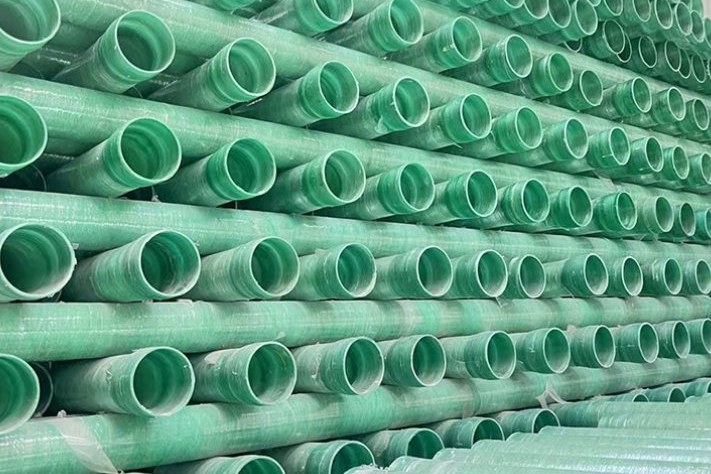
District energy networks are unforgiving on buried pipework: the carrier carries warm or chilled water for 30–50 years, the soil around it moves, and stray currents from traction systems and cathodically protected gas mains hunt for metal to attack. Glass-fibre reinforced plastic (GRP/FRP) pipe has earned a firm place in this market — not by replacing steel in the hot transmission core, but by solving three problems steel handles badly: external corrosion, stray-current pickup, and weight during trenchless installation. This guide sets out where GRP fits in district heating and district cooling (DH/DC) networks, what temperature and pressure limits actually apply, how to insulate it, and how to design for the thermal movement that GRP's higher expansion coefficient produces.
1. Where GRP Pipe Fits in a District Energy Network
A typical DH or DC network has three tiers: a transmission main from the plant, distribution mains in streets, and service connections into buildings. GRP competes in all three, but for different reasons in each tier:
- Cooling networks (the strongest fit). Chilled water at 4–7 °C supply and 12–14 °C return is comfortably inside GRP's normal operating window. Corrosion is the dominant failure mode for buried steel in wet soils, and GRP simply does not corrode — which is why Gulf district cooling utilities have adopted GRP distribution mains at scale.
- Protective casings for pre-insulated heating lines. In this role GRP does not carry the hot water at all: it is a structural jacking or sleeve pipe around a steel carrier with polyurethane foam, replacing a steel casing that would corrode or pick up stray current. Warsaw's heating company SPEC has built roughly 90 such projects since 1998 — about 11 km of line, mostly DN 300–1800 in stiffness class SN 10000, including a DN 324 jacking casing around a DN 150 pre-insulated heating line where the measured jacking force never exceeded 20 t against an allowable 30 t.
- Low-temperature heating distribution. Fourth-generation district heating (4GDH) targets supply temperatures of 50–70 °C. Centrifugally cast GRP pipe is rated for continuous operation from −50 °C to +70 °C as standard, and manufacturers confirm medium temperatures up to about 80 °C — adequate for return lines and low-temperature distribution, marginal for 3rd-generation supply mains at 90–110 °C.
The honest boundary: for high-temperature transmission, pre-insulated steel to EN 253 remains the default, and GRP's role there is the casing. For everything cooler, wetter, or electrically hostile, GRP carrier pipe wins on life-cycle cost.
2. Temperature Ratings: What GRP Can and Cannot Carry
Resin chemistry sets the ceiling. An isophthalic polyester laminate loses stiffness quickly as it approaches its heat distortion temperature; vinyl ester extends the range, and high-temperature formulations (e.g. bisphenol-A epoxy vinyl ester) reach further still. In practice, suppliers quote a continuous medium temperature rather than a resin HDT, because the pipe wall also carries pressure.
| Service temperature band | Typical resin system | Where it applies in DH/DC |
|---|---|---|
| −50 to +25 °C | Isophthalic polyester | Chilled water supply/return, buried in temperate climates |
| +25 to +70 °C | Isophthalic polyester (standard rating) | District cooling, 4GDH return and low-temp distribution |
| up to +80 °C | Isophthalic/terephthalic polyester, vinyl ester option | Low-pressure heating distribution — confirm derating with the supplier |
| +80 to +110 °C continuous | Vinyl ester only, with documented derating | Return mains of 3rd-generation DH; special projects only |
| +110 to +140 °C | Not applicable to standard GRP carriers | Steel carrier inside EN 253 pre-insulated system; GRP as casing |
Two cautions. First, pressure capacity falls with temperature: any reputable manufacturer will apply a derating factor to the pressure class above ambient, so a PN 16 pipe may only be PN 10 or lower at 70 °C — get the derated curve, not the room-temperature table. Second, thermal ageing of polyester resins is cumulative; EN 253's Annex B philosophy (thermal life estimation against continuous operating temperature) is a sensible template even when the carrier is GRP.
3. Pressure Classes and Water Hammer in Cooling Networks
District cooling pumps heads are modest by oilfield standards — typically PN 10 to PN 16 covers the distribution tier, with plant-adjacent transmission sometimes needing PN 25. GRP manufactures comfortably in this band (centrifugally cast systems span PN 1–25). The design item most often missed is transient pressure.
GRP's lower elastic modulus means the pressure-wave celerity in a water-filled GRP line is roughly 300–600 m/s versus ~1,200 m/s in steel — a genuine advantage, since Joukowsky surge Δp = ρ·c·ΔV scales with c. But the lower burst margin means the accepted check still applies: a 1.0 m/s sudden velocity change against a 400 m/s celerity produces about 0.4 MPa (4 bar) of surge. On a PN 10 line that consumes 40% of the rating in one event, so pump start/stop ramps and slow-closing valves matter more than on steel. If you are new to transient design, the same logic appears in our guide to FRP pipe installation and pressure testing.
Rule of thumb: size the pressure class for (steady head + surge) against the derated temperature rating, and require valve closure times and pump ramp rates in the network control philosophy — not just on the pump datasheet.
4. GRP as Protective Casing for Pre-Insulated Steel: The Stray-Current Argument
Pre-insulated bonded systems to EN 253 comprise a steel service pipe, rigid polyurethane foam (λ ≤ 0.033 W/m·K at 50 °C mean), and a polyethylene casing, for continuous operation up to 120 °C with peaks to 140 °C. EN 253 is explicitly a steel carrier standard — a GRP carrier cannot be certified "to EN 253" — but nothing stops the casing from being GRP, and that is exactly where GRP earns its keep:
- Stray-current immunity. GRP is dielectric. Steel casings in urban soil pick up traction and CP stray currents and corrode where current leaves the metal — a dominant casing failure mode that GRP eliminates by material choice, not by coatings.
- Trenchless capability. Centrifugally cast GRP jacking pipes carry high longitudinal compressive loads; the Warsaw programme's DN 324 casings for a DN 150 heating line recorded ≤ 20 t actual against 30 t allowable jacking force.
- Thin cover tolerance. High stiffness classes (SN 10000 and above) let casings survive shallow urban alignments with dense conflicting utilities.
Specifying tip: require the casing stiffness (SN class), the allowable jacking force per diameter, and a dielectric verification — those three parameters, not "GRP pipe", are what the contractor builds around. For buried load design of the casing itself, our guide on GRP pipe bedding, backfill and ring deflection covers the embedment side.
5. Thermal Movement: The Design Item That Changes Most vs Steel
GRP's longitudinal coefficient of thermal expansion is approximately 30 × 10⁻⁶ per K — about 2.5 times steel's 12 × 10⁻⁶. Over a season this produces real movement:
| ΔT (K) | GRP, 6 m length (mm) | GRP, 12 m length (mm) | GRP, 100 m run (mm) | Steel, 12 m (mm) |
|---|---|---|---|---|
| 20 | 3.6 | 7.2 | 60.0 | 2.9 |
| 30 | 5.4 | 10.8 | 90.0 | 4.3 |
| 40 | 7.2 | 14.4 | 120.0 | 5.8 |
| 50 | 9.0 | 18.0 | 150.0 | 7.2 |
| 60 | 10.8 | 21.6 | 180.0 | 8.6 |
Three design responses, in order of preference:
- Let the joints absorb it. Push-fit elastomeric couplings accommodate the per-length movement (e.g. 10.8 mm on a 6 m pipe at ΔT = 60 K) automatically — this is the standard solution and why GRP networks rarely need separate bellows.
- Plan anchor spacings. If the network uses restrained or bonded joints, anchor blocks at rational spacing turn continuous movement into joint rotation. Thrust block sizing follows the same soil-friction mechanics as any buried GRP line — see our thrust and anchor block design guide.
- Check restrained-run stress. A fully restrained GRP run develops axial thermal stress σ = E·α·ΔT. At E ≈ 20 GPa that is 12 MPa at ΔT = 20 K and 36 MPa at 60 K. Against a DN 500 × 10 mm wall at PN 10 (hoop stress ≈ 25 MPa), a 60 K fully-restrained condition puts axial stress at 144% of hoop stress — restrained joints must be qualified for the combination, not just the pressure.
6. Insulation Options on GRP Carriers
For cooling networks, insulation prevents condensation and heat gain; for low-temperature heating, it cuts losses. The physics is identical either way. For a foam annulus of conductivity k on a pipe of outer diameter d, the linear heat flow is Q′ = 2πk·ΔT / ln(d₂/d₁):
| Service pipe | Foam thickness | Heating case Q′ (70 °C water, 8 °C soil) | Cooling case Q′ (12 °C water, 25 °C soil) |
|---|---|---|---|
| DN 200 (od 213 mm) | 50 mm | 33 W/m | 7 W/m |
| DN 500 (od 524 mm) | 50 mm | 74 W/m | 15 W/m |
| DN 500 (od 524 mm) | 80 mm | 48 W/m | 10 W/m |
Practical notes:
- Polyurethane foam (k ≈ 0.033 W/m·K) is the default; verify the foam's continuous service temperature against the resin carrier's, and remember foam ages — the λ value at 50 °C mean is the one to specify.
- Pre-insulated bonded assemblies with GRP inner pipes are offered by some system suppliers for duties up to the foam's temperature envelope; since EN 253 certification covers steel carriers only, ask for the system's own qualification data and a 30-year thermal-life statement.
- Vapour sealing on chilled lines is mandatory. Any vapour path lets moist air condense inside the insulation and destroys it; field joints need the same vapour integrity as the pipe body.
- Outer casing choices: GRP skin for strength and rodent resistance, HDPE or PE jacket for welded continuity — never leave raw foam exposed at field joints.
For tank-side insulation practice (different geometry, same foam), see FRP tank thermal insulation and heat tracing.
7. Buoyancy and Embedment in Wet Trenches
Empty GRP pipe floats — hard. A DN 500 with a 10 mm wall displaces about 196 kg of water per metre but the wall itself weighs only about 29 kg/m, giving a net uplift of roughly 167 kg/m. A steel equivalent (6 mm wall, ~73 kg/m) also floats (about 123 kg/m uplift), but GRP's lower weight makes flotation reach set-out elevations sooner, and the lighter pipe moves more easily before the backfill has gripped it.
- Compute uplift for the largest diameter with the thinnest wall on the project, at the highest expected groundwater level.
- Hold pipes with sandbags or screw anchors between laying and testing; do not rely on partial backfill.
- Concrete set-on weights or continuous slab anchoring for reaches below the water table, spaced per the calculated uplift.
- Never test a gravity line with open ends before buoyancy measures are in place — the test water is the flood case.
8. Jointing Systems for DH/DC Duty
Joint selection is where temperature rating, movement, and restraint intersect:
| Joint type | Axial movement | Pressure restraint | Best use in DH/DC |
|---|---|---|---|
| Push-fit coupling (elastomeric seal) | High — absorbs thermal movement per length | End-thrust must be externally anchored | Standard buried distribution, both networks |
| Restrained / bolted coupling | None at joint | Self-restraining | Direction changes, valve tie-ins, casing transitions |
| Laminated (bonded) joint | Rigid | Full | Fabricated fittings, plant areas — requires qualified laminators |
| Flanged adapter | None | Bolting-dependent | Pump stations, plant connections; insulate fasteners where stray current matters |
Because GRP does not conduct, it also does not need the bonded-jumpers and continuity testing that steel networks carry in cathodically protected areas — one more reason commissioning checklists are shorter. Above-ground runs inside plant follow the support-span rules in our FRP pipe support spacing guide, with spans shortened where the line runs hot and softens.
9. Specification Checklist for Purchasing GRP DH/DC Pipe
When you write the purchase specification, these are the line items that decide whether the network survives its first decade:
- Temperature-derated pressure class at the maximum sustained medium temperature, with the derating curve attached — not just a room-temperature PN figure.
- Stiffness class (SN 5000 / SN 10000 or higher) matched to burial depth, traffic loads and any jacking duty.
- Surge allowance stated explicitly: design pressure + transient, against the derated rating.
- Joint qualification: coupling movement capacity per length versus calculated ΔT movement, plus restraint method at fittings.
- Insulation system data: foam λ at 50 °C mean, density, compressive strength, vapour-barrier detail at field joints (cooling duty).
- Standards trail: EN 253 applies to the steel/PUR/PE bonded system; for the GRP carrier or casing, cite the structural and pressure standards the manufacturer actually certifies (e.g. EN 1796 / ISO 10639 for GRP pipe families) rather than borrowing the steel-system number.
- Longitudinal properties: CTE value used in movement design, and allowable axial stress for restrained sections.
- Buoyancy and installation plan: groundwater case, holding measures, test-while-empty prohibition.
The single most common procurement error in this market is mixing standard families: certifying the carrier against EN 253 (a steel standard), quoting PN at ambient, and sizing anchors from the steel CTE. Each error is small; together they void the design.
10. Summary: Choosing the Right Role for GRP in Your Network
GRP pipe is not a drop-in steel replacement across the whole district energy temperature range — it is a targeted tool. Use it as the carrier wherever the medium stays below about 70–80 °C, which covers every district cooling network and most 4GDH distribution: you gain corrosion immunity, stray-current immunity, lighter handling and smoother hydraulics (k ≈ 0.01–0.016 mm Colebrook-White). Use it as the casing for hotter pre-insulated heating lines, where its dielectric nature and jacking strength solve the two classic steel-casing failures. Design the three GRP-specific items properly — temperature-derated pressure class, thermal movement absorbed by couplings or handled by restrained-joint stress checks, and buoyancy in wet trenches — and the network inherits a pipe material whose expected life is measured in the same decades as the energy contract behind it.
Related Reading
Filament winding angle design for FRP pressure pipe · FRP pipe for desalination and brine service · FRP pipe installation and pressure testing
Need help selecting FRP products?
Our engineers answer technical questions free of charge.
Ask an Engineer on WhatsApp